










Linde India Limited Q2 Revenue Rises 12.3% as Margins Decline
Key highlights
- Linde India reported Q2 FY27 revenue of ₹723 crore, up 12.3% from ₹644 crore a year earlier.
- Q2 FY27 EBITDA fell 18% to ₹232 crore and EBITDA margin declined to 32% from 44%.
- Net profit was ₹119 crore, down 30.5% year-on-year but up 13.6% from the previous quarter.
- Linde India acquired two 1,800-tonnes-per-day ASUs at Tata Steel's Kalinganagar site on 30 September 2026.
powered by IRIS
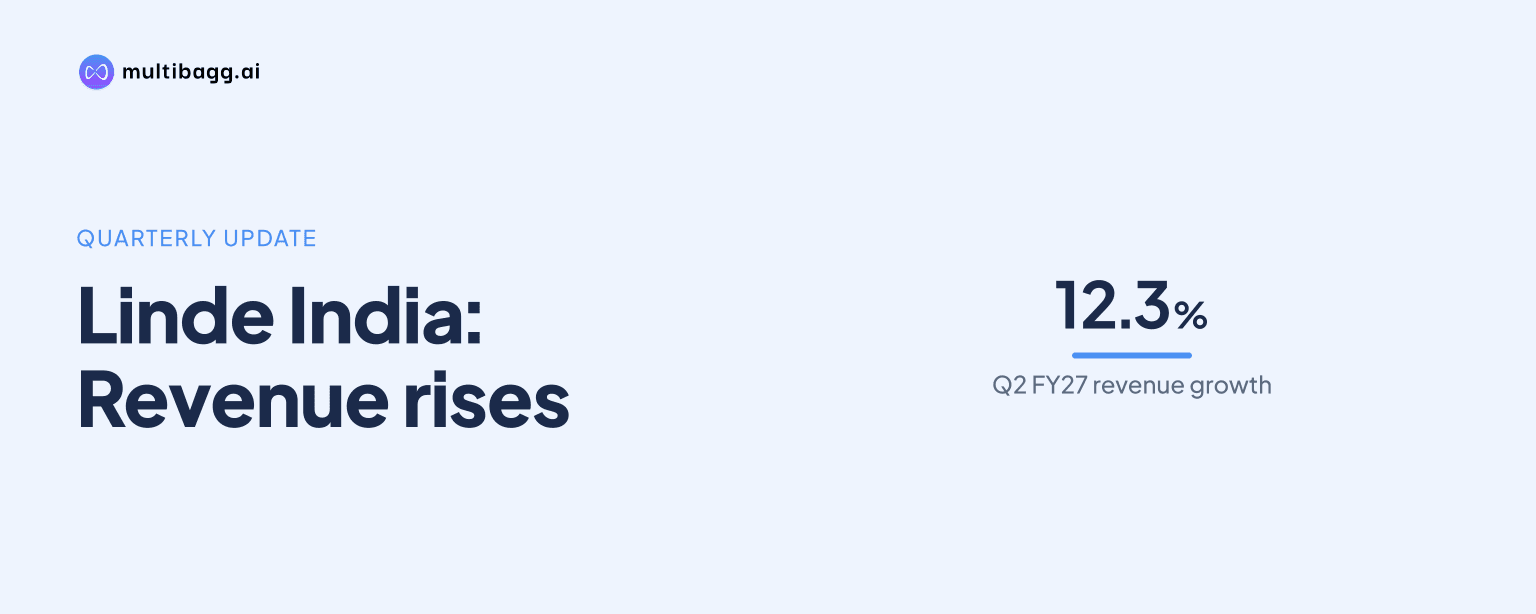
Linde India Limited reported Q2 FY27 revenue of ₹723 crore, up 12.3% year-on-year, but its EBITDA margin fell to 32% from 44% as EBITDA declined 18% to ₹232 crore. The quarter coincided with the completion of two 1,800-tonnes-per-day air separation unit acquisitions at Tata Steel's Kalinganagar complex.
Know Linde India inside out
Results, valuation, peers and who's buying, in one view.
What did Linde India report in Q2 FY27?
Linde India reported higher revenue but lower operating profit in the September-quarter results. Revenue rose to ₹723 crore from ₹644 crore in Q2 FY26, representing growth of 12.3%. EBITDA fell to ₹232 crore from ₹282 crore, while the EBITDA margin contracted by about 1,200 basis points to 32%.
Net profit stood at ₹119 crore, down 30.5% from ₹171 crore a year earlier. However, the profit was 13.6% above the preceding quarter. The figures show that sales growth did not translate into comparable operating-profit growth during the period.
The market response was positive on the day of the results. Linde India shares closed at ₹5,838 on the BSE on 3 November, up 1.3%. The reported movement came alongside developments in the company's onsite gas-supply network for Tata Steel.
Why did Linde India acquire the Kalinganagar ASUs?
Linde India completed the acquisition of two 1,800-tonnes-per-day air separation units, or ASUs, at Tata Steel's Kalinganagar Phase II expansion project on 30 September 2026. The company executed a conveyance deed with Tata Steel and started supplying industrial gases to the steelmaker from the facility on the same day.
The transaction follows agreements announced by Linde in October 2024 to de-captivate the two units and expand industrial-gas supply to Tata Steel in Odisha. Those agreements included a long-term supply arrangement for oxygen, nitrogen and argon to support Tata Steel's capacity-expansion project.
ASUs separate atmospheric air through cryogenic distillation to produce gases including oxygen, nitrogen and argon. These gases are used in steelmaking and also have applications across chemicals, pharmaceuticals and other industrial processes. Ownership of the units adds production and supply assets to Linde India's onsite operating network.
The two acquired units have combined capacity of 3,600 tonnes per day. Linde India's total oxygen capacity in the Kalinganagar region now exceeds 7,000 tonnes per day, according to the provided information. The regional network is intended to support Tata Steel's planned increase in output at the site from three million tonnes a year to eight million tonnes a year, alongside the merchant market.
How does Linde India's industrial-gases business operate?
Linde India operates through gases and related products as well as its Project Engineering Division, or PED. The gases business serves large customers through onsite pipeline supply, mid-sized customers through liquid-gas deliveries by cryogenic tanker, and smaller customers through compressed-gas cylinders.
Onsite supply is important for high-volume industrial users that require dependable and continuous gas availability. Linde India has also built a 2,550-tonnes-per-day ASU at Jamshedpur to supply Tata Steel under a long-term contract. Such arrangements link the company's infrastructure with customer production operations.
PED designs, supplies and commissions air-separation plants, nitrogen plants and hydrogen pressure swing adsorption plants. The division also manufactures cryogenic and non-cryogenic vessels, including cryogenic vessels for internal use and third-party customers.
The company produces industrial and medical gases and serves sectors including metals and mining, healthcare, food and beverages, chemicals and energy, electronics, and manufacturing. Its stated offerings include medical oxygen, specialty gases for electronics, clean hydrogen and carbon-capture systems.
Got a follow-up? Ask IRIS
What do the results mean for investors and industrial customers?
The Q2 figures show a contrast between top-line growth and operating-margin pressure. Revenue increased by ₹79 crore year-on-year, but EBITDA decreased by ₹50 crore and net profit decreased by ₹52 crore. The decline in margin from 44% to 32% is the clearest reported change in the quarterly performance.
For industrial customers, the Kalinganagar transaction formalises Linde India's supply role at Tata Steel's Phase II expansion project. The company has confirmed that supplies began after the asset transfer was completed. The long-term arrangement covers oxygen, nitrogen and argon, gases that are integral to steel operations.
For investors, the acquisition expands Linde India's onsite capacity in a major steel-producing region. But the financial data also places attention on the company's ability to convert revenue growth into operating earnings, given the reported reduction in EBITDA and net profit during Q2 FY27.
The stock closed 1.3% higher at ₹5,838 on the BSE on 3 November, the results day cited in the source material. That movement is a single-day market data point and does not establish a longer-term price trend.
What is the broader background behind Linde India's expansion?
Linde India is a member of Linde plc and was formerly known as BOC India. It has more than 35 operating facilities across India, according to the provided company information, along with cylinder bottling units and a fleet of cryogenic bulk tankers.
The company's earlier acquisitions show its effort to broaden supply reach across different delivery formats. In 2021, it agreed to acquire HPS Gases' packaged-gases business and certain distribution assets for ₹27.5 crore. The agreement also included long-term arrangements for product supply and purchases.
The Kalinganagar transaction has a longer history than the September 2026 completion date. Company communications in February 2023 and September 2024 had outlined the transaction, while Linde's October 2024 announcement described agreements to expand supply to Tata Steel.
The relevance of the expansion rests on the connection between gas infrastructure and industrial capacity. Air separation plants provide core inputs to steelmaking, while Linde India's bulk and packaged-gas channels extend distribution to customers beyond large onsite contracts.
Conclusion
Linde India's Q2 FY27 results combined 12.3% revenue growth with a marked decline in profitability, as EBITDA fell 18% and margin dropped to 32%. At the same time, the completed acquisition of two 1,800-tonnes-per-day ASUs at Kalinganagar expanded its onsite supply infrastructure and began gas deliveries to Tata Steel.
The next disclosed operational point is the role of the Kalinganagar facilities in Tata Steel's planned expansion from three million tonnes to eight million tonnes of annual output at the site. Investors will also track whether future quarterly results show an improvement in EBITDA margin and profit conversion as the enlarged onsite network operates.