










Lumax targets Rs 800-1,000 crore Mechatronics revenue by FY31
Key highlights
- Lumax expects Mechatronics revenue of Rs 800-1,000 crore by FY31.
- Lumax disclosed a Rs 500 crore Mechatronics order book, including Rs 250 crore for Body Control Modules.
- Lumax plans to expand Mechatronics from six product categories to almost 10 by 2030-31.
- Lumax targets internally technology-driven products to contribute 25% of consolidated Mechatronics within three to four years.
powered by IRIS
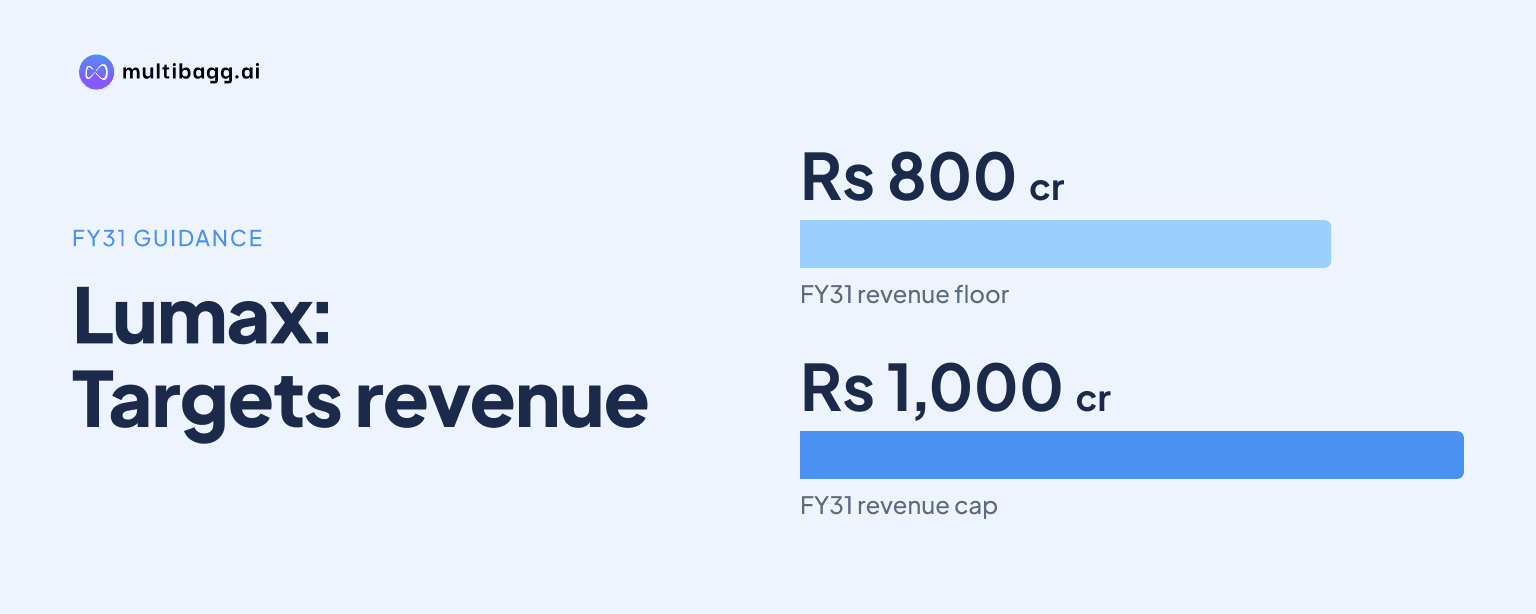
Lumax Auto Technologies said its Mechatronics vertical is expected to reach Rs 800-1,000 crore in revenue by financial year 2031 (FY31), supported by expansion from six to almost 10 product categories and a Rs 500 crore order book. Management also targets internally technology-driven products to provide 25% of consolidated Mechatronics within three to four years.
Know Lumax Auto Technologies inside out
Results, valuation, peers and who's buying, in one view.
What is Lumax's FY31 Mechatronics revenue target?
Lumax expects Mechatronics revenue to reach Rs 800-1,000 crore by FY31, against management's broader expectation of about Rs 11,000 crore in company revenue that year. Management described Mechatronics as the fastest-growing vertical from a small base, with the Rs 800-1,000 crore range forming part of its stated revenue-growth framework rather than reported current revenue.
Management continues to estimate a 20% compound annual growth rate (CAGR) through FY31, using FY25 as the base. It said it is now more confident that a 20% CAGR could be achieved through organic growth if industry momentum persists, compared with its earlier view that 15% organic growth was achievable and acquisitions could add 5-7 percentage points.
The Rs 500 crore Mechatronics order book provides management's disclosed pipeline measure for the vertical. Within it, the newer Body Control Module, or BCM, business has an order book of Rs 250 crore; management said it began start of production in July and was still in its first six months of launch and scale-up.
Which products will expand Lumax Mechatronics?
Lumax expects BCMs, connected-vehicle products and vehicle electronic control unit, or ECU, interface-management products to expand Mechatronics through FY31. Management said BCM was always included in the 20% CAGR framework, although the product category was announced more recently than the underlying development work and customer nominations.
The BCM business is reported as standalone Lumax revenue within the Mechatronics division. Management said the business initially operates on a build-to-print basis, with technology from an unnamed large Japanese automotive-component maker rather than a joint venture, while Lumax localises manufacturing and builds its own integration capabilities.
Lumax currently has six Mechatronics product categories and plans to add three or four, taking the total to almost 10 by 2030-31. The planned additions are intended to extend an existing product set that includes telematics, connectivity systems, BCMs and oxygen sensors, while management continues to explore further technology partnerships.
The vertical rests on five global partnerships, including Alps Alpine, Yokowo, Ituran, Nidec and FAE. Management said many of these individual component categories are not directly connected with each other except through the original equipment manufacturer, or OEM, vehicle interface and ECU management system, although cockpit aggregation alongside the IAC business could create a route toward a more integrated offering.
How will Lumax develop its own Mechatronics technology?
Lumax has an internal target for its own technology-driven initiative to account for 25% of consolidated Mechatronics over the next three to four years, while partner-supported design and intellectual property, or IP, would account for the remaining 75%. This is a forward target for the technology mix, not a disclosed current revenue allocation.
Management said some product lines will continue to use technology led by partners that own the relevant IP. At the same time, Lumax's Smart Hub for Innovation and Future Trends, or SHIFT, is developing electronic components that could be productionised at standalone entities or facilities, with both internally developed and partner-led products counted in Mechatronics.
The BCM programme illustrates the mixed approach. The Rs 250 crore order book is supported by an external technology tie-up, but management said SHIFT will progressively contribute to the technology element as Lumax learns, localises manufacturing and scales the product line from its July start of production.
Management also said it had narrowed its electric-vehicle component strategy to a basket of three to five products. Lumax is sourcing technology and exploring possible inorganic measures for those products, with management identifying the 2028-30 period as the intended window for active start of production.
Got a follow-up? Ask IRIS
How does Mechatronics change Lumax vehicle content and margins?
Lumax said Mechatronics currently contributes about 20% of its Rs 70,000-75,000 passenger-vehicle content basket and should be the fastest driver of further content growth. Its overall product basket also represents Rs 20,000-22,000 of content per two-wheeler, while the passenger-vehicle figure includes products across multiple divisions and partnerships.
Management said nearly 50% of passenger-vehicle content is in the IAC interior business, while Greenfuel contributes roughly Rs 5,000 to Rs 8,000 per vehicle. Mechatronics, transmission and control systems account for the remainder, and management expects BCMs and other electronic components to increase Mechatronics' contribution as more categories are launched.
Management said the Rs 70,000-75,000 passenger-vehicle content basket could rise by about 10% in the next two to three years. In a separate response, it described an ambition to increase content by 10-15% from roughly Rs 70,000 through new electronics and Mechatronics product baskets, making the ranges directionally consistent but not a formal segment forecast.
Lumax said Mechatronics margins are broadly in line with overall company profitability as the vertical approaches critical mass. Management did not disclose a separate Mechatronics earnings before interest, tax, depreciation and amortisation, or EBITDA, margin, but said the Rs 500 crore order book and scaling production were bringing the vertical closer to Lumax's wider profitability level.
What operating factors could affect the Mechatronics ramp-up?
Lumax said BCM production is still in the early scale-up stage, with competition from global suppliers and manufacturing localisation still underway. The division therefore has a Rs 250 crore disclosed order book, but management did not state the revenue conversion timing, plant capacity or a standalone Mechatronics margin target for FY31.
At the company level, management said raw-material inflation is generally recovered from OEMs, though the pass-through can lag by up to one quarter. Lumax said this lag can dilute quarterly EBITDA margin by about 30-40 basis points because revenue and costs both increase, without an addition to profitability.
Management reaffirmed its target of about Rs 1,000 crore of absolute EBITDA in FY28 and said current margins should be sustainable for the remainder of FY27. That target applies to Lumax overall, not specifically to Mechatronics, whose margin outcome will depend on the pace of BCM ramp-up, product-category additions and the balance between internal and partner technology.
Conclusion
Lumax's FY31 Mechatronics plan combines a Rs 800-1,000 crore revenue objective with a wider product range and a deliberate technology mix. The vertical is intended to move from six to almost 10 categories, use external design and IP support for 75% of its target mix, and build 25% through internal technology while raising electronic content per passenger vehicle.
The next indicators are conversion of the Rs 500 crore Mechatronics order book, including the Rs 250 crore BCM pipeline, and progress toward adding three or four categories by 2030-31. Investors can also watch management's stated goal for internally technology-driven products to reach 25% of consolidated Mechatronics within three to four years and its planned 2028-30 start of production window for a separate electric-vehicle product basket.