










Lux Industries Limited submits investor presentation to exchanges
Key highlights
- Lux Industries cited a 14-15% share of organised men’s innerwear in its investor presentation.
- Lux Industries reported H1 FY24 revenue from operations of ₹1,169.00 crore, down 3.5% year on year.
- H1 FY24 EBITDA was ₹92.56 crore and EBITDA margin was 8.01%, compared with 12.12% a year earlier.
- The Dankuni manufacturing facility covers about 12 lakh square feet and involved ₹83 crore of investment.
powered by IRIS
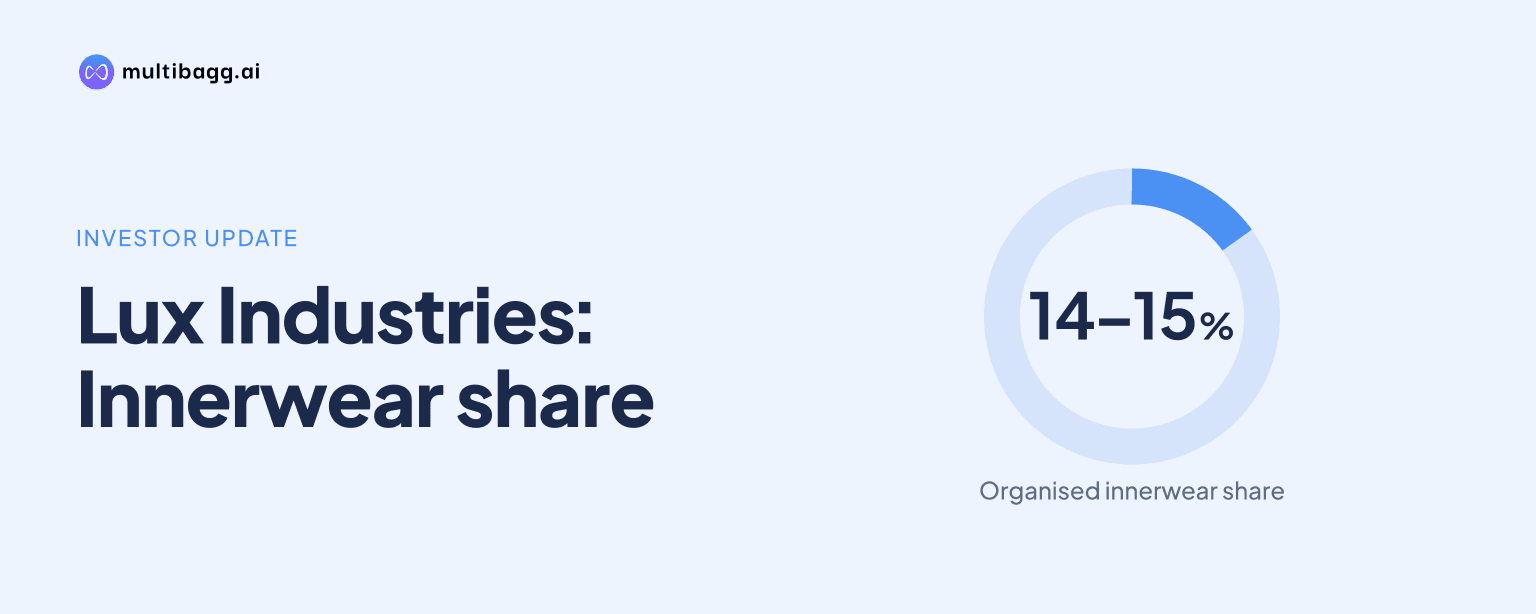
Lux Industries Limited submitted an investor presentation to the National Stock Exchange of India and BSE, outlining its innerwear portfolio, manufacturing network, market position and expansion priorities, including a stated 14-15% share of organised men’s innerwear. The filing makes the presentation available to shareholders and other market participants through the exchanges and the company website.
Know Lux Industries inside out
Results, valuation, peers and who's buying, in one view.
What did Lux Industries Limited disclose to the stock exchanges?
Lux Industries Limited disclosed that it had submitted its investor presentation to the National Stock Exchange of India and BSE under its listed-company disclosure process. The exchange filing stated that the presentation was also available on the company’s website for information and record.
The presentation describes Lux Industries as a hosiery and innerwear company with products across men’s, women’s and children’s categories. Its portfolio includes innerwear, winterwear, socks and women’s slacks, sold under multiple brands and sub-brands. The material also sets out information on the company’s corporate identity, governance practices, sustainability initiatives, manufacturing capabilities and market presence.
The filing itself does not constitute an offer, recommendation or invitation to buy or subscribe to securities, according to the safe-harbour language included in the presentation. This qualification is standard in investor materials and indicates that the document is intended to provide corporate and operating information rather than investment advice.
The presentation also refers to future opportunities around market expansion, product additions, exports and digitalisation. These points are presented as business priorities and objectives. They do not represent a confirmed forecast of financial performance in the exchange announcement.
How large is Lux Industries’ innerwear business and product range?
Lux Industries reported in its presentation that it has more than 100 products across 12 brands and a range of more than 5,000 stock-keeping units, or SKUs. The company said the count would exceed 13,000 if colours and sizes were considered separately.
The presentation describes Lux Industries as the leading innerwear company by volume, the leading innerwear brand in Bengal and the leading Indian exporter of innerwear. It also cites a 14-15% share of the organised men’s innerwear market. These are company-presented market-position statements, rather than independently verified exchange figures.
Its historical corporate material said the company manufactured 20 crore garment pieces annually and operated 13 fully automated in-house stitching units. Another presentation reference describes a combined manufacturing capacity of 30 crore garment pieces across seven plants for the merged entity in FY21. As these figures relate to different presentation periods and entity structures, they should not be treated as directly comparable capacity measures.
Lux Industries has stated that its products cover innerwear and athleisure categories. The company’s reported retailer reach and exports are relevant because innerwear is a high-volume consumer category where availability, distribution depth, price points and brand recall can influence sales across regions.
What manufacturing expansion has Lux Industries highlighted?
Lux Industries highlighted a manufacturing facility at Dankuni in West Bengal as part of its technology-led expansion. The company said the facility spans approximately 12 lakh square feet and involved an investment of ₹83 crore across 11.48 acres on the outskirts of Kolkata.
According to the presentation, the facility included 108 stitching or sewing machines from Singapore, 11 high-speed knitting machines from Germany, 60 sock-knitting machines from China and a cutting machine from Singapore. The disclosure indicates that the company has sought to add automation and specialised equipment to its production infrastructure.
Manufacturing scale is an important operating factor for innerwear companies because product categories require a broad range of sizes, colours and designs. The company’s stated SKU range suggests that inventory planning, production scheduling and distribution execution remain central to its operating model.
The company also referred to the proposed merger of J. M. Hosiery & Co. Limited and Ebell Fashions Private Limited with Lux Industries. Its board had approved the merger scheme, according to the presentation. The provided material does not give an update on subsequent implementation or the final status of the scheme.
Got a follow-up? Ask IRIS
What financial targets and recent performance figures were disclosed?
Lux Industries’ presentation stated an objective of achieving revenue of ₹1,500 crore with annual growth of 13-15%, while seeking a sustainable EBITDA margin improvement of 100 to 150 basis points. These are management objectives disclosed in the presentation and should be read as targets rather than reported results.
For the half year ended September 30, 2023, the company reported consolidated revenue from operations of ₹1,169.00 crore, EBITDA of ₹92.56 crore and profit after tax of ₹51.02 crore. Revenue was 3.5% lower than ₹1,210.01 crore in the corresponding prior-year half, while EBITDA declined 36% from ₹145.09 crore.
In the September 2023 quarter, income from operations was ₹643.57 crore, compared with ₹638.32 crore a year earlier. However, quarterly EBITDA declined to ₹59.32 crore from ₹67.29 crore, and EBITDA margin narrowed to 9.32% from 10.66%. Profit after tax was ₹35.90 crore, compared with ₹41.09 crore in the prior-year quarter.
Why does the investor presentation matter for shareholders?
The investor presentation matters because it brings together the company’s stated operating scale, market positioning, capital investment and financial ambitions in a single exchange-filed document. For shareholders, the main measurable context is the gap between the stated growth and margin objectives and the earnings trend disclosed for the first half of FY24.
The reported H1 FY24 revenue decline was modest at 3.5%, but the EBITDA and profit after tax declines were steeper. EBITDA margin fell by 411 basis points to 8.01% in H1 FY24 from 12.12% a year earlier. This makes margin recovery and cost management relevant considerations when assessing the company’s stated plans for sustainable margin expansion.
The presentation’s references to automated facilities, a wide product range and retailer reach point to the operational infrastructure behind the business. At the same time, the filing does not provide a new earnings forecast, a revised capital-expenditure plan or a timetable for the market-expansion and digitalisation priorities it identifies.
For the wider hosiery and innerwear sector, Lux Industries’ disclosure reflects the importance of manufacturing efficiency, extensive distribution and brand portfolios. Companies in the segment operate in a consumer-facing market where volume growth alone may not determine profitability, particularly when margins differ across products and channels.
Conclusion
Lux Industries’ investor presentation provides a consolidated view of its stated market presence, product range, production assets and strategic priorities. The company cited a 14-15% share of organised men’s innerwear, more than 5,000 SKUs and 13 automated stitching units, while its H1 FY24 results showed pressure on EBITDA and profit despite relatively stable revenue.
Investors can watch for subsequent quarterly disclosures for evidence on revenue growth, EBITDA margin movement and execution of the company’s expansion and digitalisation priorities. The presentation sets a revenue objective of ₹1,500 crore and a 100-150 basis-point improvement in EBITDA margin, but the material provided does not specify a deadline for these targets.