










Maamba Energy Limited's Q2 revenue rises 20.5% in Zambia
Key highlights
- MEL reported Q2 FY27 total revenue of 68.7 in reported USD amounts, up 20.5% year on year.
- MEL’s Q2 FY27 average PLF reached 91.6%, compared with 89.3% in Q1 FY27.
- MEL increased its tariff by 4.1% with effect from 1 September 2026.
- External coal sales rose 48.7% year on year to 171.6 thousand tonnes in Q2 FY27.
powered by IRIS
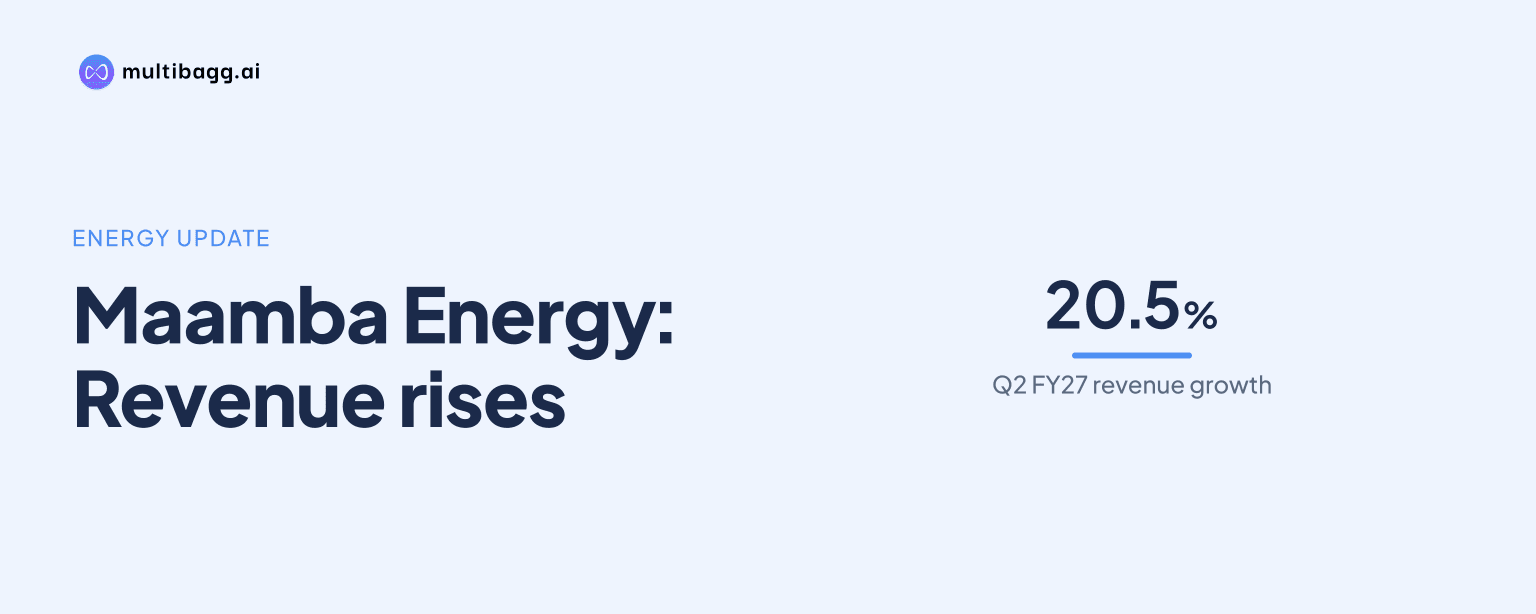
Maamba Energy Limited increased Q2 FY27 total revenue by 20.5% year on year to 68.7 in the presentation’s reported USD amounts, from 57.0 in Q2 FY26. MEL reported average plant load factor of 91.6%, a 4.1% tariff increase effective 1 September 2026 and 48.7% growth in external coal sales as the operating drivers.
Know Nava inside out
Results, valuation, peers and who's buying, in one view.
Why did MEL’s Q2 FY27 revenue increase?
MEL’s Q2 FY27 revenue increased because energy-division revenue rose with higher plant availability, while coal revenue increased as external coal sales expanded. Total revenue was 68.7 in reported USD amounts, compared with 65.3 in Q1 FY27 and 57.0 in Q2 FY26, representing increases of 4.9% sequentially and 20.5% year on year.
Management said energy-division revenue increased 4.9% quarter on quarter as plant availability improved to 91.6% from 89.3% in Q1 FY27. It also said the energy division’s revenue rose 18.3% year on year on increased availability, while coal revenue increased because external sales were 48.7% higher than in Q2 FY26.
The year-on-year improvement covered both electricity and coal activity. Power units sold increased to 548.1 million kilowatt-hours (kWh) in Q2 FY27 from 478.0 million kWh in Q2 FY26, while external coal sales rose to 171.6 thousand tonnes from 115.4 thousand tonnes. The presentation does not disclose the separate reported revenue amounts for the energy and coal businesses.
How did MEL’s availability and power sales change?
MEL’s average plant load factor (PLF), which measures operating output relative to capacity, increased to 91.6% in Q2 FY27 from 89.3% in Q1 FY27 and 80.1% in Q2 FY26. The 2.3-percentage-point sequential improvement was the availability change that management linked to the 4.9% increase in energy-division revenue.
Power units sold rose 4.1% from 526.4 million kWh in Q1 FY27 and 14.7% from 478.0 million kWh a year earlier. The combination of higher PLF and higher units sold is consistent with MEL’s reported increase in energy-division revenue, although the presentation does not provide a realised power tariff or an energy-revenue figure.
For H1 FY27, MEL’s PLF was 90.4%, compared with 88.1% in H1 FY26, and power sales were 1,074.5 million kWh against 1,038.5 million kWh. Q2 FY27 PLF was also above the FY26 average of 89.6%, while H1 FY27 power sales were slightly more than half of FY26 sales of 2,115.1 million kWh.
Got a follow-up? Ask IRIS
What did the tariff increase and coal demand contribute?
MEL said its tariff increased by 4.1% with effect from 1 September 2026, adding a pricing change during Q2 FY27. Management cited both the tariff increase and plant availability of 91.6%, versus 89.3% in Q1 FY27, in explaining the 4.9% quarter-on-quarter increase in energy-division revenue.
The presentation does not disclose the tariff level before or after the increase, the applicable customer arrangement, or the standalone revenue impact of the 4.1% revision. It therefore identifies the tariff as a contributor to the Q2 movement, but does not permit the pricing benefit to be separated from the effect of higher availability and power volumes.
External coal sales increased to 171.6 thousand tonnes in Q2 FY27 from 121.4 thousand tonnes in Q1 FY27, a 41.4% increase that MEL attributed to increased external demand. Sales were also 48.7% above the 115.4 thousand tonnes recorded in Q2 FY26, which management said increased coal revenue.
H1 FY27 external coal sales were 292.9 thousand tonnes, compared with 233.5 thousand tonnes in H1 FY26. Q2 supplied 171.6 thousand tonnes of that first-half total, compared with 121.4 thousand tonnes in Q1, indicating that the sequential increase in external demand was concentrated in the second quarter.
How did MEL’s profit and receivables change?
MEL’s profit after tax (PAT) increased to 26.7 in Q2 FY27 from 16.7 in Q1 FY27 and 12.9 in Q2 FY26, based on the presentation’s reported USD amounts. Management said the 60.3% quarter-on-quarter PAT increase resulted from a reversal of deferred tax liability provision following depreciation of the Zambian kwacha.
The profit movement was larger than the 4.9% sequential rise in total revenue, because management identified a tax-provision reversal rather than only operating growth. Year on year, MEL said PAT doubled with higher income and lower tax expense; the reported PAT figure increased by 13.8 from Q2 FY26 to Q2 FY27.
Earnings before interest, tax, depreciation and amortisation (EBITDA) was 33.1 in Q2 FY27, down from 34.0 in Q1 FY27 but above 25.6 in Q2 FY26. Receivables were 70.9 at Q2 FY27, higher than 67.9 in Q1 FY27 but lower than 97.0 a year earlier, while H1 FY27 revenue reached 134.0 against 122.8 in H1 FY26.
Conclusion
MEL’s Q2 FY27 revenue growth reflected three disclosed operating factors: higher 91.6% availability, the 4.1% tariff increase effective 1 September 2026 and stronger external coal demand. Compared with Q2 FY26, PLF increased by 11.5 percentage points, power sales rose 14.7% and external coal sales increased 48.7%, alongside the 20.5% rise in total revenue.
The next reported periods will show whether MEL can sustain availability near the H1 FY27 level of 90.4% and external coal sales above the 121.4 thousand tonnes recorded in Q1 FY27. The presentation discloses the September 2026 tariff increase but gives no further tariff plan, PLF target or coal-sales forecast, while the deferred-tax-liability reversal remains relevant to subsequent PAT comparisons.