










Mach Travel: MICE remains 60%-65% despite diversification
Key highlights
- MICE accounted for approximately 60% to 65% of Mach Travel’s H1 FY27 business.
- Mach Travel said corporate travel contributed about 10% to 15% and its corporate client base reached 140 from zero on March 31.
- Mach Travel reported H1 FY27 revenue of Rs 348 crore and profit after tax of Rs 15.42 crore.
- Q2 FY27 employee benefit expense rose to Rs 10.45 crore from Rs 3.36 crore in Q2 FY26.
powered by IRIS
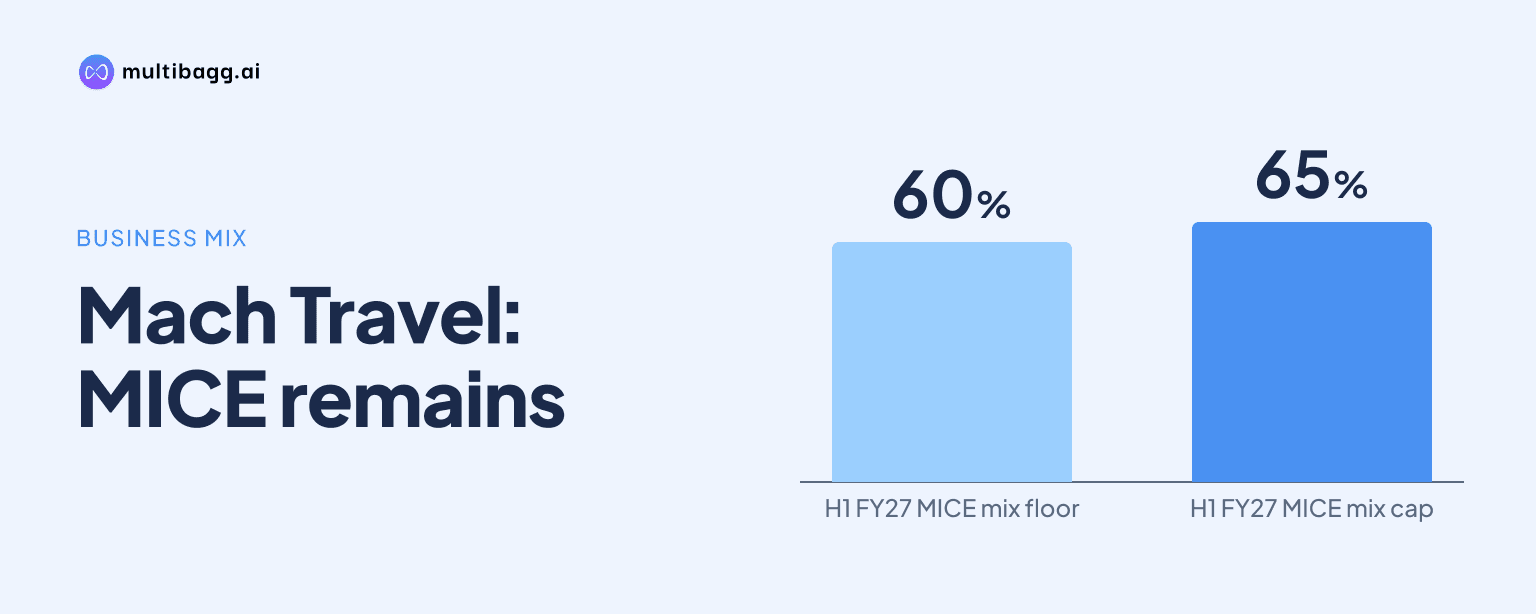
Mach Travel Solutions Limited said MICE generated approximately 60% to 65% of its H1 FY27 business, making it the largest vertical despite expansion into corporate travel, leisure, B2B and government work. The company reported Rs 348 crore of H1 FY27 revenue and said corporate travel represented about 10% to 15% of the mix.
Know Mach Travel Solutions inside out
Results, valuation, peers and who's buying, in one view.
What is Mach Travel’s current business mix?
Mach Travel’s current mix remains led by MICE, or meetings, incentives, conferences and exhibitions, at about 60% to 65% of H1 FY27 business. Management estimated corporate travel at 10% to 15%, leisure, including visa services, at 5% to 7%, and business-to-business, or B2B, at 3% to 4% of reported business.
The B2B figure is not directly comparable with the other shares because Mach Travel said its financial statements record only commissions from that activity. Management described B2B as a large-volume business even though it accounted for only 3% to 4% of reported business under that accounting treatment.
In a separate H1 FY27 explanation of the Rs 348 crore revenue base, management said government and institutional activity accounted for 15% to 20%, MICE supplied 60% to 65%, and corporate travel contributed about 10%. It did not provide exact segment revenue, nor did it reconcile each stated range to a single total, so the disclosed figures are approximate management estimates rather than a formal segment-revenue disclosure.
How is Mach Travel adding business beyond MICE?
Mach Travel is adding non-MICE business through corporate travel, government and institutional projects, leisure, B2B, business-to-consumer, or B2C, and inbound travel. Corporate travel is the clearest disclosed expansion measure: management said the company moved from zero corporate clients on March 31 to 140 corporate clients at the time of the call.
Government and institutional work is another new contributor, with management estimating its H1 FY27 share at 15% to 20%. Mach Travel said it had secured an order for up to 10,000 passengers from the Madhya Pradesh government under the Mukhyamantri Tirth Yatra programme and was in discussions with the Bihar and Uttar Pradesh governments for other opportunities.
The company said it had been empanelled in Madhya Pradesh as a tour operator, submitted applications in Bihar and Uttar Pradesh, and was already empanelled with Indian Railway Catering and Tourism Corporation, or IRCTC, and a Karnataka government undertaking. Management said government contracts can be won either through empanelment or open tenders, while qualification for larger government work takes time because past delivery records and technical-bid requirements matter.
Got a follow-up? Ask IRIS
Why does MICE remain Mach Travel’s main revenue engine?
MICE remains Mach Travel’s main revenue engine because management expects it to be the company’s largest revenue generator for years, even as the business develops six travel verticals. Management said the company was focused only on MICE for most of its 22-year history and that the MICE team had not been disrupted by the diversification programme of the past six or seven months.
The strategy is to extend services around existing and new customers rather than replace MICE. Management said the 140 corporate clients can provide access to thousands of employees who may become leisure customers, while some of those companies may also purchase MICE services, hotel bookings, ticketing or visa support.
Management cited one undisclosed MICE client relationship of eight or nine years that has expanded into corporate ticketing and adoption of Mach Travel’s self-booking tool, or SBT. This example supports the cross-selling plan, but management did not disclose the revenue from that client, the number of corporate customers using the SBT, or a measure of customer lifetime value.
What do the new verticals mean for growth and margins?
Mach Travel reported Rs 348 crore in H1 FY27 revenue and Rs 15.42 crore in profit after tax, compared with Rs 7.82 crore in H1 FY26. Profit after tax margin declined to 4.38% from 7.93%, which management attributed to investment in new verticals, expanded staffing and business and technology infrastructure.
The staffing cost increase was visible in Q2 FY27 employee benefit expense of Rs 10.45 crore, against Rs 3.36 crore in Q2 FY26. Management said headcount had increased from about 70 employees to about 350, while its infrastructure was designed for around 1,000 team members, including a 13,000-square-foot Noida office that can accommodate 250 to 275 employees.
Sequential profitability improved in Q2 FY27. Earnings before interest, tax, depreciation and amortisation, or EBITDA, including other income, rose to Rs 14.39 crore from Rs 9.23 crore in Q1 FY27, while EBITDA margin increased to 7.00% from 6.30%. Management said it had accepted lower margins while acquiring customers and expects operating leverage as its workforce, empanelments and newer verticals generate more business, but it gave no margin target or timetable.
Conclusion
Mach Travel’s H1 FY27 disclosures show that diversification is under way, while MICE remains the principal contributor at approximately 60% to 65% of business. Corporate travel’s 10% to 15% share, government and institutional work’s stated 15% to 20% contribution, and growth to 140 corporate clients show that newer channels are contributing alongside the core MICE operation.
The next evidence point is whether the 140 corporate clients, government empanelments and B2C beta product produce more disclosed revenue by vertical. Management expects about 25% annual growth, remains optimistic about its stated 2.5x FY27 growth guidance, and said its next investor call is expected in late January or the first week of February.