










Mamata Machinery Limited targets FY27 revenue despite H1 losses
Key highlights
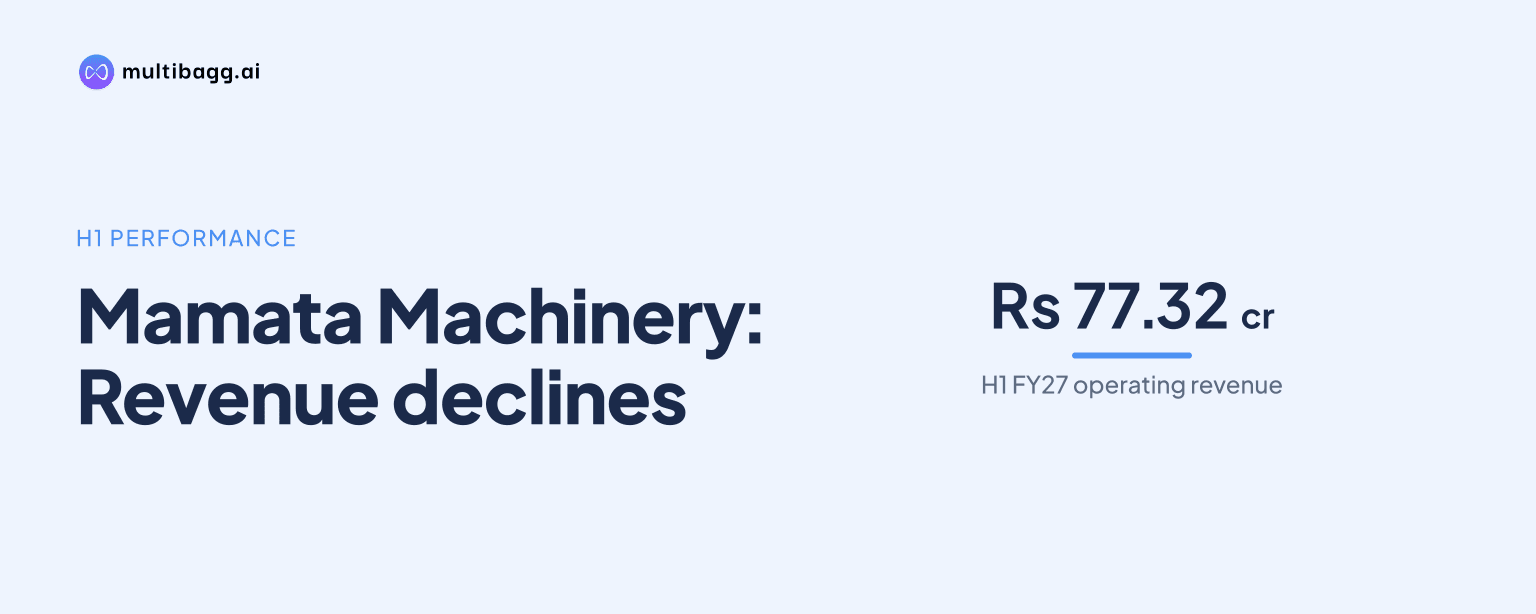
- H1FY27 revenue from operations declined 16% year on year to Rs 77.32 crore.
- H1FY27 EBITDA was a loss of Rs 5.55 crore, compared with EBITDA of Rs 9.87 crore in H1FY26.
- Flooding shut the Ahmedabad plant for four days, followed by five to six weeks of operational disruption.
- Packaging machinery-sales revenue declined 67% year on year to Rs 10.90 crore in H1FY27.
powered by IRIS
Mamata Machinery expects FY27 revenue to be on par with FY26 despite reporting an H1FY27 EBITDA loss of Rs 5.55 crore and a net loss of Rs 4.52 crore, as management plans higher execution and dispatches in the second half from its order backlog and recent order intake.
Know Mamata Machinery inside out
Results, valuation, peers and who's buying, in one view.
Why does Mamata Machinery expect FY27 revenue to match FY26?
Mamata Machinery expects FY27 revenue to match FY26 because management says its order backlog and recent order intake can support higher execution and dispatches in H2FY27. The company said the Converting business was already in line with its annual targets, while Packaging and Co-extrusion were expected to accelerate through much higher second-half execution.
The target follows a first half in which revenue from operations declined 16% year on year to Rs 77.32 crore from Rs 92.03 crore in H1FY26. In Q2FY27, revenue was Rs 41.05 crore, 23% below Rs 53.37 crore a year earlier but above Rs 36.28 crore in Q1FY27, an increase of Rs 4.77 crore from the preceding quarter.
Mamata Machinery also identifies seasonality as part of the recovery case: management said the business has historically been weighted towards the second half of the financial year. Its stated focus for the remainder of FY27 is converting its backlog into dispatches, rather than citing a new annual revenue number or a revised profitability target.
What caused Mamata Machinery's H1FY27 loss?
Mamata Machinery's H1FY27 loss reflected delayed machine deliveries amid elevated polymer prices, flooding at its Ahmedabad plant and higher operating expenses. Management said the unresolved West Asia crisis kept crude oil and polymer prices elevated through H1FY27, straining customers' working capital and causing them to push back machine deliveries.
Torrential rainfall in late July caused flooding at the Ahmedabad plant, resulting in a complete four-day shutdown. Although production resumed on July 30, management said full-fledged operations remained disrupted for another five to six weeks while the plant was cleaned and normalised and shop-floor stock was cleaned and refurbished.
The disruption coincided with gross profit declining to Rs 46.34 crore in H1FY27 from Rs 56.06 crore in H1FY26, while operating expenses rose 12% to Rs 51.89 crore from Rs 46.19 crore. Gross margin fell by 99 basis points, where one basis point equals one-hundredth of a percentage point, to 60% from 61%, leaving an EBITDA loss of Rs 5.55 crore against EBITDA of Rs 9.87 crore.
Management said other expenses were 18% higher year on year in H1FY27, including higher exhibition and trade-show costs incurred in Q1FY27, while employee benefit expenses increased 7%. Finance cost rose to Rs 57 lakh from Rs 35 lakh and depreciation increased to Rs 2.27 crore from Rs 1.83 crore during the half year.
Got a follow-up? Ask IRIS
Which Mamata Machinery segments fell most in H1FY27?
Mamata Machinery's Packaging segment recorded the largest H1FY27 decline, with machinery-sales revenue down 67% year on year to Rs 10.90 crore. Co-extrusion declined 53% to Rs 3.52 crore, while Converting fell 14% to Rs 40.86 crore, making Converting the largest of the three disclosed machinery verticals.
The quarterly mix shows why management is seeking a second-half pickup outside Converting. Q2FY27 Converting revenue increased 15% year on year to Rs 23.44 crore, but Packaging fell 77% to Rs 5.39 crore and Co-extrusion recorded no Q2FY27 machinery revenue, compared with Rs 7.02 crore in Q2FY26.
These vertical figures cover machinery sales only and exclude Attachments and Spares and After-Sales Services. Management said domestic Packaging demand and order intake remained firm, whereas the United States Packaging business continued to face persistent headwinds, a distinction relevant to the planned H2FY27 execution increase.
What supports Mamata Machinery's H2FY27 execution plan?
Mamata Machinery's stated support for its execution plan is its backlog, recent order intake and an existing second-half seasonal pattern, rather than a disclosed increase in plant capacity. Management said it aims to raise Packaging and Co-extrusion execution in H2FY27 after the four-day closure and the subsequent five-to-six-week normalisation period at Ahmedabad.
The company also disclosed product-validation milestones for RecTech™, its recyclable film technology. RecTech™ received 100% Recyclability Certification in the European Union from Institut cyclos-HTP GmbH in August and APR Design® for Recyclability Recognition from the Association of Plastic Recyclers in the United States in October, adding to its earlier certification from the Central Institute of Petrochemicals Engineering & Technology in India.
In August, Mamata Machinery also received two Indian patents for technologies used in its HFFS and Quadra 600 machines. Management said its longer-term priorities remain entering new export markets for Packaging, expanding into new product categories and optimising operating costs, while the near-term objective remains dispatching the existing order backlog.
The presentation identifies more than 5,400 global installations, machinery delivered to more than 80 countries and an export share of 63% of top line. These indicators describe Mamata Machinery's international footprint, but the H1FY27 outlook still depends on customer delivery timing and the expected execution increase in Packaging and Co-extrusion.
Conclusion
Mamata Machinery's FY27 revenue objective rests on a second-half catch-up plan after H1FY27 revenue declined by Rs 14.71 crore year on year and profitability changed from an H1FY26 profit after tax of Rs 7.18 crore to a Rs 4.52 crore loss. Converting delivered 15% year-on-year Q2FY27 revenue growth, while Packaging and Co-extrusion accounted for the larger machinery-sales shortfalls.
The next point to watch is whether H2FY27 dispatches convert backlog into enough revenue to bring FY27 revenue level with FY26, as management expects. Management also identified domestic Packaging order intake, persistent United States Packaging headwinds and operating-cost optimisation as relevant factors after H1FY27 other expenses increased 18% year on year.