










Marico targets ₹20,000 crore-plus revenue under FY30 plan
Key highlights
- Marico targets consolidated revenue of more than ₹20,000 crore by FY30.
- Premium and digital portfolios are projected to rise from 37% of revenue in FY26 to 50% in FY30E.
- H1FY27 revenue rose 18% to ₹7,854 crore and EBITDA rose 26% to ₹1,528 crore.
- Foods and premium personal care are projected to contribute about 33% of revenue in FY30E, versus about 23% in FY26.
powered by IRIS
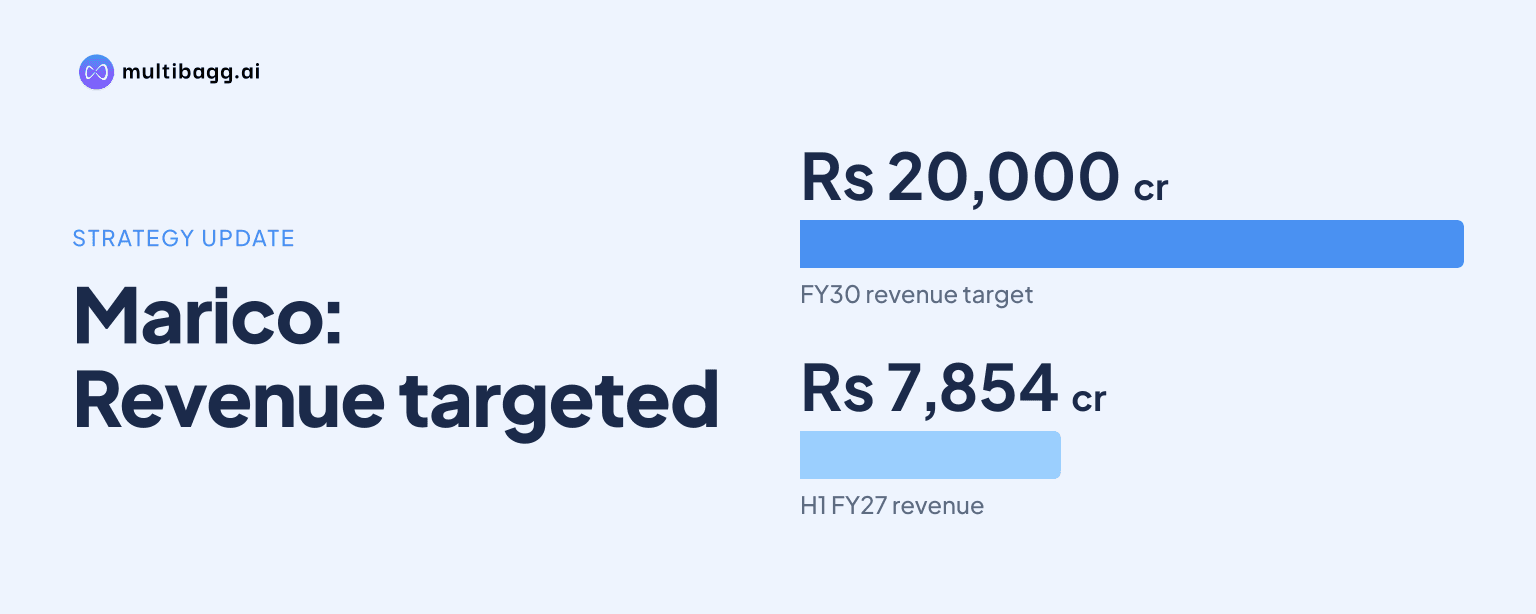
Marico Limited is targeting consolidated revenue of more than ₹20,000 crore by financial year 2030 (FY30), with premium and digital portfolios planned to account for 50% of sales, compared with 37% in FY26. Management’s plan calls for double-digit revenue compound annual growth from FY26 to FY30E.
Know Marico inside out
Results, valuation, peers and who's buying, in one view.
What is Marico’s FY30 revenue and earnings target?
Marico’s FY30 objective is consolidated revenue above ₹20,000 crore, supported by double-digit compound annual revenue growth from FY26 to FY30E. Management also aspires to mid-teen compound annual growth in earnings before interest, tax, depreciation and amortisation (EBITDA) over the same period, driven by operating leverage, premiumisation and profitable scale-up of new growth engines.
The FY30 ambition follows a nearer-term FY27E target of revenue above ₹15,000 crore and revenue growth in the teens. For FY27E, Marico expects double-digit volume growth in India, mid-teens growth in its international-business metric and EBITDA growth in the mid-twenties. Management links the FY26-to-FY30E plan to top-quartile volume growth in India and teens growth internationally.
Marico reported revenue from operations of ₹7,854 crore in H1FY27, up 18% from ₹6,671 crore in H1FY26. EBITDA increased 26% to ₹1,528 crore and the margin rose 130 basis points to 19.5%, while reported profit after tax increased 28% to ₹1,180 crore. These reported first-half results provide the financial backdrop for the plan but do not establish its outcome.
How will Marico’s portfolio mix change by FY30?
Marico plans for premium and digital portfolios to make up 50% of revenue in FY30E, equal to the planned 50% mass-portfolio share. Marico defines mass as commodity-linked categories. The target represents a 13-percentage-point increase in premium and digital share from 37% in FY26, alongside a 13-point reduction in mass from 63%.
The portfolio has already changed from FY20, when premium and digital contributed 27% of sales and mass contributed 73%. Marico projects premium and digital to reach 44% in FY27E, versus 56% for mass, before the intended 50:50 split in FY30E.
Marico’s EDGE framework identifies category creation, premiumisation, portfolio expansion and geographic diversification as ways to expand its addressable market. Its distribution and digitisation agenda includes artificial intelligence-enabled decision-making and integrated digital ecosystems, while its profitable-growth agenda specifies sharper portfolio choices, disciplined capital allocation and focused investment behind growth engines.
What role will Foods and premium personal care play in India?
Marico expects Foods and premium personal care, including digital-first brands, to contribute about 33% of revenue in FY30E, up from about 23% in FY26 and about 11% in FY20. Their profit share, measured as net contribution, is projected at about 10 times the FY20 level in FY30E, after reaching about five times in FY26.
Marico defines net contribution as net revenue less all variable costs and marketing expenses, equivalent to contribution margin 3. Foods revenue is projected at about 15 times its FY20 base by FY30E, following about four times in FY24 and about nine times in FY27E. The presentation does not disclose the underlying FY20 rupee revenue base or an absolute FY30 Foods target.
Digital-first premium personal care exit annual recurring revenue is projected at about 2.5 times its FY24 base in FY27E and about five times by FY30E. Marico targets a double-digit EBITDA margin at the FY27E exit and a margin in the teens by FY30E, framing this as part of profitable scale-up in India.
Got a follow-up? Ask IRIS
How is Marico reshaping its international business?
Marico plans to increase the share of non-Bangladesh markets in international revenue to about 65% by FY30E, from about 55% in FY26 and about 50% in FY20. It also targets premium categories to contribute about 40% of international revenue in FY30E, compared with about 30% in FY26 and about 20% in FY20.
Marico defines overseas premium categories as beauty and personal care, including hair cleansing, hair styling and care excluding hair oils, skin care and baby care. For the international business excluding Bangladesh, the EBITDA margin is projected to reach the twenties by FY30E, compared with high teens in FY26 and high-single digits in FY20.
Regional growth varied in Q2: Vietnam recorded 22% on Marico’s reported CCG measure, while the Middle East and North Africa and South Africa each recorded 15%, and Bangladesh recorded 5%. Marico reported international-business CCG of 13% in Q2 and 14% in H1, attributing Vietnam’s performance to portfolio growth and e-commerce acceleration and South Africa’s acceleration to hair care.
What milestones will Marico pursue before FY30?
Marico’s stated FY27E milestones are revenue above ₹15,000 crore, double-digit India volume growth, mid-teens international-business CCG and mid-twenties EBITDA growth. Management cites pricing power in core brands, softening copra prices, supply-chain capabilities, Foods and premium personal-care scale-up, overseas premium categories and the MarVal cost-management programme as supports for this outlook.
The SETU 2.0 go-to-market plan includes artificial intelligence-enabled assortment selling, sales-call gamification, premium Foods and personal-care distribution, and digital-first brands in general trade. Marico is targeting direct-reach expansion of more than 1.5 times from FY24 to the FY27 exit and about twice deeper rural penetration through added stockists over the same period.
In Q2FY27, material cost was 51.9% of revenue, down from 57.9% in Q2FY26, while advertising and sales promotion was 11.6%, up from 9.1%. EBITDA margin was 18.2% in Q2FY27 versus 16.2% a year earlier, showing the margin effect of lower material-cost share alongside higher advertising and sales-promotion spending.
Conclusion
Marico’s FY30 strategy combines a more than ₹20,000 crore revenue target with a planned shift away from commodity-linked portfolios. Premium and digital products are intended to account for 50% of sales, while Foods, premium personal care and overseas premium categories are identified as the engines for a larger share of revenue and net contribution.
The next disclosed milestones are FY27E revenue above ₹15,000 crore, premium and digital portfolio share of 44%, and Foods and premium personal care contributing about 27% of revenue. Progress in international premium-category share, targeted at about 40% by FY30E, and the projected margin expansion outside Bangladesh are additional measures to watch.