










Marico raises Q2 EBITDA margin 200 basis points as sales grow
Key highlights
- Marico's Q2FY27 EBITDA margin increased 200 basis points to 18.2% from 16.2% in Q2FY26.
- Marico's material cost represented 51.9% of Q2FY27 revenue, versus 57.9% a year earlier.
- Marico's Q2FY27 advertising and sales promotion expenditure increased 44% to Rs 451 crore.
- Marico's H1FY27 EBITDA rose 26% to Rs 1,528 crore and PAT increased 28% to Rs 1,180 crore.
powered by IRIS
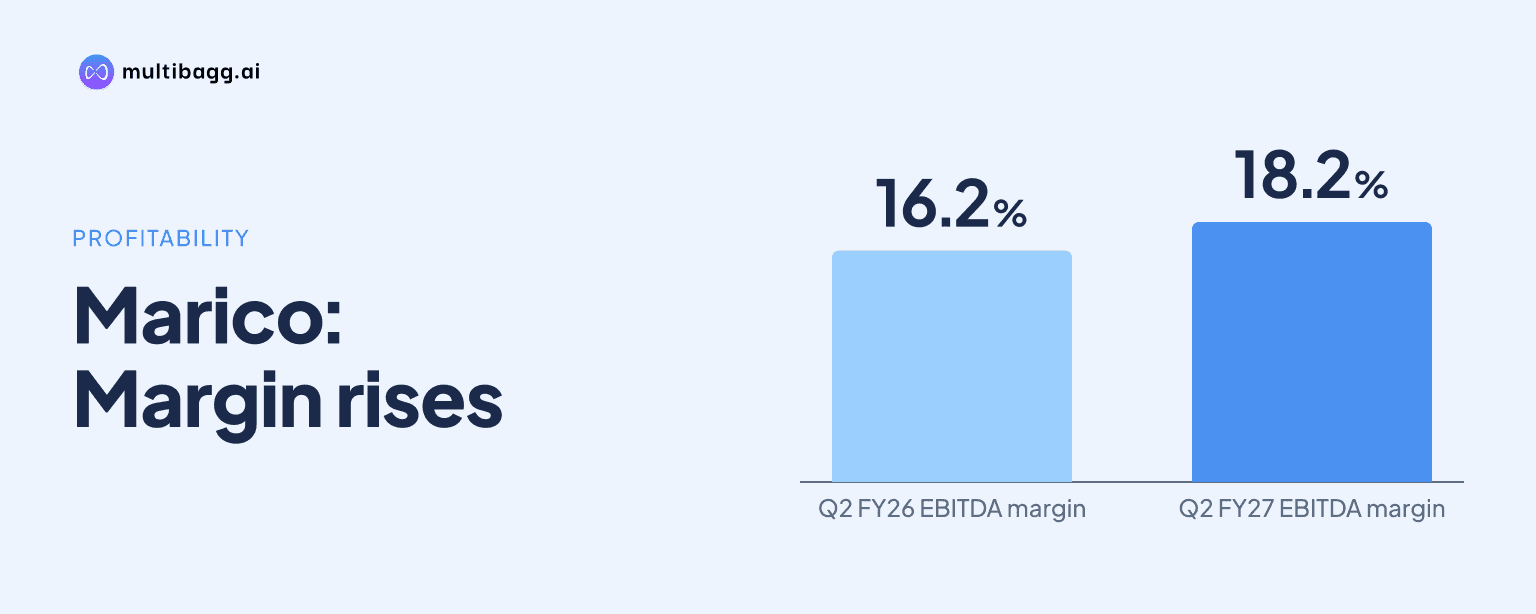
Marico Limited raised consolidated Q2FY27 earnings before interest, tax, depreciation and amortisation (EBITDA) margin by 200 basis points to 18.2%, as revenue from operations rose 13% to Rs 3,897 crore and material cost represented 51.9% of revenue, despite a 44% increase in advertising and sales promotion expenditure to Rs 451 crore.
Know Marico inside out
Results, valuation, peers and who's buying, in one view.
How did Marico expand EBITDA margin in Q2FY27?
Marico expanded EBITDA margin as EBITDA rose 27% to Rs 709 crore in Q2FY27, ahead of 13% revenue growth to Rs 3,897 crore. The margin increased from 16.2% in Q2FY26 to 18.2%, while material cost increased 1% to Rs 2,022 crore, compared with a Rs 447 crore increase in revenue from operations.
Advertising and sales promotion (ASP) rose Rs 138 crore year on year to Rs 451 crore, employee cost increased Rs 41 crore to Rs 259 crore, and other expenses rose Rs 94 crore to Rs 456 crore. These three expenses together increased Rs 273 crore, while the lower growth rate in material cost relative to revenue supported the increase in EBITDA.
What changed in Marico's material-cost structure?
Marico's material-cost ratio fell by 6 percentage points year on year, to 51.9% of Q2FY27 revenue from 57.9% in Q2FY26. The presentation's operating-margin annexure includes raw materials and packaging within this line, while the consolidated profit and loss statement shows material cost rising only Rs 25 crore to Rs 2,022 crore.
The market-price backdrop was mixed through Q2FY27. Copra prices were down 31% year to date year on year, while rice bran oil was up 22%, liquid paraffin was up 91%, and high-density polyethylene was up 54%. Marico states that these charts reflect average quarterly market prices and not its actual purchase prices, so they do not establish the company's realised procurement cost.
The presentation's margin bridge also shows EBITDA before ASP at 29.8% of revenue in Q2FY27, compared with 25.3% in Q2FY26. ASP increased to 11.6% of revenue from 9.1%, but the 4.5-percentage-point increase in EBITDA before ASP was larger than the 2.5-percentage-point increase in ASP intensity, leaving reported EBITDA margin 2 percentage points higher.
Why did Marico's advertising spending rise 44%?
Marico's ASP spending rose 44% to Rs 451 crore in Q2FY27 from Rs 313 crore in Q2FY26, raising its share of revenue to 11.6% from 9.1%. The presentation says the Q2FY26 comparison has been adjusted for the reclassification of advertising and sales promotion expenses referred to in the Q1FY27 earnings presentation.
ASP intensity also increased sequentially, to 11.6% in Q2FY27 from 8.3% in Q1FY27. Over the same two quarters, the reported EBITDA margin declined to 18.2% from 20.7%, while material cost as a share of revenue improved to 51.9% from 53.4%. The figures show that the Q2 advertising increase was accompanied by a lower quarterly EBITDA margin than in Q1FY27.
For H1FY27, ASP rose 36% to Rs 778 crore from Rs 574 crore in H1FY26, while revenue increased 18% to Rs 7,854 crore. ASP therefore accounted for 9.9% of first-half revenue, versus 8.6% in the prior-year period, indicating that the higher brand-investment ratio extended across the six-month period.
Got a follow-up? Ask IRIS
How did Marico's first-half profit and working capital compare?
Marico's H1FY27 EBITDA rose 26% to Rs 1,528 crore from Rs 1,215 crore, and EBITDA margin increased 130 basis points to 19.5% from 18.2%. Revenue grew 18% to Rs 7,854 crore, while material cost increased 11% to Rs 4,134 crore, reducing the material-cost ratio to 52.6% from 55.9%.
Profit before tax rose 21% to Rs 1,464 crore in H1FY27 from Rs 1,206 crore. Reported profit after tax (PAT) and recurring PAT were both Rs 1,180 crore, up 28% from Rs 924 crore in H1FY26, according to the consolidated profit and loss statement.
Working-capital days increased sequentially during Q2FY27. Net working capital rose to 33 days from 26 days in Q1FY27, debtors turnover rose to 36 days from 31 days, and inventory turnover increased to 50 days from 40 days. Marico said it maintained healthy working-capital ratios through the quarter.
What should be monitored after Marico's Q2FY27 results?
Marico's future material-cost ratio will depend on the mix and movement of tracked inputs, which ranged from a 31% year-to-date decline in copra prices to a 91% increase in liquid paraffin prices through Q2FY27. The presentation does not disclose its actual purchase prices, leaving the relationship between market-price movements and future reported material cost unresolved.
ASP is another disclosed variable to monitor after Q2FY27 spending of Rs 451 crore and an 11.6% share of revenue. The contrast with Q1FY27, when ASP was 8.3% of revenue and EBITDA margin was 20.7%, provides a quarterly comparison for assessing how changes in advertising intensity coincide with reported margins.
Conclusion
Marico's Q2FY27 results combined 13% revenue growth, a material-cost ratio that was 6 percentage points lower year on year, and a 44% increase in ASP spending. That cost and revenue mix coincided with EBITDA rising 27% to Rs 709 crore and reported margin increasing to 18.2% from 16.2%.
The next reported periods will clarify whether copra's 31% year-to-date price decline and increases in rice bran oil, liquid paraffin and high-density polyethylene continue to affect the consolidated material-cost ratio. The presentation also leaves open whether ASP remains near Q2FY27's 11.6% of revenue and whether net working capital moves from 33 days after its increase from 26 days in Q1FY27.