










Marvel Decor projects reach 30% of H1 sales as mix shifts
Key highlights
- Marvel said projects represented 30% of H1 sales, while dealer-led retail represented 70%.
- Management cited individual project margins of 15%, 20% and 30% but gave no project-segment average.
- Marvel said it secured about Rs 3 crore to Rs 5 crore of United States hotel business in H1.
- Management plans branding and display activity with more than 100 channel partners in H2.
powered by IRIS
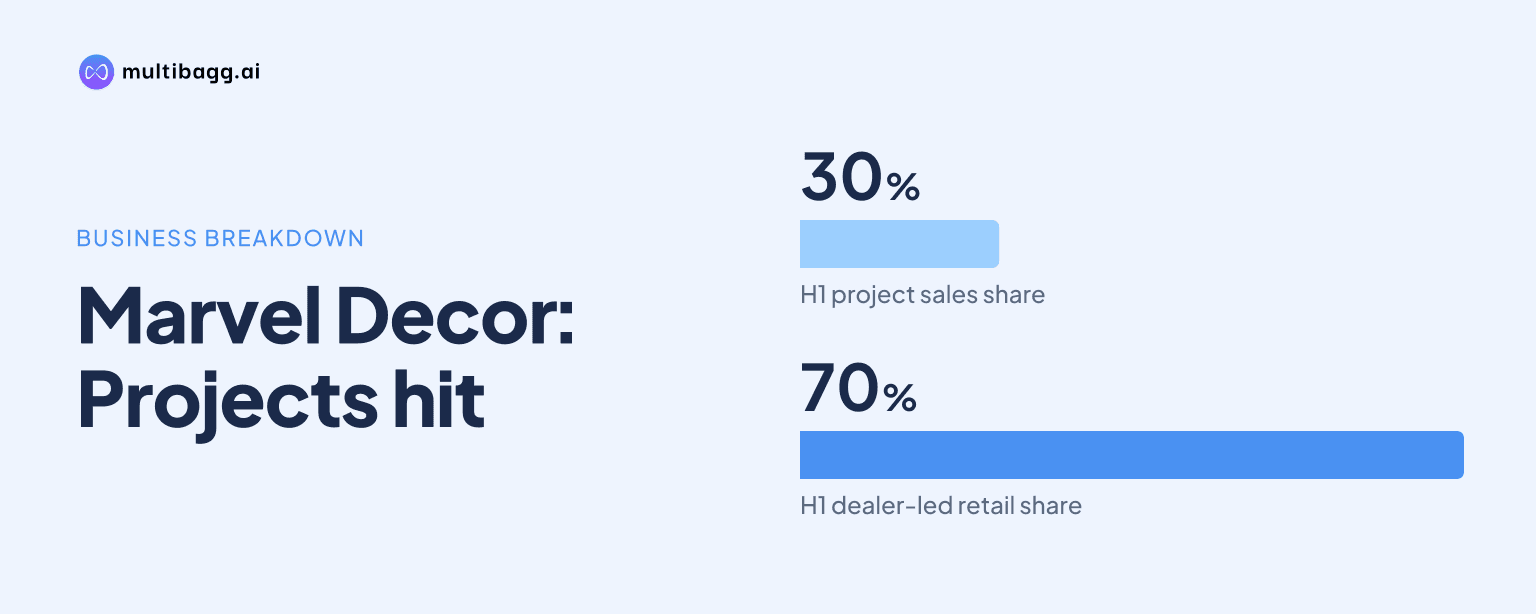
Marvel Decor said its project business generated 30% of H1 sales, against 70% from dealer-led retail, as it expands into customised hospitality and residential work. Management expects the project proportion to change further in H2 and the following year, supported by a combined blinds-and-curtains offering and project-specific procurement.
Know Marvel Decor inside out
Results, valuation, peers and who's buying, in one view.
How large was Marvel’s project business in H1?
Marvel’s project business accounted for 30% of H1 sales, while retail sales through dealers represented 70%. Management said Marvel had historically been a retail-led company but has now entered projects, and it expects both channels to grow while the relative sales mix changes in H2 and the next year.
The project contribution gives Marvel a second sales channel alongside its dealer network in more than 257 Indian cities. Management said it has a presence in every Indian state and plans branding and display activity with more than 100 channel partners in India and the United Arab Emirates during H2.
Projects involve a broader scope than dealer retail because customers can require blinds, curtains, fabrics, finishing, stitching and installation coordination. Management identified hotels and resorts as a major project opportunity, where a supplier can be selected for an integrated soft-furnishing requirement rather than for one product line.
Why does Marvel expect project sales to rise?
Marvel expects project sales to rise because its curtain offering allows it to pursue full assignments in hospitality and high-end residential markets. Management said hotels, including Hyatt and Marriott properties it has started approaching in India, can seek a supplier that handles both blinds and curtains instead of providing blinds alone.
Curtains are intended to complement blinds rather than displace them. Management said larger windows commonly require curtains and homes often use both categories. It has introduced Ellovaire premium fabrics for curtains and upholstery, while its existing fabric range serves blinds and shades; management said it has completed a couple of projects using Ellovaire fabrics.
Marvel is also building the production capability required for that broader project scope. Management said it has established an ultra-modern stitching unit in Dubai and plans to add one at its Jamnagar factory in India. The stated objective is to manage fabric finishing and stitching as well as blinds, curtains and motorisation for larger assignments.
Are Marvel’s project margins higher than dealer margins?
Management said project margins are good because projects require technical execution, operations and customised products, but Marvel has not disclosed a segment-wide margin premium over dealer distribution. Asked to quantify the difference after H1 margins of about 10% to 11%, management cited individual project margins of 15%, 20% and 30% and said clearer data may be available next year.
Those figures are examples from different assignments, not a reported average for the project business. Management said five-star hotels place value on finishing quality and delivery timing because a one-day delay in opening rooms can carry a material cost for the hotel. It also said its employee base of about 400 supports customer confidence in execution.
Motorisation is another element of Marvel’s project proposition. Management said Solis motors can work with automation systems covering lights, air conditioning and heating, ventilation and air-conditioning systems using a single motor, rather than different motor sets. It said this can shorten project scoping and has set a target to increase motorisation from an estimated 4% to 5% to 10%.
Got a follow-up? Ask IRIS
How could projects change Marvel’s inventory needs?
Management said customised projects should not leave residual project inventory because materials are procured against each project’s requirements. It said customers generally allow two to three months for project execution, enabling Marvel to buy materials for the specified work and reduce that project inventory to zero on completion.
This model differs from holding broad inventory for retail sale and forms part of Marvel’s working-capital plan. Management said it is selling discontinued fabric colours and related products, expects total inventory to fall as those items are cleared, and said its H1 inventory-reduction target was achieved. It expressed hope of reducing inventory again in H2 and having positive cash flow in FY28.
Curtains are not expected to add to Marvel’s inventory under its current approach. Management said it has tie-ups with curtain manufacturers that will hold stock, meaning curtain inventory should not increase Marvel’s working-capital use. That arrangement supports the project model, where procurement is matched to customer specifications instead of stockpiled in advance.
What is Marvel doing in US hospitality projects?
Marvel is pursuing United States hospitality projects through hotel-brand approvals and a small number of channel partners, rather than through small dealer orders shipped from Dubai. Management said its initial dealer approach was uneconomic for relatively small cross-border orders, so it shifted its United States focus to larger projects.
For H1, management said Marvel had secured about Rs 3 crore to Rs 5 crore of United States hotel business and had about 15 to 20 hotels in the pipeline for H2 and the following year. It described the opportunity as early-stage and gave no forecast for conversion, revenue or profitability from the pipeline.
Management said hotel brands have renovation requirements running every five to seven years, which it views as supporting project demand. It also said dealer activity in the United States could be reconsidered if it opens a local unit, which management hopes may happen in one or two years. Until then, the disclosed approach remains focused on hospitality projects.
Conclusion
Marvel’s H1 sales mix shows that projects are now a meaningful channel at 30%, alongside 70% dealer-led retail. Management’s expansion case rests on supplying a wider blinds-and-curtains scope to hospitality and high-end residential customers, supported by fabric, stitching and motorisation capabilities. While management says project work can support better pricing, it has not yet reported a separate project-margin average.
The next measures to watch are whether the project share changes in H2, whether inventory falls again, and whether the planned activity with more than 100 channel partners is completed. Management has also identified 15 to 20 United States hotels in its H2 and next-year pipeline, targets 10% motorisation adoption, and said clearer project-margin data may be available next year.