










Max Estates expects Rs 4,800-5,700 crore PBT in FY28-FY31
Key highlights
- Max Estates estimates Rs 4,800-5,700 crore of launched-project PBT will be recognised across FY28-FY31.
- Max Estates reported FY26 revenue of Rs 199.4 crore and PBT of Rs 23.3 crore.
- Max Estates had sold Rs 15,652 crore, or 83%, of its Rs 18,760 crore launched book.
- Estate 128 has the highest disclosed estimated margin range at 40-45%.
powered by IRIS
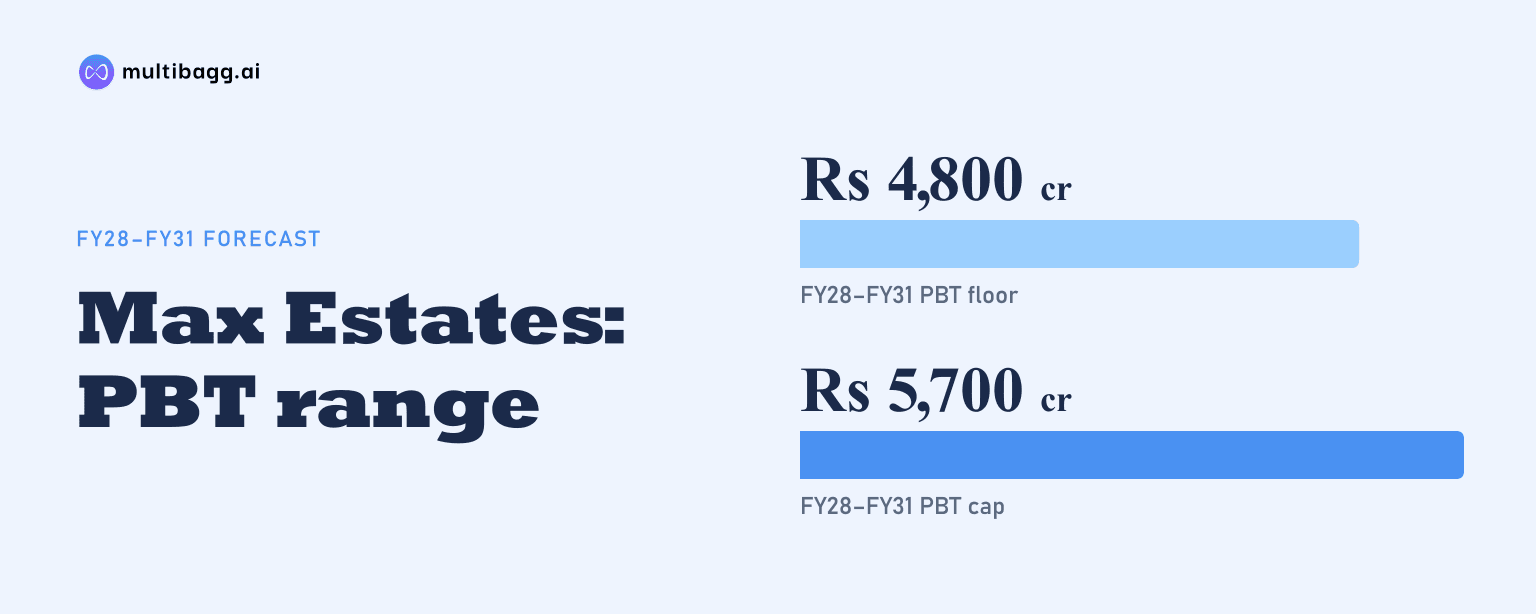
Max Estates Limited estimates that Rs 4,800-5,700 crore of profit before tax from launched projects will be recognised across FY28-FY31, compared with FY26 reported PBT of Rs 23.3 crore. The presentation links this timing to possession, applicable Indian Accounting Standard 115 (Ind AS 115) criteria and transfer of control.
Know Max Estates inside out
Results, valuation, peers and who's buying, in one view.
How much PBT does Max Estates expect from launched projects?
Max Estates estimates Rs 4,800-5,700 crore of embedded PBT from launched projects, with recognition expected over FY28-FY31. The company labels the amount as an estimate and says it represents value yet to be booked in the profit and loss account from sold units and launched gross development value (GDV).
The estimate is associated with approximately Rs 15,650 crore of embedded revenue already contracted in launched projects. In the consolidated residential position presented for Q2 FY27, Max Estates reported Rs 15,652 crore of sales from a Rs 18,760 crore launched book, meaning 83% of launched value had been sold.
FY26 reported revenue was Rs 199.4 crore and reported PBT was Rs 23.3 crore. The comparison shows that contracted sales and estimated project profit can precede accounting recognition, while Max Estates' Rs 4,800-5,700 crore PBT estimate remains subject to the conditions described in its presentation.
Why has Max Estates not reported most of this profit?
Max Estates says revenue is recognised under Ind AS 115 when applicable criteria are met and control is transferred. Customer bookings establish contracted sales, collections support funding and construction, and construction costs are incurred before the related revenue and project margin are reflected in reported earnings.
The company's accounting sequence starts with pre-sales or bookings, followed by collections and construction progress, then revenue recognition and reported earnings. The five projects in the embedded-PBT schedule identify possession for PBT and sales booking between FY28 and FY31, rather than recognition at the date of sale.
Collections are also distinct from reported revenue. Of the Rs 18,760 crore launched book, the consolidated summary shows Rs 4,063 crore collected, Rs 11,588 crore sold but yet to be collected, and Rs 3,108 crore unsold. These booking and collection measures are substantially larger than FY26 revenue of Rs 199.4 crore, but they do not by themselves represent recognised revenue.
Which projects make up Max Estates' estimated PBT?
Max Estates attributes its Rs 4,800-5,700 crore estimate to Estate 128, Estate 360, Estate 361, Max One and Estate 105. The disclosed project PBT figures are after corporate allocations, while estimated project margins range from 20% to 45%.
Estate 128 has the highest stated estimated margin range, at 40-45%, and is the only project with recognition split between FY28 and FY29. Estate 360 and Estate 361 each have a 20-25% estimated margin range and Rs 1,000-1,200 crore of estimated PBT, but Estate 360 is scheduled for FY29 and Estate 361 for FY31.
Max One has an estimated PBT range of Rs 800-1,000 crore and Estate 105 has an estimated range of Rs 900-1,100 crore. Max Estates owns 51% of each project and New York Life owns 49%, while the presentation does not provide a separate PBT allocation between the two owners.
Got a follow-up? Ask IRIS
What cash flows and costs remain on launched projects?
Max Estates estimates Rs 14,696 crore of remaining receipts from sold and unsold launched units, comprising Rs 9,029 crore in residential and Rs 5,667 crore in mixed use. Estimated total receipts are Rs 12,539 crore for residential and Rs 6,221 crore for mixed use, with the presentation identifying these as estimates.
For sold units, remaining collections are Rs 7,506 crore in residential and Rs 4,082 crore in mixed use. Collections to date from sold units total Rs 3,510 crore in residential and Rs 554 crore in mixed use, distinguishing cash received from the future revenue-recognition process.
Estimated balance costs to be incurred are Rs 6,569 crore for residential launched units and Rs 3,105 crore for mixed-use launched units. On this basis, Max Estates estimates operating cash flow from launched units of Rs 2,460 crore in residential and Rs 2,562 crore in mixed use.
Collection efficiency differs among the projects shown. Estate 361 had collected Rs 484 crore against Rs 513 crore billed, or 94%, while Max One had collected Rs 188 crore against Rs 259 crore billed, or 73%. Post-10% cancellations were 22 units worth Rs 139 crore, concentrated in Estate 360 and Estate 361.
When will Max Estates recognise the estimated PBT?
Max Estates expects recognition across FY28-FY31 rather than in FY27. Estate 128 Phase 1 is the earliest stated possession milestone in FY28, followed by Estate 128 Phase 2 and Estate 360 in FY29, Max One in FY29/30, and Estate 361 plus Estate 105 in FY31.
The source does not allocate the Rs 4,800-5,700 crore PBT range to individual financial years. It instead provides project-level possession timing, which means the disclosed schedule indicates when individual projects may contribute to reported PBT rather than setting annual PBT guidance.
The estimate covers launched projects, not the entire future development pipeline. Max Estates reported a Rs 29,058 crore balance pipeline and H1 FY27 pre-sales of Rs 3,184 crore, but the embedded PBT estimate is specifically tied to launched GDV and sold units yet to be recognised in the profit and loss account.
Conclusion
Max Estates presents a material timing difference between its FY26 reported PBT of Rs 23.3 crore and the Rs 4,800-5,700 crore of estimated PBT embedded in launched projects. The difference reflects the company's stated progression from bookings and collections through construction and possession to recognition under Ind AS 115.
The next disclosed milestones are Estate 128 Phase 1 in FY28, Estate 128 Phase 2 and Estate 360 in FY29, Max One in FY29/30, and Estate 361 and Estate 105 in FY31. Progress in collecting the estimated Rs 14,696 crore of remaining receipts and completing the estimated Rs 9,674 crore of balance costs will be central to that schedule.