










MAX Healthcare's ₹448 crore profit includes unaudited partners
Key highlights
- MAX Healthcare reported ₹448 crore of Q2 FY27 network profit after tax, including ₹422 crore from the company, subsidiaries and Silos.
- Q2 FY27 network net revenue rose 18% year on year to ₹3,055 crore, while reported EBITDA reached ₹797 crore.
- Three unaudited partner facilities contributed to the memorandum consolidation: Balaji Society, GM Modi Society (Hospital) and Devki Devi Society.
- Inpatient volumes increased 12% year on year to 98,464 patients, while average revenue per inpatient patient rose 8% to ₹2.31 lakh.
powered by IRIS
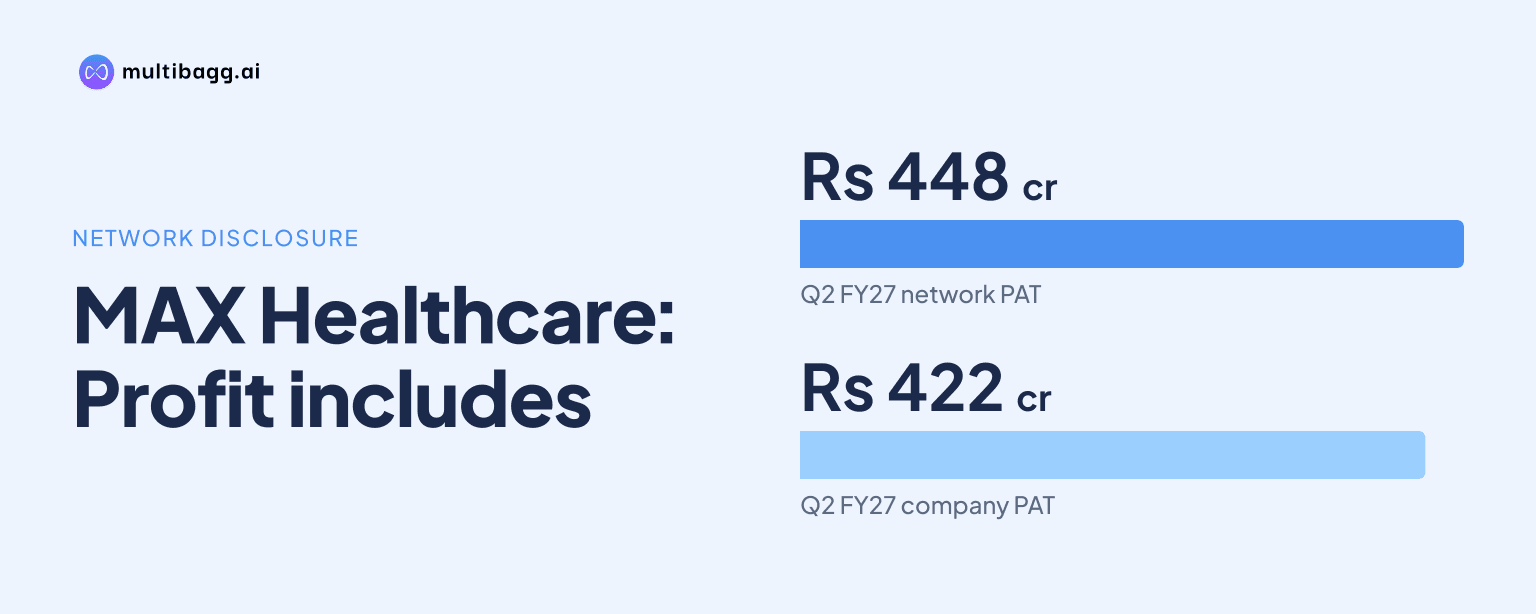
MAX Healthcare reported ₹448 crore of Q2 FY27 network profit after tax, but the figure is a memorandum-consolidated measure rather than solely the Indian Accounting Standards, or Ind AS, result of entities it controls. The total includes unaudited financials from three partner healthcare facilities, while the company, subsidiaries and Silos column recorded ₹422 crore of profit after tax.
Know Max Healthcare Institute inside out
Results, valuation, peers and who's buying, in one view.
What does MAX Healthcare's ₹448 crore network profit include?
MAX Healthcare's ₹448 crore Q2 FY27 network profit after tax includes the results of the company, its subsidiaries and Silos, three separately presented partner healthcare facilities, Ind AS adjustments, and eliminations and adjustments. The presentation calls the measure a “memorandum consolidation of network P&L” and identifies the partner figures as unaudited Indian Generally Accepted Accounting Principles, or IGAAP, financials.
The network measure reported total operating income of ₹3,055 crore in Q2 FY27, comprising ₹3,046 crore of net revenue from operations and ₹10 crore of other income, as presented. The company, subsidiaries and Silos generated ₹2,578 crore of operating income in that schedule, while Balaji Society, GM Modi Society (Hospital) and Devki Devi Society contributed ₹202 crore, ₹252 crore and ₹216 crore respectively before eliminations.
Net revenue rose 18% year on year from ₹2,580 crore and operating earnings before interest, tax, depreciation and amortisation, or EBITDA, rose 18% to ₹820 crore in Q2 FY27. Reported EBITDA was ₹797 crore after ₹15 crore of equity-settled scheme expense and ₹8 crore related to the movement in fair value of contingent consideration payable and amortisation of contract assets. MAX Healthcare stated that profit-after-tax growth was 10% after normalising Q2 FY26 for a one-time ₹149 crore tax gain.
How does the memorandum consolidation change MAX Healthcare's Q2 FY27 profit?
The memorandum consolidation takes ₹422 crore of Q2 FY27 profit after tax in the company, subsidiaries and Silos column and arrives at ₹448 crore after partner-facility outcomes and ₹27 crore of eliminations and adjustments. Balaji Society recorded a ₹16 crore loss after tax, while GM Modi Society (Hospital) and Devki Devi Society recorded profit after tax of ₹2 crore and ₹12 crore respectively.
The bridge is not a simple addition of hospital results because it also contains accounting entries. The schedule shows no Ind AS adjustment at profit-after-tax level, ₹27 crore of eliminations and adjustments, and ₹3 crore of tax within those adjustments. At the reported EBITDA level, the components were ₹720 crore for the company, subsidiaries and Silos, negative ₹12 crore for Balaji Society, ₹40 crore for GM Modi Society (Hospital), ₹21 crore for Devki Devi Society, ₹3 crore of Ind AS adjustment and ₹25 crore of eliminations and adjustments.
The network P&L statement and memorandum schedule align on the final ₹448 crore profit-after-tax figure and ₹797 crore reported EBITDA figure, but the memorandum schedule identifies the components behind those totals. The headline network result therefore covers three facilities beyond the Ind AS unaudited company, subsidiaries and Silos column, as well as the stated adjustment entries.
Got a follow-up? Ask IRIS
Why are partner facilities outside MAX Healthcare's Ind AS control?
MAX Healthcare states that it has service agreements with the partner entities but does not own or control them under Ind AS 110. The separately shown facilities are Balaji Society, GM Modi Society (Hospital) and Devki Devi Society, whose Q2 FY27 total operating incomes were ₹202 crore, ₹252 crore and ₹216 crore respectively.
The presentation also says Nirogi Society and Vikrant Foundation are not separately reflected because they had negligible operational revenues and are included within eliminations and adjustments. Eliminations cover revenue from partner healthcare facilities and intra-network sales and purchases, while associated adjustments include the consequential amortisation impact from reversal of intangible assets recognised by the company and its subsidiaries for partner-facility contracts.
The individual partner columns show differing cost and profit outcomes that are not visible in the combined network total. Balaji Society had ₹215 crore of total expenses against ₹202 crore of operating income, producing negative ₹12 crore of operating EBITDA, whereas GM Modi Society (Hospital) generated ₹40 crore and Devki Devi Society generated ₹21 crore. Balaji Society's result was stated after a ₹25 crore donation to Nirogi Society to aid development of about 400-bed hospitals in Patparganj.
What operating factors supported MAX Healthcare's Q2 FY27 network earnings?
MAX Healthcare attributed the Q2 FY27 contribution-margin increase to lower material costs, a reduction in institutional-bed share and a favourable treatment mix. Contribution was ₹1,814 crore, or 59.4% of net revenue, compared with ₹1,520 crore, or 58.9%, in Q2 FY26; direct costs fell to 40.6% of net revenue from 41.1% despite rising in rupee terms to ₹1,241 crore.
Patient and revenue data provide context for the 18% network revenue increase. Inpatient volumes, measured by patients discharged, rose 12% year on year to 98,464 in Q2 FY27, while average revenue per inpatient patient increased 8% to ₹2.31 lakh. Outpatient consultations rose 13% to 11.44 lakh, while average length of stay remained 3.9 days in Q2 FY26, Q1 FY27 and Q2 FY27.
Indirect overheads increased 20% year on year to ₹995 crore, or 32.6% of net revenue, from ₹826 crore, or 32.0%. MAX Healthcare attributed the increase to higher healthcare-facility fees linked to international patient revenue, provision for doubtful debts from aged debts, and people costs associated with beds commissioned at MSSH Mohali, Max Smart, MSSH Lucknow and Nanavati-Max. The Q2 FY27 figure included ₹17 crore relating to MSSH Bhubaneswar.
Conclusion
MAX Healthcare's ₹448 crore Q2 FY27 network profit after tax is a broader management-presented network measure, rather than a result limited to entities controlled under Ind AS 110. It combines ₹422 crore from the company, subsidiaries and Silos with the results of three unaudited partner facilities and ₹27 crore of eliminations and adjustments, alongside ₹3,055 crore of network net revenue.
The disclosed development to watch is the planned development of about 400-bed hospitals in Patparganj, supported by Balaji Society's ₹25 crore donation to Nirogi Society. Future memorandum consolidations will also show whether the three named partner facilities remain separately reported and whether Nirogi Society and Vikrant Foundation continue to be grouped within eliminations and adjustments because of negligible operational revenue.