










Medanta will build new hospitals at scale for complex care
Key highlights
- Medanta expects South Delhi, Mumbai and Guwahati hospitals to be completed and operating around FY30.
- Medanta cited a later addition of about 18 operating rooms at Gurugram as support for upfront infrastructure planning.
- Lucknow is expected to add approximately 5 operating rooms in Q3, if possible, or early Q4.
- Cluster 2 occupied bed days increased about 40%, while Medanta cited about 20% volume growth at Noida.
powered by IRIS
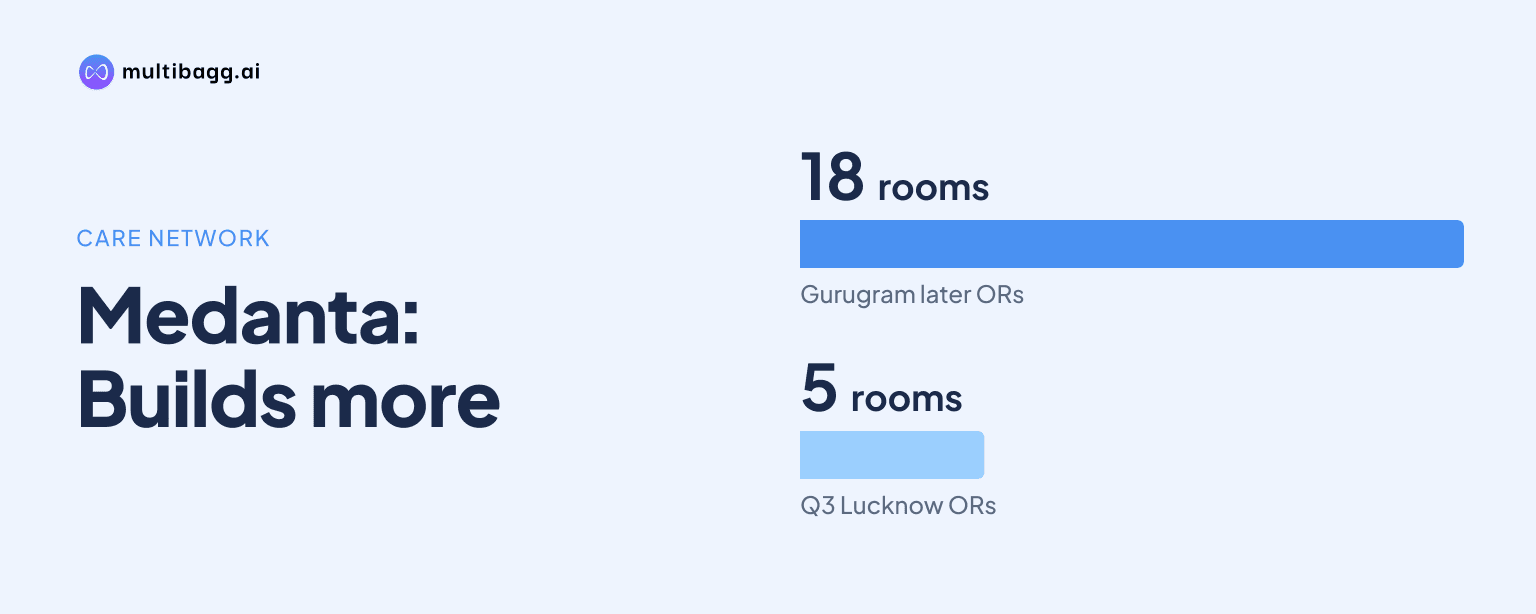
Medanta plans to build new hospitals at substantial scale for complex care rather than add core infrastructure in stages, citing its Gurugram experience where a floor with about 18 operating rooms was added years after opening and still did not meet requirements. Management expects South Delhi, Mumbai and Guwahati to be completed and operating around FY30.
Know Global Health inside out
Results, valuation, peers and who's buying, in one view.
Why will Medanta build hospitals at scale from the outset?
Medanta says it will design facilities to serve their communities for years and potentially decades, even where one or two floors may initially remain unused. Management said each project’s size depends on available land, regulatory conditions and the capital that can be invested, but its preference is to create infrastructure that can accommodate complex clinical work from the beginning.
Medanta’s stated reason is that later physical expansion can disrupt the integrated layout required for patient movement, clinical practice and infection management. Pankaj Sahni said constructing one tower initially and another tower three, four or five years later does not enable complex work as effectively as building the intended infrastructure in one coordinated phase.
The Guwahati project is an example of this planning approach. Medanta increased the planned size of the hospital after feedback from the region and its assessment that more beds, operating rooms and procedural areas could be needed over the long term. Management said the revised design allows capacity to be retained for the future even if one or two floors are not activated at launch.
Medanta also referred to its Gurugram hospital, where a complete floor containing about 18 operating rooms was built many years after the hospital had opened. Management said that additional capacity remains insufficient and more operating rooms are still being added, supporting its view that future requirements should be considered during the original build-out.
Will Medanta open all beds and specialties on day one?
Medanta does not apply a fixed rule that every bed and specialty must be operational on the first day, because activation depends on the region, timing and availability of doctors. Its stated strategy is to build a physical platform capable of handling complex care, while deciding the pace of operational ramp-up separately for each location.
Management distinguished between building a hospital and staffing it. Sahni said Medanta aims to create an environment in which doctors can carry out high-end complex work, but this requires the relevant clinical talent to be available. Yogesh Gupta said scaling a large facility differs from scaling a 200-bed or 300-bed hospital because talent must be recruited with eventual operation of all beds in mind.
Medanta cited Noida as a location where the ramp-up could proceed relatively quickly because doctors were available and willing to join. Gupta said a Tier 2 city may require slower hiring and service activation if comparable talent is unavailable, meaning the operating profile of a future hospital may not replicate Noida’s pace.
The opening equipment mix may also vary by location and period. Sahni said a surgical robot might once have been deferred at a new hospital but may now be part of the initial equipment because robotic surgery has become more common, while radiation-oncology equipment is another area where launch decisions have changed. Medanta said these decisions will be assessed by region, clinical talent and timing.
Got a follow-up? Ask IRIS
What evidence does Medanta cite from existing hospitals?
Medanta says reported quarterly growth reflects actions undertaken well before the quarter, often over 12 to 24 months. Management identified doctor hiring, equipment, infrastructure, beds, clinics and operating rooms as investments that can take time to translate into patient volumes and financial results, rather than being actions taken in a single three-month period.
Lucknow illustrates Medanta’s focus on capacity beyond beds. Following the September-end, a ward was ready for operationalisation and Medanta expected further bed additions during the current quarter. It also expected to add approximately five operating rooms in Q3, if possible, or in the early part of Q4.
Medanta also plans to operationalise a new outpatient floor in Lucknow in the coming months, adding approximately 20% to 30% of the hospital’s outpatient capacity. Management said the expansion can support outpatient, day-care and procedural volumes, showing why bed count alone does not determine a hospital’s capacity to generate activity.
Gurugram provides a comparison with Lucknow because management said there have been no bed additions there for several years, yet patient and procedural volumes have continued to grow. Medanta attributed that growth to efficiency, recruitment of doctors and higher treatment capacity, whereas Lucknow is combining operational improvements with beds, outpatient capacity and about five additional operating rooms.
Medanta linked larger infrastructure to operating leverage in Cluster 2, which includes Lucknow, Patna and Noida. Sahni said occupied bed days in the cluster rose by about 40%, including Noida, while Noida itself recorded about 20% volume growth. He described Lucknow and Patna as hospitals that are around five and six years old, respectively, and said additions of 30, 40 or 50 beds can contribute to operating leverage as units scale.
Which Medanta projects are expected to progress toward FY30?
Medanta said South Delhi, Mumbai and Guwahati should be completed and begin operations around FY30, subject to construction and approval progress. Sahni provided that indication in response to an analyst’s question, while separately describing different development stages for each project rather than assigning the FY30 timing to every hospital in the wider pipeline.
The South Delhi project in GK was progressing well, although Medanta said pollution-linked construction norms could slow or stop activity for one or two months. Guwahati had received all approvals, contracts had been awarded and construction had started after a monsoon-related slowdown. In Mumbai, Medanta had most approvals and expected piling and digging to start before work proceeded at full speed.
Varanasi was at an earlier stage, with drawings submitted for approval and construction awaiting the necessary permissions. Pitampura was running slower than Medanta’s prior-quarter plan because revised drawings and approvals were still under consideration. Ghaziabad was the most recent project, and Medanta said it would apply for the relevant approvals.
The project pipeline therefore combines the upfront-build philosophy with location-specific execution risks. Medanta intends to build infrastructure that can support complex work, but the operating start dates remain dependent on approvals, construction activity and clinical hiring. The stated FY30 expectation covers three projects, while Pitampura’s revised plans and Varanasi’s pending approvals remain unresolved.
Conclusion
Medanta’s expansion strategy is to establish the physical capability for complex care before all capacity is required, while bringing beds, equipment and specialties into service according to local demand and doctor availability. The company supports this model with Gurugram’s later addition of about 18 operating rooms and with Cluster 2 occupied bed days increasing about 40% as Lucknow, Patna and Noida have scaled.
The next disclosures to watch are construction and approval milestones. Management expects South Delhi, Mumbai and Guwahati around FY30; Guwahati construction has started and Mumbai is preparing for piling and digging, while Varanasi awaits approvals, Pitampura remains delayed by revised drawings and approvals, and Ghaziabad is entering the approval process.