










Medplus approves ₹130 crore buyback at ₹750 per equity share
Key highlights
- Medplus approved an open-market buyback of up to ₹130 crore on November 6, 2026.
- Medplus must deploy at least ₹97.50 crore, equal to 75% of the ₹130 crore maximum buyback size.
- At ₹750 per share, Medplus could buy 17,33,333 shares, equal to 1.44% of paid-up equity capital.
- Medplus promoters and persons in control cannot participate in the open-market buyback.
powered by IRIS
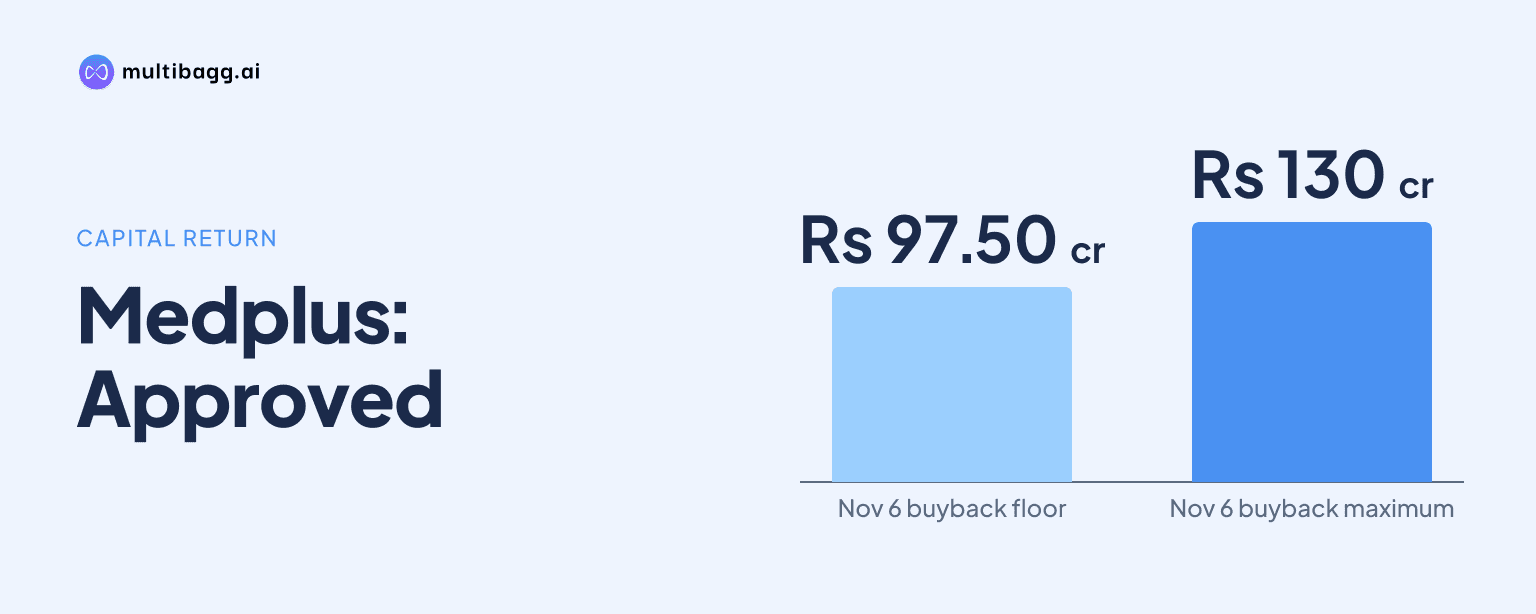
Medplus Health Services Limited (Medplus) approved an open-market buyback on November 6, 2026, with a maximum outlay of ₹130 crore and a price ceiling of ₹750 per equity share. The programme requires Medplus to deploy at least ₹97.50 crore and could retire an indicative 17,33,333 shares, or 1.44% of paid-up equity capital, at the maximum price.
Know Medplus Health Services inside out
Results, valuation, peers and who's buying, in one view.
What exactly did Medplus approve for the buyback?
Medplus approved a cash buyback of fully paid equity shares with a face value of ₹2 each through the stock-exchange mechanism under the open-market route. The board set the maximum buyback size at ₹130 crore, excluding brokerage, turnover charges, applicable taxes, filing fees, adviser fees, legal fees, intermediary fees and other related expenses.
The November 6, 2026 decision followed Medplus’ October 30, 2026 intimation that its board would consider the proposal. The board meeting started at 10:30 a.m. and concluded at 12:30 p.m., with the buyback approved under the applicable provisions of the Companies Act, 2013, and Securities and Exchange Board of India, or SEBI, Buyback Regulations.
The ₹130 crore maximum equals 9.87% of Medplus’ paid-up equity share capital and free reserves on the audited standalone financial statements as of March 31, 2026. It equals 6.61% of the same aggregate on the audited consolidated financial statements for that date, with both measures below the 15% statutory limit cited in the filing.
How many Medplus shares could be bought back?
Medplus indicated that 17,33,333 equity shares could be bought back if it deploys the full ₹130 crore at the maximum price of ₹750 per share. That indicative number represents 1.44% of Medplus’ existing paid-up equity share capital as of November 6, 2026 and remains below the 25% capital limit referred to in the filing.
The actual share count can exceed 17,33,333 if Medplus purchases shares below ₹750 each while fully deploying the ₹130 crore maximum. However, the aggregate purchase amount cannot exceed ₹130 crore, and the number of shares bought back remains subject to the applicable limit on existing paid-up equity capital.
Medplus said it shall utilise at least ₹97.50 crore, equal to 75% of the ₹130 crore maximum buyback size. At the ₹750 maximum price, this minimum deployment translates into an indicative purchase of 13,00,000 equity shares; purchases at lower prices could raise the number acquired for the same outlay.
The filing distinguishes between the maximum price and the eventual market purchase price. ₹750 is a ceiling, not a stated execution price, so the final number of shares retired and the final percentage of capital bought back will be determined after the programme is completed.
Got a follow-up? Ask IRIS
Who can sell shares in the Medplus buyback?
Medplus said shareholders and beneficial owners other than promoters and persons in control may participate in the open-market buyback. Promoters and persons in control are barred from participating through this route under the SEBI Buyback Regulations.
The pre-buyback shareholding data, based on the last weekly beneficiary-position data as of October 30, 2026, records 12,01,56,156 equity shares outstanding. The promoter and promoter group, including persons acting in concert, held 4,82,88,291 shares, representing 40.19% of the total.
Foreign investors held 1,54,10,187 Medplus shares, or 12.83%, in the October 30, 2026 table. Mutual funds, financial institutions, banks, alternative investment funds, non-banking financial companies and insurers held 3,79,72,832 shares, or 31.60%, while individuals, bodies corporate, trusts and other holders owned 1,84,84,846 shares, or 15.38%.
Medplus’ illustrative post-buyback table assumes that 17,33,333 shares are acquired, reducing the total share count from 12,01,56,156 to 11,84,22,823. Under that assumption, the promoter and promoter-group holding is shown at 40.78%, compared with 40.19% before the buyback, while the promoter share count remains 4,82,88,291 because promoters cannot tender into the programme.
What happens next in the Medplus buyback process?
Medplus said the process, timetable and other required details will be included in a public announcement under the SEBI Buyback Regulations. The November 6, 2026 filing does not specify a purchase start date, closing date or the prices at which shares will actually be acquired.
The board has formed a Buyback Committee and delegated powers needed for the proposed transaction. Medplus appointed Shrenik Soni, its company secretary and compliance officer, as compliance officer for the buyback, and appointed Nuvama Wealth Management Limited as manager to the buyback.
The structure fixes a maximum spend of ₹130 crore and a mandatory minimum spend of ₹97.50 crore, while allowing purchases below the ₹750 ceiling. This means final deployment, the average purchase price and the eventual number of shares bought will be known only after the open-market programme is completed.
Conclusion
Medplus has authorised an open-market buyback with a maximum outlay of ₹130 crore, a price ceiling of ₹750 per equity share and a minimum required deployment of ₹97.50 crore. At the maximum price, the plan implies purchases of 13,00,000 shares at the minimum deployment and 17,33,333 shares at the maximum outlay, with the latter equal to 1.44% of paid-up equity capital.
The next disclosed event to watch is Medplus’ public announcement, which is to set out the timetable, process and other operational details. Investors can then track the final cash deployed, the actual market purchase price and the completed share count, as buying below ₹750 could increase the number of shares retired within the ₹130 crore cap.