










Meta Infotech Limited H1 revenue falls 57% as mix shifts
Key highlights
- Meta Infotech reported H1FY27 revenue of Rs 89.5 crore, down 57% from Rs 210.1 crore in H1FY26.
- Gross margin rose to 32.2% in H1FY27 from 16.8% a year earlier.
- EBITDA margin increased to 8.7% from 7.5%, while PAT margin reached 5.4% from 5.0%.
- Meta Infotech had a Rs 92.7 crore order book on September 30, 2026, and added 12 clients in H1FY27.
powered by IRIS
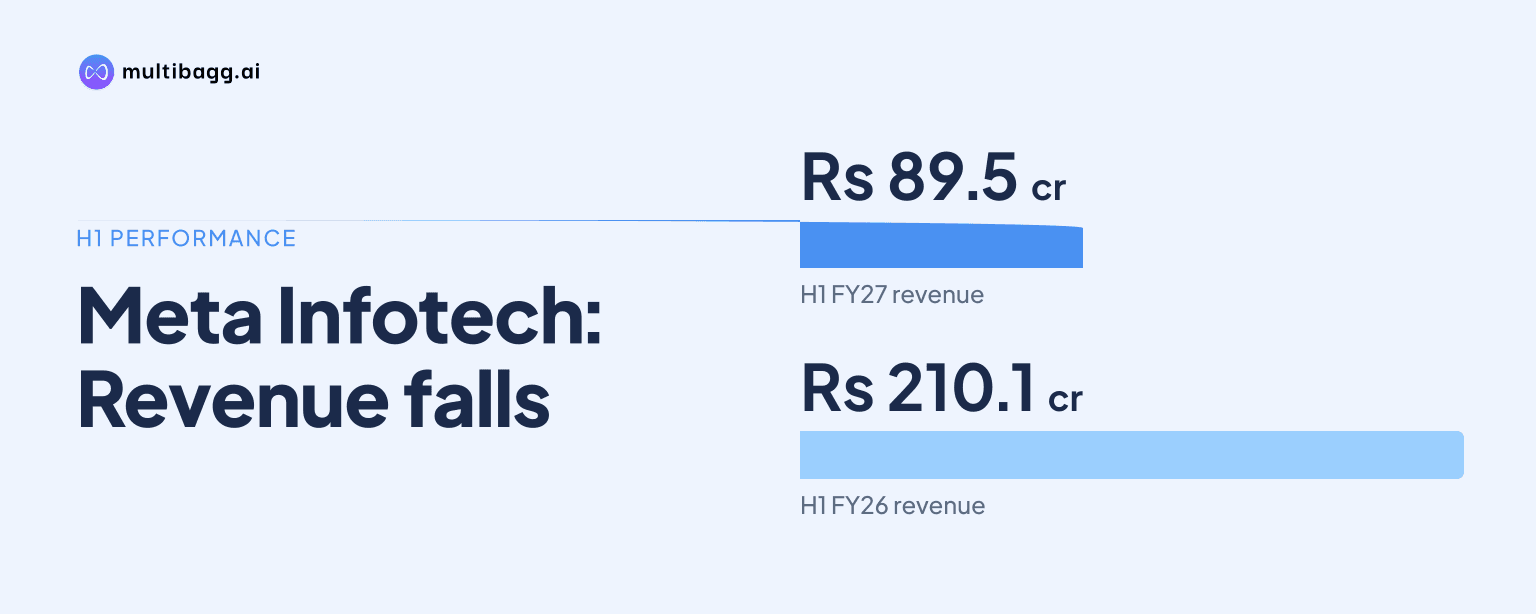
Meta Infotech reported revenue of Rs 89.5 crore for the first half of financial year 2027 (H1FY27), down 57% year on year, after ending lower-margin product sales to a leading banking client, while gross margin rose to 32.2% from 16.8% as cybersecurity services became a larger part of sales.
Know Meta Infotech inside out
Results, valuation, peers and who's buying, in one view.
Why did Meta Infotech revenue fall 57% in H1FY27?
Meta Infotech’s revenue fell because it deliberately stopped product sales to a leading banking client in favour of a services-led model designed to protect margins. Revenue from operations was Rs 89.5 crore in the half year ended September 30, 2026, compared with Rs 210.1 crore in the first half of financial year 2026 (H1FY26), a decline of Rs 120.6 crore. The company said it retained its strategic cybersecurity relationship with that client through service offerings rather than the discontinued product business.
The company reported H1FY27 revenue above the Rs 59.9 crore recorded in the second half of financial year 2026 (H2FY26), an increase of 49% half on half. Meta Infotech characterised the decision as a conscious move away from lower-margin, product-led revenue and towards higher-value cybersecurity engagements. The release therefore shows a lower year-on-year revenue base but a higher revenue level than H2FY26 after the strategic shift.
How did Meta Infotech’s margins change after the sales exit?
Meta Infotech’s gross margin increased to 32.2% in H1FY27 from 16.8% in H1FY26, an increase of 15.4 percentage points despite the revenue decline. Gross profit was Rs 28.8 crore, down 18% from Rs 35.2 crore a year earlier. The smaller percentage decline in gross profit than in revenue reflects the disclosed shift toward cybersecurity services after lower-margin product sales were stopped.
EBITDA margin was 8.7% in H1FY27, compared with 7.5% in H1FY26 and 3.8% in H2FY26. EBITDA was Rs 7.8 crore, 50% lower than the Rs 15.8 crore reported a year earlier but 246% above Rs 2.3 crore in H2FY26. Management attributed the margin improvement to higher-margin cybersecurity services and its focus on revenue quality.
What happened to Meta Infotech’s net profit in H1FY27?
Meta Infotech’s PAT was Rs 4.9 crore in H1FY27, down 53% from Rs 10.4 crore in H1FY26 as revenue contracted by 57%. PAT margin nevertheless rose to 5.4% from 5.0% in the prior-year half. The differing movement in absolute profit and margin is consistent with the company’s stated aim of replacing lower-margin product revenue with services revenue.
Against H2FY26, PAT increased from Rs 0.4 crore to Rs 4.9 crore, which the release presents as 1,010% half-on-half growth. PAT margin similarly rose from 0.7% in H2FY26 to 5.4% in H1FY27. The half-on-half comparison starts from the Rs 0.4 crore PAT reported for H2FY26, while the year-on-year comparison shows lower absolute earnings than the Rs 10.4 crore reported in H1FY26.
Got a follow-up? Ask IRIS
What business pipeline and client additions did Meta Infotech report?
Meta Infotech reported an order book of Rs 92.7 crore as of September 30, 2026, which it said provides a base for future revenue conversion. The company said the lower order book reflected its move toward higher-margin, value-added services and disciplined selection of profitable opportunities. It did not provide a prior-period order-book figure, so the scale of the change cannot be calculated from the release.
The company added 12 new clients during H1FY27 across sectors and regions. Its expansion beyond Mumbai included new client additions in Chennai, Bengaluru, Hyderabad and Delhi, as well as international markets. Meta Infotech said these newer geographies were beginning to contribute to business growth and offered room for further client acquisition, deeper customer relationships and revenue expansion as its presence scales.
How is Meta Infotech expanding its cybersecurity services?
Meta Infotech added three new vendors, expanding the service portfolio it uses to offer integrated cybersecurity solutions. Management said that, as these partnerships mature and business volumes scale, the company expects better operating efficiencies and improved margins. This is a management expectation rather than a financial outcome reported for H1FY27.
The company’s portfolio includes more than 15 cybersecurity solutions and services, including Secure Access Service Edge, database security, endpoint detection and response, extended detection and response, cloud security, identity security, application and application programming interface security, network and perimeter security, and managed security services. Chairman and Managing Director Venu Gopal Peruri said the H1FY27 transition focused on expanding high-value services while maintaining strategic customer relationships through services rather than certain product sales.
Conclusion
Meta Infotech’s H1FY27 results show the immediate trade-off from its business-model change: revenue fell by Rs 120.6 crore year on year to Rs 89.5 crore, while gross margin increased by 15.4 percentage points to 32.2%. Gross profit fell by Rs 6.4 crore, while EBITDA and PAT margins rose to 8.7% and 5.4%, respectively, as the company shifted toward a services-led mix.
The next indicators are whether the Rs 92.7 crore order book converts into revenue and whether the 12 clients added in H1FY27, newer geographies and three vendor partnerships support the planned expansion of high-value services. Management has said it will prioritise profitable opportunities, long-term customer relationships and revenue quality over low-margin product-led sales, while expecting maturing partnerships and higher volumes to improve efficiencies and margins.