










Mihika sets Rs 7.50 calls, trading suspensions, forfeiture
Key highlights
- Mihika's Rs 10 Rights Equity Share requires Rs 2.50 on application and Rs 7.50 through three later calls.
- The three Rs 2.50 calls are stated for January 11-21, February 19-March 02 and April 01-12, 2027.
- Mihika says trading in partly paid Rights Equity Shares will be suspended from each call record date.
- A missed call can lead to board-set interest or forfeiture of the shares and amounts already paid.
powered by IRIS
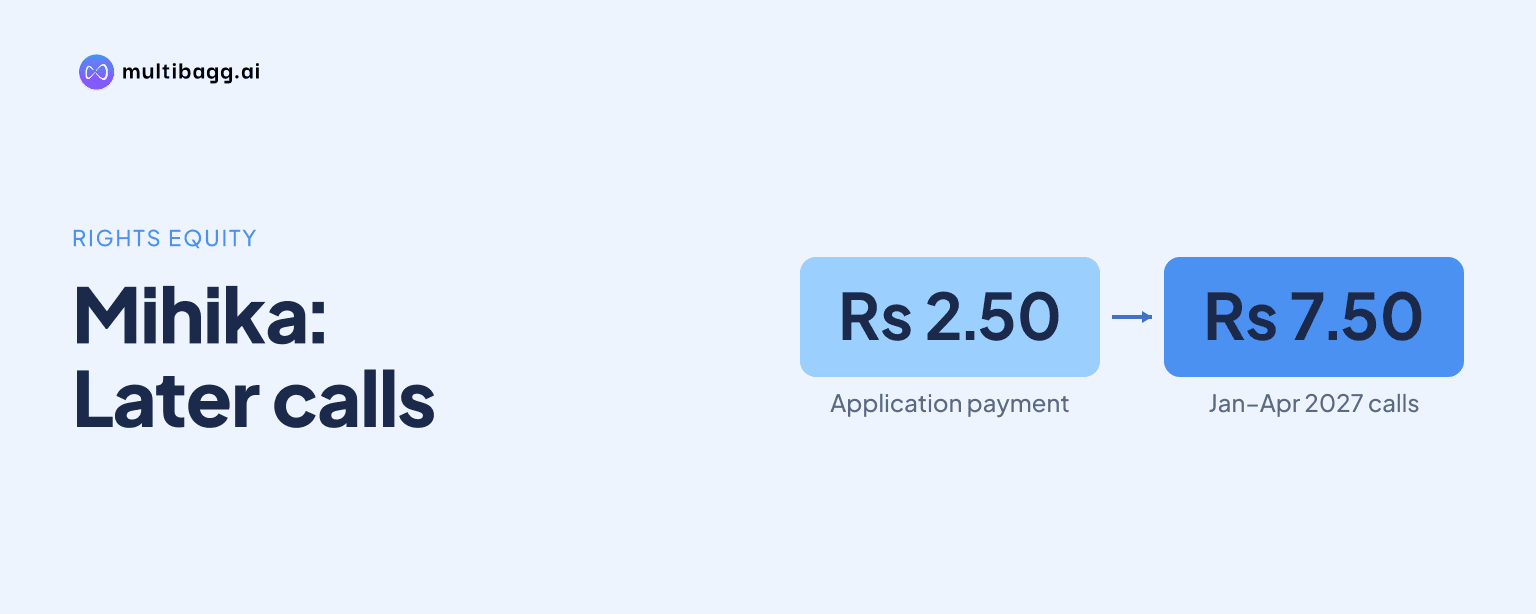
Mihika requires holders of partly paid Rights Equity Shares to pay the remaining Rs 7.50 per share through three Rs 2.50 calls from January to April 2027, and states that missed payments can lead to interest or forfeiture. The Rs 10 issue price requires only Rs 2.50, or 25%, on application.
Know Mihika Industries inside out
Results, valuation, peers and who's buying, in one view.
What will Mihika rights-share holders have to pay?
Mihika has set the issue price at Rs 10 per Rights Equity Share, comprising Rs 2.50 on application and Rs 7.50 payable later. The application amount is 25% of the issue price, while the remaining Rs 7.50 is 75%, leaving holders with a payment obligation after allotment.
The unpaid amount is split into three calls of Rs 2.50 each, with each call allocated to face value and no premium. Unlike a fully paid issue, the holder's total cash commitment runs until the final call period in April 2027 rather than ending at application.
Mihika describes the three call windows as being on or about the stated dates, and its board may revoke or postpone calls. Under its Articles of Association, investors will receive at least 14 days' written notice for call payment, while the board may extend the payment deadline from time to time.
When can Mihika partly paid rights shares be traded?
Mihika says trading in Rights Equity Shares will be suspended from the call record date for every call before the final call, for the period required under applicable law. For the final call, partly paid shares will not trade from the call record date used to identify investors liable for the final payment.
The shares will be listed under a separate International Securities Identification Number, or ISIN, while they remain partly paid. Mihika says the Rights Equity Shares will trade in a segment separate from its existing Equity Shares, meaning their market price may not track the price of fully paid Equity Shares.
After payment of the final Rs 2.50 call, partly paid Rights Equity Shares are to convert into fully paid Equity Shares and be listed under Mihika's existing ISIN. Mihika also states that holders will not be able to trade the securities until they are credited as fully paid-up Rights Equity Shares.
Mihika says an active market for Rights Equity Shares may not develop, noting the limited history of partly paid-share trading in India. It also states that Rights Entitlements may lack an active market during the renunciation period, while their price can be volatile and affected by the quoted Equity Share price.
Got a follow-up? Ask IRIS
What happens if a Mihika holder misses a call payment?
Mihika says a defaulting Rights Equity Shareholder may have to pay interest at a rate fixed by its board, unless the board waives the charge. Alternatively, Mihika may forfeit the Rs 2.50 application money and any call money received for earlier calls, in accordance with the Companies Act, 2013 and its Articles of Association.
Mihika separately states that failure to receive complete call money within the stipulated time would result in forfeiture of the Rights Equity Shares allotted to the shareholder who does not pay. The stated outcome can therefore include loss of the partly paid shares as well as amounts already paid on those shares.
Mihika may send call-payment reminders at its discretion, but does not promise that it will do so. The company states that it would forfeit application money if call money is not received within the stipulated timeline, making the written call notice and payment period relevant deadlines for holders.
The consequence also extends to the fundraise. Mihika says incomplete receipt of call money and the related forfeiture of application money may cause a shortfall in net proceeds, which may need to be met through internal accruals and may affect business expenditure and growth opportunities.
How do unpaid amounts affect Mihika shareholder rights?
Mihika says dividend entitlement on Rights Equity Shares is proportional to the amount paid up. Voting rights exercisable in a poll are also proportional to the holder's paid-up portion of Mihika's equity capital, rather than equal to the rights attached to a fully paid Rs 10 Equity Share.
The partly paid structure also restricts Mihika's capital-raising options while these shares remain outstanding. Mihika states that it cannot undertake a further rights issue, further public offer or bonus issue until existing partly paid equity shares have become fully paid or have been forfeited.
For holders, the final call is the stated conversion point. Mihika will fix a call record date to determine the allottees who receive the final-call notice, and the separate ISIN for partly paid shares will be terminated after that record date.
Payment of the final Rs 2.50 call is the mechanism for converting the partly paid Rights Equity Shares into fully paid Equity Shares under the existing ISIN. Mihika says the final-call record date will also precede a suspension of trading in the partly paid shares for the applicable period under rules and regulations.
Conclusion
Mihika's Rs 10 rights-share structure creates a staged payment obligation: Rs 2.50 on application followed by three Rs 2.50 calls. The arrangement combines trading suspensions around call record dates, proportional dividends and voting rights before full payment, and possible interest or forfeiture where call money is not received on time.
The next disclosed milestones are the first call from January 11 to January 21, 2027, the second from February 19 to March 02, 2027, and the final call from April 01 to April 12, 2027. Investors should watch for Mihika's written call notices, any board decision to postpone or extend a call, and the final-call record date before conversion to fully paid shares.