








Minda Corporation says EV platforms account for 35% of order book
Max Plan at ₹4,999/yr₹8,999

Find your next multibaggerBe a Pro Investor
Research stocks and track your picks on the go. Download the app.
Key highlights
- Minda Corp said 35% of its order book now comes from EV platforms.
- EV platforms currently account for about 10% of Minda Corp’s wiring-harness business.
- Minda Corp said it has 100% localised high-voltage cables for India’s highest-selling passenger vehicle.
- Minda Corp expects passenger-vehicle revenue to exceed 25%, from about 18% to 20%, over the next couple of years.
powered by IRIS
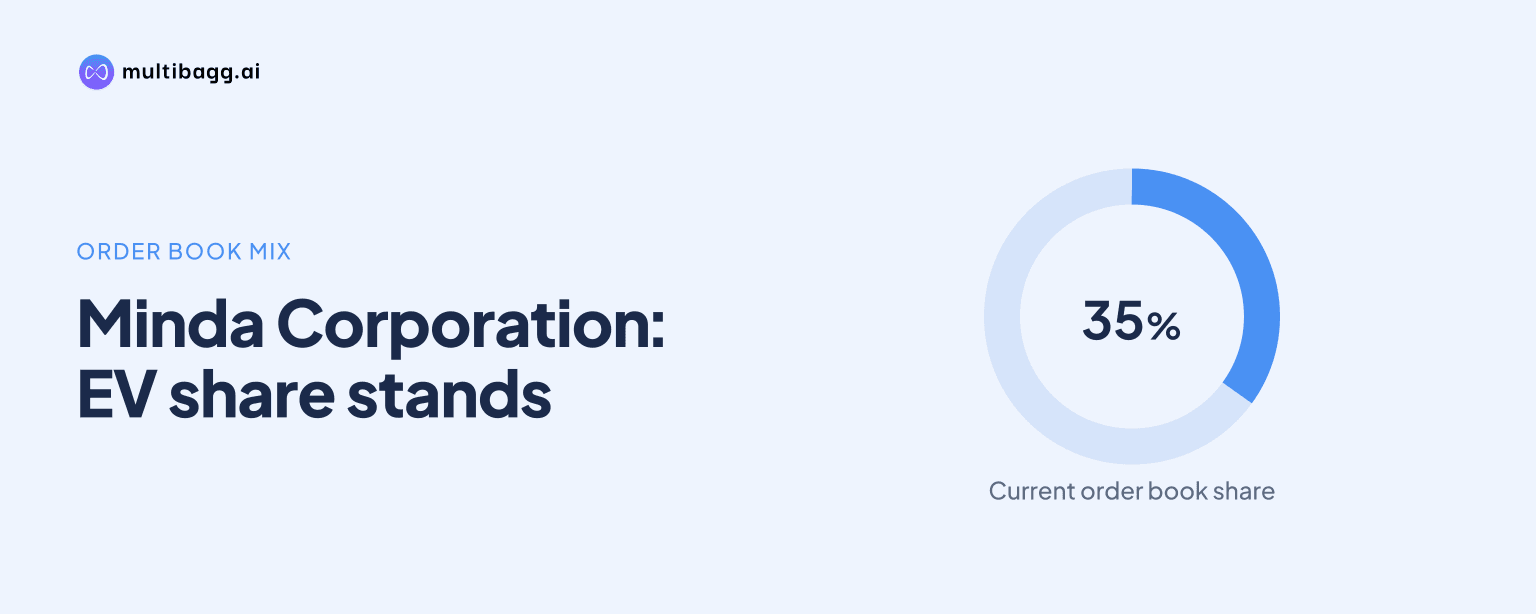
In the earnings call, Minda Corp said EV platforms accounted for 35% of its order book, versus about 10% of its wiring-harness business, indicating a larger future EV mix. Management cited fully localised high-voltage cables for India’s highest-selling passenger vehicle and a dedicated northern India facility.
Know Minda Corporation inside out
Results, valuation, peers and who's buying, in one view.
How much of Minda Corp’s order book comes from EV platforms?
Minda Corp said 35% of its order book is now coming from EV platforms across customers. Management described the order book received on a quarterly basis as equivalently split across vehicle segments and product domains, including EV and internal-combustion-engine, or ICE, platforms. The 35% figure measures future contracted business rather than current revenue.
The timing of the order book matters because management said roughly 40% to 50% of business is linked to replacement platforms, while 60% is from new customer platforms and products. Products typically begin production about 18 to 24 months after an order is received, and peak production comes about two years after that start, according to Minda Corp. The 35% EV share may therefore translate into revenue over several years rather than immediately.
What is Minda Corp’s current EV wiring-harness exposure?
Minda Corp said EV platforms represent about 10% of its overall wiring-harness business, compared with the 35% EV share of its order book. Management did not provide the percentage of passenger-vehicle revenue represented by high-voltage products, saying its passenger-vehicle EV harness journey had only recently begun. The difference between current harness exposure and the order-book mix indicates that EV business is weighted towards future vehicle launches.
Management said high-voltage and EV products are rising in two-wheelers, three-wheelers and passenger vehicles. In commercial vehicles, it said EV penetration is increasing in small commercial vehicles, while heavy commercial vehicles and medium-and-heavy EVs continue largely in ICE applications. This gives the wiring-harness opportunity exposure to several vehicle classes rather than only passenger vehicles.
Copper prices have risen by about 4% to 5% in Minda Corp’s overall wiring-harness domain, management said. These movements are indexed back-to-back with customers, although with a one-quarter lag before compensation is received. The arrangement addresses the cost change in a subsequent quarter, while the lag affects input costs in the intervening period.
Which high-voltage products is Minda Corp localising?
Minda Corp said it has 100% localised high-voltage cables for India’s highest-selling passenger vehicle. Management did not name the vehicle or disclose associated revenue, but said it had fully localised that vehicle’s high-voltage requirements. The programme is the company’s stated initial entry point for passenger-vehicle EV harnesses.
The company also said it has been awarded development business involving CCS2 inlets and high-voltage cables. Management said these products should enter mass production soon, without disclosing a launch date, customer name or production volume. The work extends the product range beyond conventional low-voltage vehicle wiring.
Minda Corp has already set up a dedicated facility in northern India for passenger-vehicle high-voltage requirements. Management disclosed the facility alongside the localised cable programme and the CCS2 development work, linking capacity with an expected production ramp. It said more passenger-vehicle programmes are yet to follow the initial programme for India’s highest-selling vehicle.
Got a follow-up? Ask IRIS
How could passenger vehicles change Minda Corp’s revenue mix?
Minda Corp expects passenger-vehicle original equipment manufacturer, or OEM, revenue to exceed 25% over the next couple of years, from a current range of about 18% to 20%. Management attributed the expected increase to new order wins, partnerships, product launches and exports. It said merger-and-acquisition activity could also change the mix if such activity occurred, but did not identify a transaction.
Two-wheelers and three-wheelers currently account for close to 50% of the business, while commercial vehicles contribute about 25%, management said. Looking ahead, Minda Corp expects two-wheelers and three-wheelers to remain the largest segment at about 40% to 45%, and commercial vehicles to represent about 20% to 25%. Passenger vehicles are therefore the segment management expects to gain proportionally, including through EV products and technology-led offerings.
What other products support Minda Corp’s EV strategy?
Minda Corp said EV products and thin-film-transistor, or TFT, clusters are two areas that can expand as EV products and TFT-cluster penetration increase. An analyst described research and development, or R&D, expenses as roughly 3%, while management said about 30% to 35% of overall operating expenditure, or opex, is directed towards software-related technologies. Management linked that spending to its move from components to systems and module manufacturing.
The company said it is pursuing localisation in TFT displays as well as EV hardware. In the first phase, the TFT programme is intended to meet the requirements of Minda Instruments Limited, while a second phase would involve supplying complete display panels directly to OEMs. Management said most TFT-cluster customer wins had been in association with Qualcomm, without providing order values or production dates.
Minda Corp also identified switches, power footsteps and sunroofs as newer product lines alongside EV products. For sunroofs, management said its panoramic product has content per vehicle of about Rs 20,000, plus or minus. It said it is on bidder lists for Korean, Chinese and Indian OEMs, but did not disclose any domestic sunroof awards.
Conclusion
Minda Corp’s disclosures show a marked difference between current EV wiring-harness exposure and its future pipeline: EV platforms account for about 10% of the harness business today but 35% of the order book. Fully localised high-voltage cables, awarded CCS2 development work and a dedicated passenger-vehicle facility are the operating mechanisms management identified behind that expected mix shift.
The next disclosed milestones are mass production of CCS2 inlets and high-voltage cable programmes, and the normal 18-to-24-month period between order receipt and start of production. Management also expects passenger-vehicle OEM revenue to exceed 25% over the next couple of years, compared with its current 18% to 20% range.

