










MobiKwik lending disbursals rose 47% as costs declined
Key highlights
- ZIP EMI disbursals rose 47% quarter on quarter to Rs 1,082.6 crore in Q2 FY27.
- MobiKwik's major lending partners increased to 11 from 9 in Q1 FY27 and 6 in Q2 FY26.
- Lending-related expense fell 16% year on year to Rs 29.83 crore, or 2.76% of digital credit GMV.
- Financial-services gross margin increased to 65.7% in Q2 FY27 from 41.8% a year earlier.
powered by IRIS
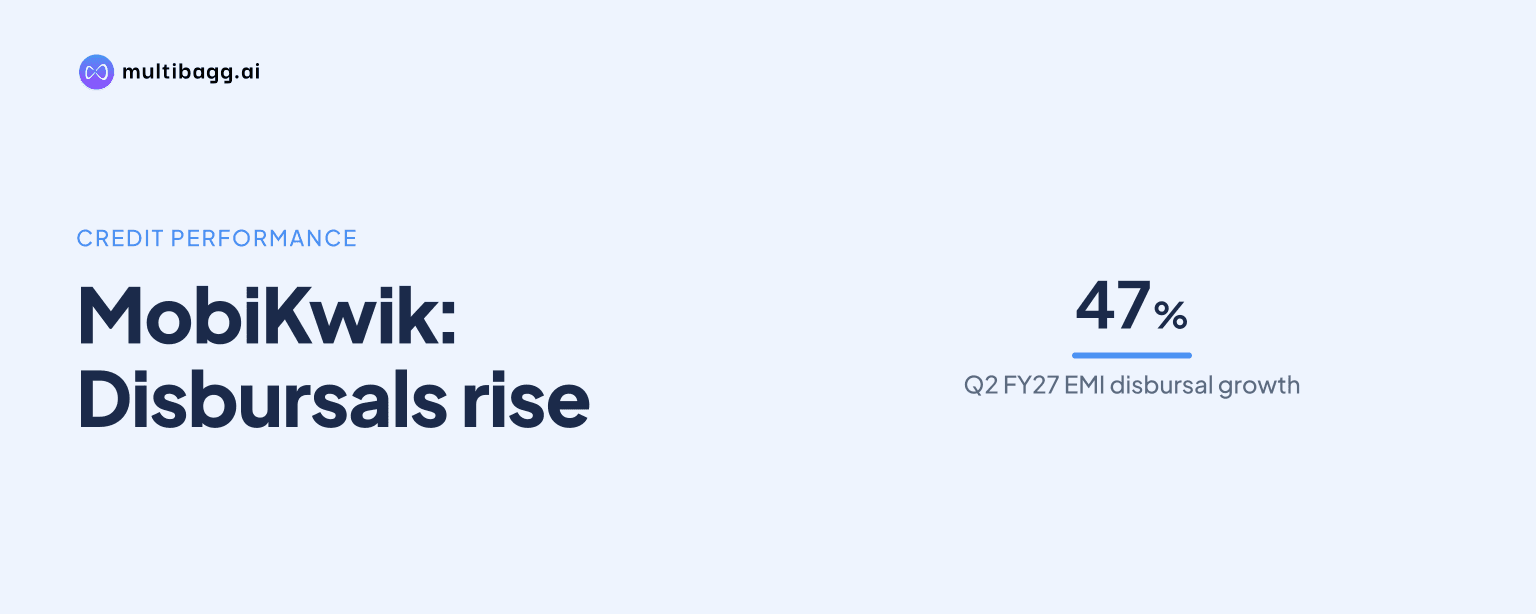
MobiKwik restored lending growth in Q2 FY27, as ZIP EMI disbursals rose 47% quarter on quarter to Rs 1,082.6 crore after a technology infrastructure migration affected Q1 FY27. The recovery accompanied a 59% repeat-borrower share and lending-related expense of 2.76% of digital credit gross merchandise value (GMV), down from 4.42% a year earlier.
Know One Mobikwik Systems inside out
Results, valuation, peers and who's buying, in one view.
How did MobiKwik's lending disbursals recover?
MobiKwik's lending disbursals recovered to Rs 1,082.6 crore in Q2 FY27, up 47% from Rs 736.7 crore in Q1 FY27 and 34% from Rs 807.1 crore in Q2 FY26. MobiKwik said the Q1 FY27 decline followed a technology infrastructure migration for disbursal transfer, and Q2 disbursals exceeded the Rs 1,000 crore quarterly level indicated in the prior quarter.
The number of major lending partners increased to 11 in Q2 FY27 from nine in Q1 FY27 and six in Q2 FY26. MobiKwik defines major partners as those with disbursals above Rs 5 crore per quarter. Top-three lender concentration fell to 71% in Q2 FY27 from 91% in Q2 FY26, although it was unchanged from Q1 FY27.
The First Loss Default Guarantee (FLDG) model accounted for 79% of Q2 FY27 disbursals, while the distribution model contributed 21%. In the FLDG model, MobiKwik shares risk with lender partners and manages origination, servicing and collections. The distribution model is partner-driven and is designed for larger-ticket, longer-tenure credit.
What is driving MobiKwik's repeat-borrower strategy?
MobiKwik is using pre-approved and pre-qualified offers to convert existing non-borrowing users into borrowers, generating about Rs 200 crore of Q2 FY27 disbursals through pre-approved offers. The company identified 96 million engaged users, comprising an immediate target pool of 33 million users with permanent account number (PAN) data and 63 million users without PAN data for a future track.
The process includes a monthly credit-bureau scrub that divides users into deciles based on risk and repayment behaviour. Users with PAN data follow a bureau-verified track, while users without PAN data are assessed through a deep-dive or surrogate-data track. Both routes feed marketing, top-of-funnel, offer-generation and disbursal stages.
Repeat users represented 59% of MobiKwik's borrower base, compared with 40% a year earlier, while new users represented 41%. The portfolio included 47% of borrowers aged 31 to 40 and 25% aged up to 30. MobiKwik reported that all borrowers had bureau scores of 700 or above, including 46% in the 700-749 range and 38% in the 750-774 range.
The borrower base was 51% salaried and 49% self-employed. By monthly income, 43% earned up to Rs 75,000, 25% earned Rs 75,000 to Rs 1.5 lakh, and 32% earned more than Rs 1.5 lakh. Management's stated focus areas include personalised offers for repeat lending, distribution partnerships for premium customer acquisition and collections-infrastructure investment.
Got a follow-up? Ask IRIS
How do MobiKwik's FLDG and distribution models differ?
MobiKwik operates two models with different loan sizes, tenures and approval structures. The FLDG model focuses on short-tenure, small-ticket loans in segments with a stated return on investment of 22% to 32%, while the distribution or marketplace model addresses larger-ticket, longer-tenure loans with a stated return on investment of 12% to 24%.
In the FLDG model, lending partners underwrite loans using filtration parameters co-created with MobiKwik's in-house scorecards for eligibility and loan sizing. MobiKwik reported overall approvals of about 3.5% to 4%. Distribution credit decisions are driven by lender policies, with tighter lender-side filtering resulting in reported approval rates of about 1% to 1.5%.
The displayed FLDG offers included loans of Rs 2 lakh, minimum interest of 22.9% per annum and maximum tenure of 15 months. Distribution offers reached Rs 15 lakh, with shown minimum rates ranging from 12% to 19% per annum and tenures of 36 to 48 months. These examples reflect the different ticket-size and tenure ranges of the two models.
MobiKwik said credit-risk performance improved by about 22% year on year as the portfolio tilted toward repeat and super-prime cohorts. Its disclosed plans include FLDG policy refinement for risk control and improved risk-based pricing for product-market fit. The presentation does not provide default or delinquency rates, or define the measurement behind the stated credit-risk improvement.
How did MobiKwik's financial-services margins change?
MobiKwik's financial-services revenue reached Rs 86.9 crore in Q2 FY27, up 18% quarter on quarter from Rs 73.3 crore and 42% year on year from Rs 61.3 crore. Gross profit increased 32% sequentially to Rs 57.08 crore and 123% year on year from Rs 25.61 crore, while gross margin reached 65.7%.
MobiKwik attributed the revenue increase to 34% year-on-year disbursal growth and a higher stated take rate of 8.03%, compared with 7.59% in Q2 FY26. Lending-related expense was Rs 29.83 crore in Q2 FY27, down from Rs 35.67 crore a year earlier and Rs 30.09 crore in Q1 FY27. MobiKwik linked the 16% year-on-year expense reduction to improving credit quality.
Net financial-services margin was 5.27% of digital credit GMV in Q2 FY27, compared with 3.17% in Q2 FY26 but below 5.87% in Q1 FY27. The current-book take rate declined sequentially to 6.92% from 8.09%, while past-book recoveries decreased to 1.10% from 1.87%. MobiKwik said higher disbursals enlarged the denominator, making take rates and lending-related expenses appear lower while revenue from fresh disbursals is expected over loan tenure.
Conclusion
MobiKwik's Q2 FY27 lending recovery combined higher disbursals, a larger lending-partner base and a portfolio in which repeat borrowers comprised 59%. The Rs 1,082.6 crore disbursal level supported 18% sequential financial-services revenue growth, while lending-related expense fell to 2.76% of digital credit GMV and gross margin reached 65.7%.
The next measure is whether pre-approved and pre-qualified campaigns can convert more of the 33 million PAN-available users and whether new partnerships and product categories sustain quarterly disbursals above Rs 1,000 crore. MobiKwik also plans FLDG policy refinement, risk-based pricing and collections investment, while detailed credit-risk and delinquency outcomes remain undisclosed in the presentation.