










Modi Naturals ethanol order book rises to ₹540 crore
Key highlights
- Modi Naturals disclosed a ₹140 crore ethanol allocation for 1.98 crore litres, with supplies due by October 2026.
- The additional allocation took Modi Naturals' stated ethanol order book to about ₹540 crore from about ₹400 crore.
- The existing ethanol contracts cover approximately 47,900 KL, according to the company’s disclosure.
- Modi Naturals earlier outlined a ₹100 crore expansion project to increase ethanol capacity from 130 KLPD to 310 KLPD.
powered by IRIS
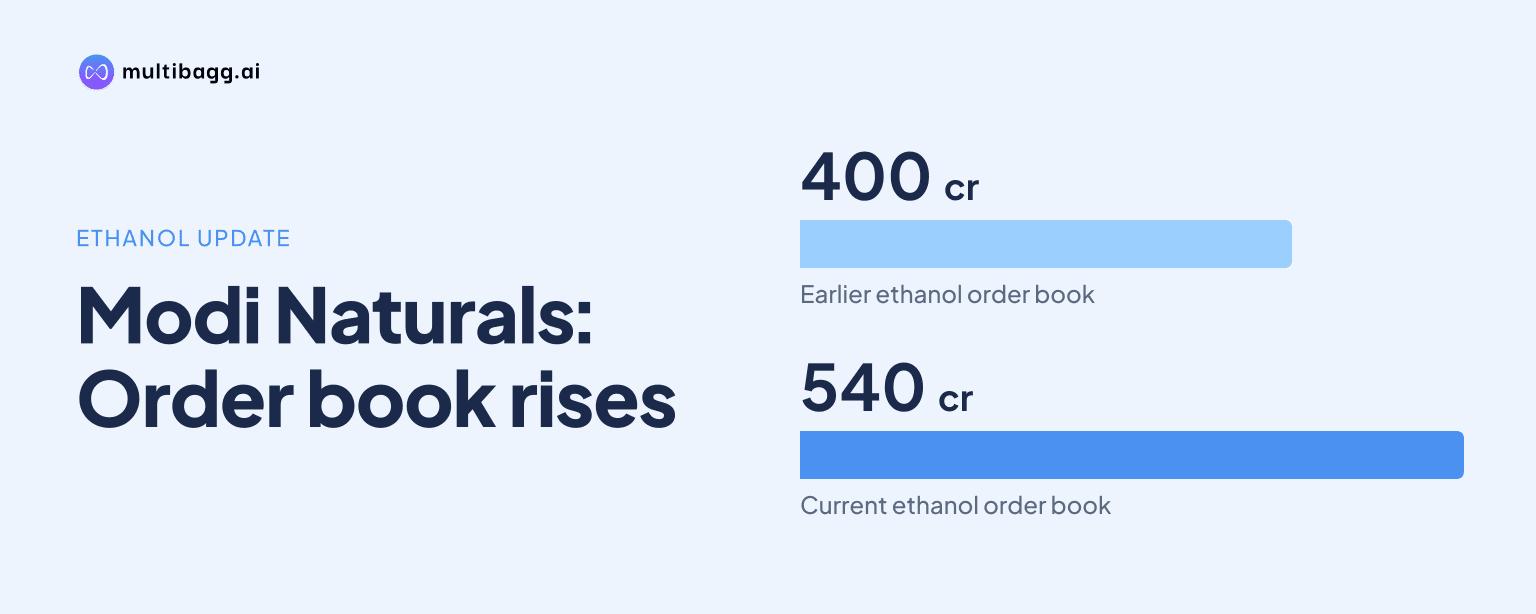
On August 17, 2026, Modi Naturals Limited said its wholly owned subsidiary, Modi Biotech Private Limited, received a ₹140 crore ethanol allocation, taking the group’s ethanol order book to about ₹540 crore for supplies under Ethanol Supply Year 2025-26 through October 2026.
Know Modi Naturals inside out
Results, valuation, peers and who's buying, in one view.
What is Modi Naturals' new ethanol order?
Modi Naturals said Modi Biotech Private Limited received an additional allocation to supply 1.98 crore litres of ethanol to various oil marketing companies, or OMCs. The allocation is estimated to be worth about ₹140 crore and is to be supplied by October 2026 under Ethanol Supply Year, or ESY, 2025-26.
The new allocation is in addition to an existing OMC order book of about ₹400 crore. The company said the earlier contracts covered approximately 47,900 kilolitres of ethanol. Together, these contracts take the stated ethanol order pipeline to about ₹540 crore, giving Modi Naturals visibility over a significant part of the current supply year.
The order matters because ethanol has become a larger operating focus for the company through Modi Biotech, its wholly owned subsidiary. The contracts are linked to supplies for the Ethanol Blended Petrol Programme, under which OMCs procure ethanol for blending with petrol.
How will Modi Naturals execute the additional ethanol supplies?
Modi Naturals said both its existing and expanded plants were expected to be fully operational by the end of August 2026, enabling it to execute the additional order book and ramp up capacity during the remaining ESY period. This timetable is central to the company’s ability to convert the order pipeline into sales.
Modi Biotech had operated a 130 KLPD grain-based ethanol distillery at Raipur in Chhattisgarh. The company had earlier announced an expansion project involving an investment of ₹100 crore and an additional 180 KLPD of capacity. Its earlier guidance indicated that the project would take total capacity to 310 KLPD once completed.
Some disclosures and reports cited in the available material refer to expanded capacity of 282 KLPD, while the company’s earlier expansion announcement referred to 310 KLPD after adding 180 KLPD to the 130 KLPD base. The company’s August 2026 statement focused on both existing and expanded plants becoming operational, rather than reconciling the capacity figures.
The expansion also includes a 5 MW captive power generation plant, according to the earlier project details. Captive generation can support a distillery’s operating requirements, although Modi Naturals has not provided financial guidance on the effect of the project on costs or profitability.
Why are OMC ethanol tenders important for Modi Naturals?
OMC tenders are important because they determine the contracted volumes that ethanol producers can supply under the national blending programme. Modi Naturals had said in its Q2 FY26 earnings call that it had secured 49,700 KL of ethanol orders along with by-product orders worth ₹400 crore in the October 2025 cycle 1 tender.
The company had also indicated that it expected further orders in subsequent tender cycles to use its expanded capacity. It said some orders for the expanded plant had already been secured for the first quarter, with additional business expected to be pursued through cycle 2 and cycle 3 tenders.
The wider demand backdrop has been supportive of ethanol procurement. Modi Naturals cited an 8% year-on-year increase in motor spirit consumption in its Q2 FY26 commentary. Higher fuel consumption can support the operational need for petrol blending, though actual procurement remains dependent on OMC tender volumes, allocation terms and supply conditions.
In August 2026, the Supreme Court issued an interim order allowing OMCs to procure an additional 149 crore litres of ethanol under the quarter IV tender for ESY 2025-26, according to the material provided. The order followed petitions led by Modi Biotech and expanded the procurement opportunity available to eligible suppliers.
Got a follow-up? Ask IRIS
What does the ₹540 crore order book mean for investors?
The ₹540 crore order book provides Modi Naturals with disclosed demand visibility for its ethanol operations, but it is not the same as reported revenue. Revenue recognition will depend on production, dispatches, fulfilment schedules and the completion of supplies by the stated deadlines.
The additional ₹140 crore allocation follows the approximately ₹400 crore order book already disclosed by the company. This indicates that Modi Biotech has continued to receive allocations from OMCs while it prepares to operate higher capacity. However, Modi Naturals has not disclosed the margins, earnings contribution or cash-flow impact of the additional allocation in the material provided.
For investors, the key operating issue is execution. A larger order book must be supported by stable plant operations, raw-material availability and timely deliveries. The company’s plan to have its existing and expanded facilities fully operational by the end of August 2026 is therefore a material milestone for monitoring fulfilment over the balance of ESY 2025-26.
The development may also keep Modi Naturals in market focus because the ethanol business is becoming more prominent relative to its legacy edible oils operations. Still, the available disclosures do not quantify the relative revenue mix, segment profit or any change in consolidated financial guidance.
How has Modi Naturals built its ethanol business?
Modi Naturals has expanded its ethanol business through Modi Biotech’s Raipur facility. Before the latest allocation, the subsidiary had received a ₹300 crore order to supply 41,600 KL of ethanol from OMCs, according to an October 2024 report. That order was described as being fulfilled in four phases.
The subsequent capacity project was designed to meet rising ethanol demand and was supported by a planned ₹100 crore investment. The company initially said construction had started and orders for equipment had been placed, with completion expected within eight to 10 months. The August 2026 update indicates that the company had moved into the operationalisation stage of this expansion.
The company’s ethanol strategy is tied to India’s Ethanol Blended Petrol Programme and OMC procurement cycles. These policies create a structured domestic market for ethanol producers, but allocations and realisations are set through tender processes rather than being assured solely by installed capacity.
Conclusion
Modi Naturals’ latest ₹140 crore allocation lifts its stated ethanol order book to about ₹540 crore and adds 1.98 crore litres of committed supply volume through October 2026. The order strengthens the visibility of Modi Biotech’s ethanol operations, while also placing execution of the expanded plant at the centre of the company’s near-term performance.
The next factors to watch are the full operational status of the existing and expanded facilities, dispatches against the OMC contracts, and further tender allocations during the remaining ESY 2025-26 cycles. Investors will also need future disclosures on ethanol revenue, margins and the final commissioned capacity to assess the financial effect of the expansion.