










Molbio retains FY27 growth guidance after contract delay
Key highlights
- Molbio said a one-month government rate-contract delay shifted about Rs 100 crore of revenue from the first half into the second half.
- Management retained FY27 guidance for 25% top-line growth and a 24% to 25% EBITDA margin.
- Molbio said its first half has historically represented 35% to 45% of full-year revenue.
- Molbio said government payment realisation averages about 60 to 75 days from invoice.
powered by IRIS
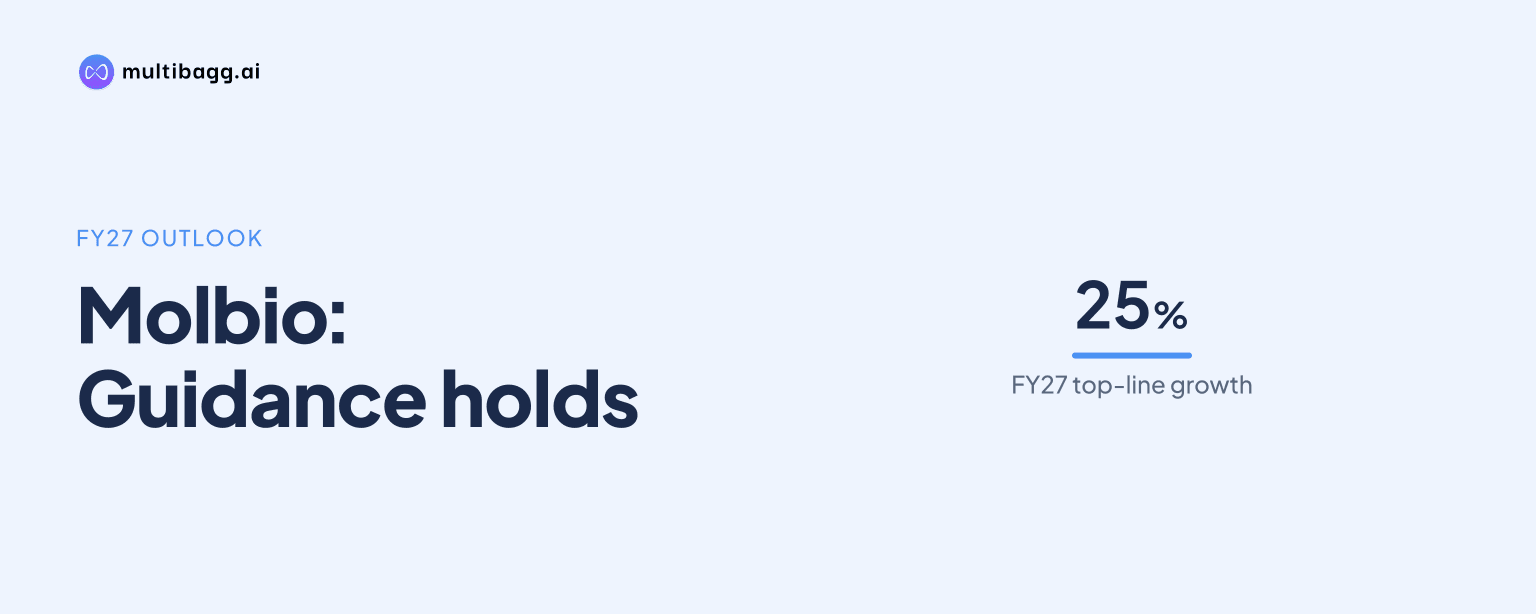
Molbio retained its FY27 target of 25% top-line growth after a one-month government rate-contract renewal delay shifted about Rs 100 crore of first-half revenue into the second half, management said. It also maintained guidance for a 24% to 25% EBITDA margin, saying kit prices under the renewed contract remain broadly similar to the previous financial year.
Know Molbio Diagnostics inside out
Results, valuation, peers and who's buying, in one view.
Why did Molbio's first-half revenue decline?
Molbio said the first-half decline reflected a one-month delay in renewing its government rate contract rather than a change in annual demand. Management said negotiations took longer than expected because the government process, including a required general-body meeting, was pushed forward by a month. That delayed the release of orders and the associated invoicing that otherwise would have fallen in the first half.
Management quantified the timing effect at about Rs 100 crore, describing it as revenue that would have been invoiced during the first half but is now expected to come into the second half. Molbio said it now has the rate contract, orders are in hand and shipments are under way. The company said the annual target for central-government procurement remains in place, although it cautioned that quarterly revenue is not expected to be linear.
The company contrasted the first half with its historical seasonality: management said the first half has typically represented 35% to 45% of full-year revenue. That range is central to its explanation that a weak first half does not necessarily alter the full-year outcome. Molbio also noted that the prior quarter had shown almost four times year-on-year change, which management had similarly said should not be extrapolated as a quarterly trend.
Did Molbio reduce government kit prices in the renewed contract?
No material reduction in government kit pricing was disclosed, according to management. Molbio said the renewed rate contract is similar to the level seen in the previous financial year and that there was no pressure to cut kit prices drastically. The management response addresses the possibility that the delayed contract renewal might have reflected lower pricing rather than only a procurement-timing issue.
Molbio added that average realizations in the second quarter were better than in the first quarter, although it attributed that comparison to product mix rather than setting out a specific realization figure. The distinction matters because a rate contract sets the agreed price framework, while the mix of products shipped during a period can still change the average revenue realized per sale.
The government’s rate-contract structure is designed to fix prices for 2 years after price negotiations. Molbio said that structure allows the government to release orders at regular intervals without conducting a full procurement exercise for each requirement. Management nevertheless said individual order releases still require a tender, quotation and internal approval process, creating potential timing variation even for a proprietary product.
What FY27 growth and margin guidance does Molbio retain?
Molbio continues to guide for 25% top-line growth from FY26 to FY27 and an EBITDA margin of about 24% to 25%. EBITDA means earnings before interest, tax, depreciation and amortisation. Management said it remains on track for these annual targets despite the one-month contract delay and the resulting shift of about Rs 100 crore into the second half.
Management framed that outlook as annual guidance rather than a commitment to even quarter-by-quarter progress. Its argument is based on the historical pattern in which the first half accounts for 35% to 45% of annual revenue, as well as the restoration of the government rate contract. The guidance therefore depends on conversion of the orders already in hand, rather than on recovering revenue through a disclosed price increase.
Molbio also described several potential contributors that it expects to progress in parallel rather than compete with one another. Truenat tuberculosis testing is expected to expand in India and overseas, while hepatitis products have begun contributing and human papillomavirus, or HPV, testing is expected to start soon. Management said new platforms, including Truepoc, Trueamp and Truecyte, would add to the human-diagnostics offering, but did not provide revenue forecasts for those products.
Got a follow-up? Ask IRIS
How do government orders move from contract to revenue at Molbio?
Molbio said the renewed rate contract permits the government to issue orders over a 2-year period, but it does not result in one order for the entire requirement. The company said the government releases orders in intervals after tendering and procedural approvals. Management said the installed base of close to 10,000 Truenat machines at primary centres supports ongoing procurement of tests used on that platform.
Once an order is placed, Molbio said it is normally given 2 months to supply kits, although it generally supplies within a few weeks. It then needs proof of delivery and acceptance at each site before submitting its bill. Management said payment occurs about 30 to 45 days after the required documents are filed, resulting in cash realisation roughly 60 to 75 days from invoice on average.
The company identified hepatitis B and C as a further government-procurement opportunity. Molbio said it has approval and is included in the national algorithm, while state procurement is occurring and a central-government procurement process had been initiated. Management expected an initial order once that process is finalised and said volumes could scale after initial supplies, using a mix of existing Truenat machines and new machines where required.
What could affect Molbio's second-half delivery of its guidance?
The main near-term factor is the pace at which the government releases, receives and accepts the orders now covered by the renewed rate contract. Molbio said orders are already being shipped, but its own description of the process includes site-level proof of delivery and acceptance before billing. That means the Rs 100 crore timing shift involves not only dispatches but also completion of the steps required for invoicing and payment.
A second factor is the central procurement process for hepatitis B and C tests. Management said the first-round order was being finalised and expected scaling after initial supplies, but it did not state an order value, delivery date or revenue contribution. Molbio’s FY27 guidance is therefore management’s annual target, supported by the renewed contract and expected procurement activity, rather than a disclosed backlog amount or a quarterly revenue forecast.
Conclusion
Molbio’s explanation for the weak first half is that a one-month administrative delay in renewing a government rate contract moved about Rs 100 crore into the second half, while the underlying annual procurement requirement remained unchanged. Management said contract pricing is broadly similar to the prior financial year, retained 25% top-line growth guidance and kept its 24% to 25% EBITDA-margin target.
The next evidence point is second-half conversion of the orders that Molbio says are in hand, including delivery, acceptance and invoicing under the renewed 2-year contract. Investors can also watch whether the central hepatitis B and C procurement produces the first round of orders that management expects, and whether the company’s 60-to-75-day average invoice-to-payment cycle remains consistent as shipments increase.