










Mphasis Limited AI-led pipeline reaches 71% by Q2FY27
Key highlights
- Mphasis reported that AI-led opportunities were 71% of pipeline in Q2FY27, versus 12% in Q2FY24.
- Mphasis reported Q2FY27 net TCV wins of US$46.6 crore, with 66% classified as AI-led.
- Mphasis reported trailing-12-month TCV of US$180 crore and five large deals in Q2FY27.
- Mphasis reported direct revenue growth of 3.5% quarter on quarter and 11.3% year on year in constant currency in Q2FY27.
powered by IRIS
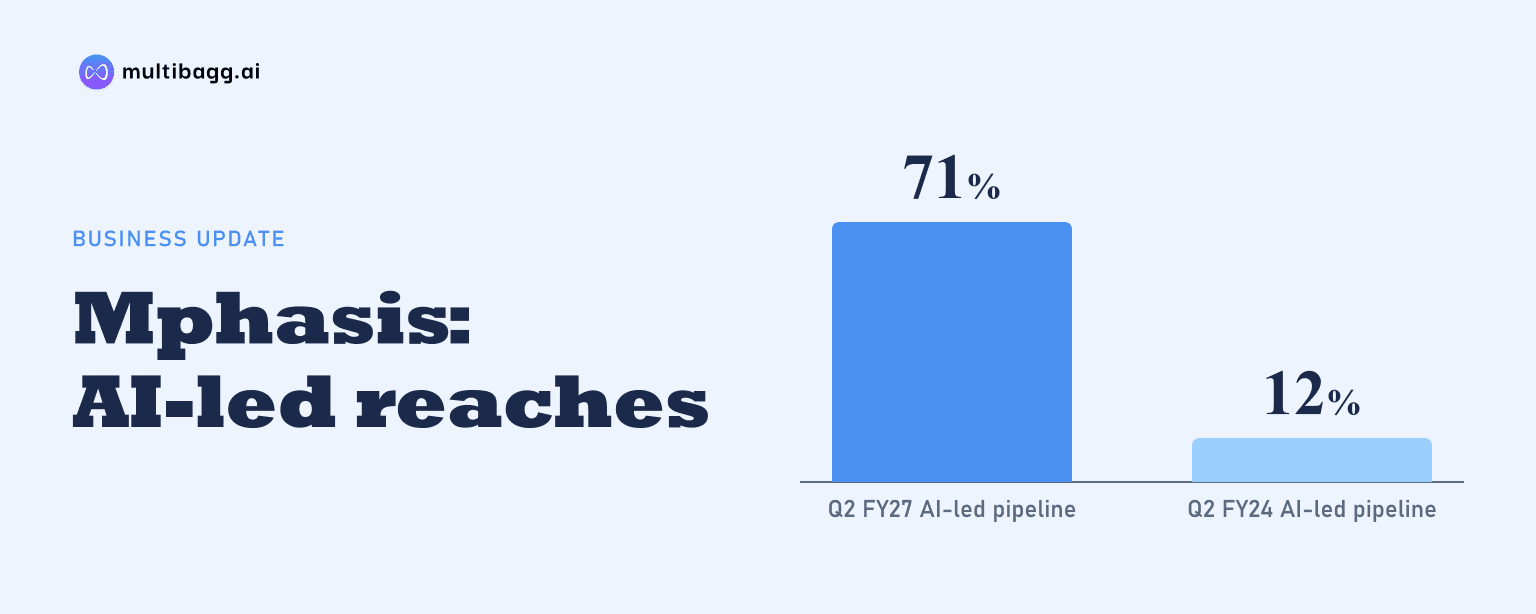
Mphasis Limited reported that AI-led opportunities accounted for 71% of its pipeline in Q2FY27, up from 12% in Q2FY24, while net total contract value, or TCV, wins were US$46.6 crore and 66% of those wins were AI-led. The figures show AI-led work becoming the company’s largest disclosed pipeline category.
Know Mphasis inside out
Results, valuation, peers and who's buying, in one view.
How quickly did Mphasis expand its AI-led pipeline?
Mphasis expanded the AI-led share of its pipeline by 59 percentage points, from 12% in Q2FY24 to 71% in Q2FY27, across 12 reported quarters. The increase accelerated through FY25: the share moved from 13% in Q3FY24 to 25% in Q4FY24, 35% in Q2FY25, 55% in Q3FY25 and 65% in Q4FY25.
Mphasis then reported a more gradual increase, reaching 68% in Q1FY26 and 69% in Q2FY26, Q3FY26 and Q4FY26. The AI-led proportion rose to 70% in Q1FY27 and 71% in Q2FY27, meaning it had remained above 65% for six consecutive quarters by the end of the reported period.
The presentation labels the total Q2FY27 pipeline as 3X, but does not provide its absolute value, comparison base or unit. The disclosure therefore establishes that the pipeline broadened and that 71% was classified as AI-led, but it does not quantify the value of the AI-led opportunity set. Pipeline represents prospective work, while TCV measures the stated value of contracts won.
Are Mphasis AI-led opportunities turning into contract wins?
Mphasis said 66% of net TCV wins in Q2FY27 were AI-led, linking its pipeline classification to signed business. Quarterly net TCV was US$46.6 crore in Q2FY27, compared with US$46.1 crore in Q1FY27, US$40.7 crore in Q4FY26, US$42.8 crore in Q3FY26 and US$52.8 crore in Q2FY26.
The Q2FY27 TCV figure was US$0.5 crore higher than Q1FY27 but US$6.2 crore below Q2FY26. Mphasis reported trailing-12-month TCV of US$180 crore and said it won five large deals during Q2FY27. The presentation does not identify the clients, deal values, industry verticals or contract durations for those five deals.
Mphasis also said TCV from contracts below US$2 crore increased 26% on a trailing-12-month basis, which it attributed to shorter-cycle deals continuing to play out. In the disclosed deal-size mix, contracts of US$2 crore or more represented 18% in Q2FY27, down from 23% in Q2FY26, while the below-US$2-crore category was shown at 35% in Q2FY27. The displayed categories do not form a complete deal-size distribution.
Management said backlog built over previous quarters supports in-quarter and near-term revenue conversion. This is management’s forward-looking view rather than a revenue forecast, and the presentation cautions that results can differ because of factors including demand conditions, foreign-exchange movements, competition, talent availability and project-delivery risks.
Got a follow-up? Ask IRIS
What does Mphasis include in its AI-led strategy?
Mphasis positions Mphasis Tria as an enterprise decision loop that connects enterprise context, prediction, optimisation and execution, with humans governing exceptions. In its November 2026 presentation, Mphasis said the intended use is to move beyond AI adoption to governed decision-making designed to produce measurable economic outcomes.
Mphasis said its strategy addresses decisions affecting revenue, margin, productivity and risk, rather than only operational delivery. The company identified enterprise context, causal decision intelligence, orchestration and governance as its stated differentiators, instead of interchangeable AI models. These statements describe management’s positioning and do not quantify financial returns from Mphasis Tria.
The company listed an AI business unit, a generative AI foundry with Amazon Web Services, NeoCruX, Mphasis NeoZeta, Mphasis NeoIP and Mphasis Tria as milestones alongside the pipeline increase from 12% in Q2FY24 to 71% in Q2FY27. It also formed a large-deal team focused on complex AI-led opportunities. The source does not give individual launch dates, revenue, pipeline or booking figures for these initiatives.
Mphasis cited a September 2026 industry report in framing an “agency gap” between AI adoption and outcomes. However, the 71% measure is Mphasis’s classification of its own pipeline; the presentation does not state that every AI-led opportunity uses Mphasis Tria, Mphasis NeoIP or a specific cloud partner.
Where did Mphasis report revenue growth in Q2FY27?
Mphasis reported direct revenue of US$48.6 crore in Q2FY27, compared with US$47.1 crore in Q1FY27 and US$44.5 crore in Q2FY26. It reported direct revenue growth of 3.5% quarter on quarter and 11.3% year on year in constant currency, and attributed growth in applications and business-process outsourcing to AI-led modernisation deals and new wins.
Applications, or APPS, generated US$36.8 crore in Q2FY27, up from US$35.6 crore in Q1FY27 and US$32.7 crore in Q2FY26. Business-process outsourcing, or BPO, contributed US$7.9 crore, versus US$7.4 crore and US$6.6 crore, respectively. Information-technology outsourcing, or ITO, declined to US$3.9 crore from US$4.1 crore sequentially and US$5.2 crore a year earlier.
The Americas produced US$41.3 crore of Q2FY27 revenue, up from US$40.2 crore in Q1FY27 and US$37.2 crore in Q2FY26. Europe, the Middle East and Africa, or EMEA, contributed US$3.7 crore, down from US$3.8 crore sequentially and US$4.1 crore a year earlier, while Rest of World rose to US$3.6 crore from US$3.1 crore and US$3.2 crore.
In verticals, banking and financial services generated US$25.9 crore and grew 4.5% sequentially and 15.0% year on year in constant currency. Technology, media and telecommunications produced US$9.4 crore and grew 10.9% sequentially, while insurance generated US$7.1 crore and grew 14.7% year on year. Logistics and transportation declined 12.0% sequentially to US$1.8 crore, showing that growth was not uniform across verticals.
Conclusion
Mphasis has disclosed a substantial shift in the composition of its sales funnel, with AI-led opportunities rising from 12% in Q2FY24 to 71% in Q2FY27. The company also reported that AI-led work represented 66% of Q2FY27 wins, while APPS and BPO revenue increased and ITO revenue declined. Together, the disclosures connect the AI strategy to both signed TCV and reported segment trends, without quantifying AI revenue separately.
The next disclosures to watch are whether Mphasis sustains the 66% AI-led share of wins, converts the backlog management says supports near-term revenue, and provides a value or base period for its 3X pipeline label. Its stated plan to pursue complex AI-led deals through its large-deal team, alongside shorter-cycle contracts and Mphasis Tria-led modernisation, makes future deal mix and segment revenue data relevant.