








My Mudra deploys 6,500-plus agents in asset-light distribution
MAX Plan at ₹4,999/yr

Find your next multibaggerBe a Pro Investor
Research stocks and track your picks on the go. Download the app.
Key highlights
- My Mudra reports 6,500-plus digital referral agents and 165-plus branches across India.
- My Mudra reports 70-plus banking and NBFC partners and 20-plus insurance partners.
- My Mudra earns commission-based revenue from distribution while lending partners retain credit-underwriting responsibility.
- My Mudra expanded into insurance and mutual-fund distribution in FY26 through IRDAI and AMFI registrations.
powered by IRIS
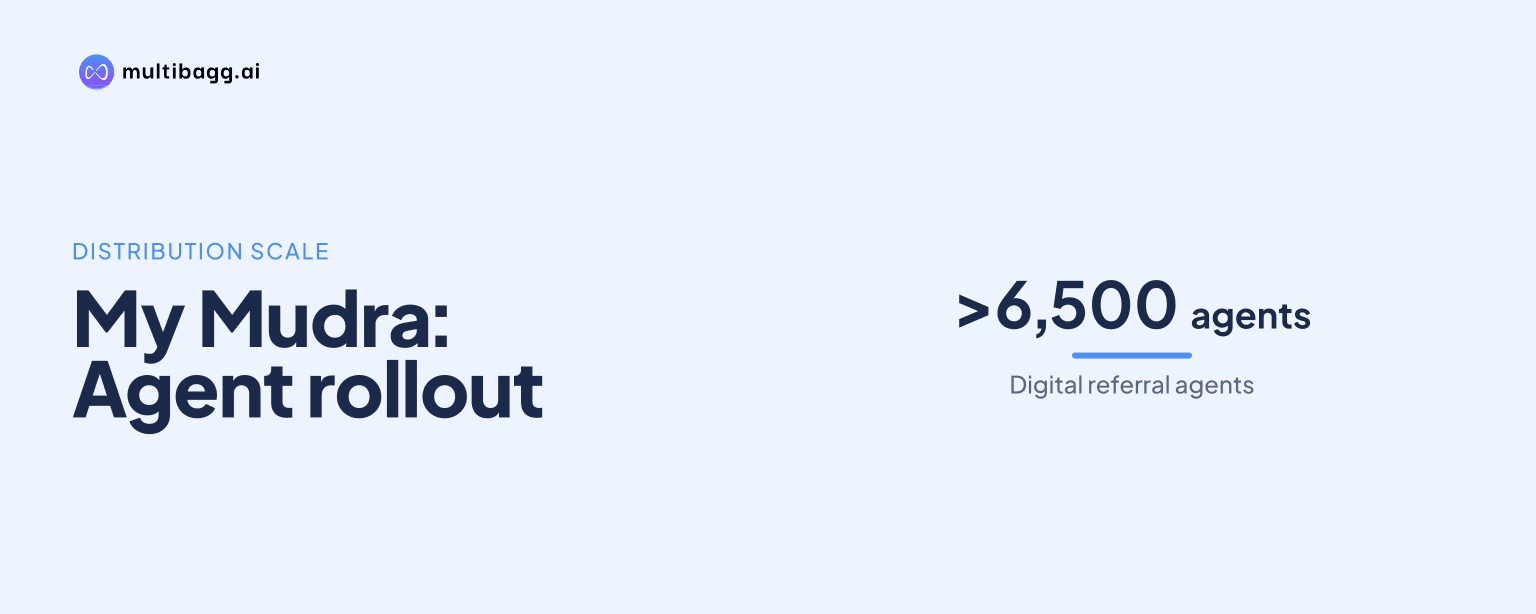
My Mudra Fincorp Limited operates an asset-light distribution model through 6,500-plus digital referral agents, 165-plus branches and 70-plus banking and non-banking financial institution partners across India. My Mudra earns commissions for distributing financial products, while partner lenders retain responsibility for credit underwriting.
Know My Mudra Fincorp inside out
Results, valuation, peers and who's buying, in one view.
How does My Mudra’s asset-light model work?
My Mudra acquires customers, matches them with products, supports documentation and assists applications before banks, non-banking financial companies (NBFCs), insurers or investment partners provide the relevant product. The stated revenue mechanism is commission-based distribution after a successful financial-product placement, rather than direct lending or lender credit underwriting by My Mudra.
The presentation sets out four operating stages: individuals, professionals and businesses enter through customer-acquisition channels; the My Mudra platform handles product matching, documentation and application support; partner financial institutions provide the product; and My Mudra receives commission-based revenue. Its portfolio includes secured and unsecured loans, insurance, mutual funds and digital lending solutions.
This structure separates distribution from the credit decision. My Mudra’s role covers the customer journey and application process for products including personal loans, business loans, home loans and loan against property, while lending partners undertake underwriting. The presentation does not disclose commission rates, loan disbursal volumes or revenue by product line.
How large is My Mudra’s distribution network?
My Mudra reports a pan-India network of 165-plus branches, 6,500-plus digital referral agents and 70-plus banking and NBFC partners. The agent base is more than 39 times the stated branch count using the minimum reported figures, making digital referral agents the larger of the two disclosed customer-access channels.
Branches and relationship managers provide personalised support, local-market presence and financial guidance, according to the presentation. Digital channels provide onboarding, streamlined documentation, real-time application tracking and integrated banking partnerships. My Mudra describes the combined physical and digital approach as phygital.
The 165-plus branch and 6,500-plus referral-agent figures appear both in the company overview and the pan-India footprint section. However, the presentation gives no geographic split, number of active agents, branch productivity, application conversion rate or applications processed through each channel.
Which financial products does My Mudra distribute?
My Mudra distributes loan products, insurance, mutual funds and digital financial services through its partner network. The loan range includes personal, business, professional and home loans, loan against property, bill discounting and working-capital loans.
A separate business overview lists business loans, personal loans, home loans, loan against property and micro, small and medium enterprise loans. The wider services list adds bill discounting and working-capital loans, while the company overview includes mutual funds and investment products, insurance distribution and digital lending solutions.
Insurance and mutual funds broaden the model beyond credit distribution. In financial year 2026 (FY26), My Mudra says it expanded into insurance and mutual-fund distribution through registrations with the Insurance Regulatory and Development Authority of India (IRDAI) and the Association of Mutual Funds in India (AMFI). It also reports 20-plus insurance partners, compared with its 2013 establishment as a platform connecting customers with lenders.
The presentation identifies My Mudra as ISO 9001:2015 and ISO 27001:2022 certified, alongside its IRDA licence and AMFI certification. It does not disclose product-wise customer numbers, insurance premium volumes, mutual-fund assets or the share of revenue produced by loans, insurance or investments.
Got a follow-up? Ask IRIS
How do branches and digital channels work together?
My Mudra combines branches and relationship managers with referral agents and digital processing to support market expansion, customer acquisition and operational efficiency. The company says this phygital arrangement enables scalable growth through an asset-light distribution network.
The My Mudra One mobile application offers a simplified digital application process for personal, business, professional and home loans. It also provides access to health and term insurance, mutual-fund investments and systematic investment plans (SIPs), alongside credit-score monitoring, equated monthly instalment (EMI) calculators and investment-planning tools.
Version 1.3.5 of My Mudra One added a mutual-funds portal and user-interface improvements. The presentation also lists real-time loan tracking, seamless digital onboarding and artificial-intelligence-powered assistance as app features, while retaining branches and relationship managers for physical support.
The company’s timeline links the two channels to separate development stages. My Mudra expanded lender partnerships during 2015 to 2018, scaled its branch and referral network during 2019 to 2021, and enhanced technology and onboarding during 2022 to 2023. FY26 included the My Mudra One launch and HDFC Bank digital integration.
Who are My Mudra’s financial-institution partners?
My Mudra identifies 70-plus banking and NBFC partners and 20-plus insurance partners, with banks, NBFCs, insurers and investment partners supplying the products it distributes. The stated partner mix gives the company access to lending, insurance and investment categories without directly underwriting loans.
Named NBFC relationships include Shriram Finance, Bajaj Finserv, Piramal Capital, SMFG India Credit, Muthoot Finance, U GRO Capital and L&T Finance. Named bank and housing-finance relationships include ICICI Bank, HDFC Bank, Kotak Mahindra Bank, Yes Bank, Punjab National Bank, Axis Bank, RBL Bank, Standard Chartered, Karur Vysya Bank, ICICI Home Finance and PNB Housing Finance.
The insurance list includes Care Health Insurance, HDFC ERGO, HDFC Life, ICICI Lombard, Max Life Insurance, SBI General and Zurich General. These named organisations span general, health and life insurance, while the presentation does not specify the volume, tenure or exclusivity of any individual partnership.
My Mudra’s strategic roadmap calls for broader collaborations with banks, NBFCs, insurers and investment partners. Management also lists deeper presence in existing markets, expansion into new geographies, product diversification and technology enhancement, but provides no numerical targets for branches, agents or partner additions.
Conclusion
My Mudra’s business model combines physical access, a substantially larger digital referral network and product relationships across lending, insurance and investments. Its commission-based structure places customer acquisition, product matching and application support with My Mudra, while partner institutions provide products and lenders retain credit-underwriting responsibility.
The next disclosed milestones are management’s plans to deepen existing-market coverage, enter new geographies, broaden partner collaborations, diversify products and strengthen technology. The presentation sets no branch, referral-agent, partnership, disbursal or revenue targets, so subsequent disclosures will be needed to assess execution against that roadmap.

