










Narendra Properties FY26 PAT rises 114% to ₹1.97 crore
Key highlights
- Narendra Properties' FY26 profit after tax rose 113.7% to ₹1.97 crore from ₹0.92 crore.
- Narendra Properties' FY26 total income increased 9.6% to ₹9.89 crore from ₹9.02 crore.
- Revenue from sales declined 13% to ₹6.38 crore in FY26, while higher other income supported profit.
- The board recommended a final dividend of ₹1 per equity share for FY26, subject to shareholder approval.
powered by IRIS
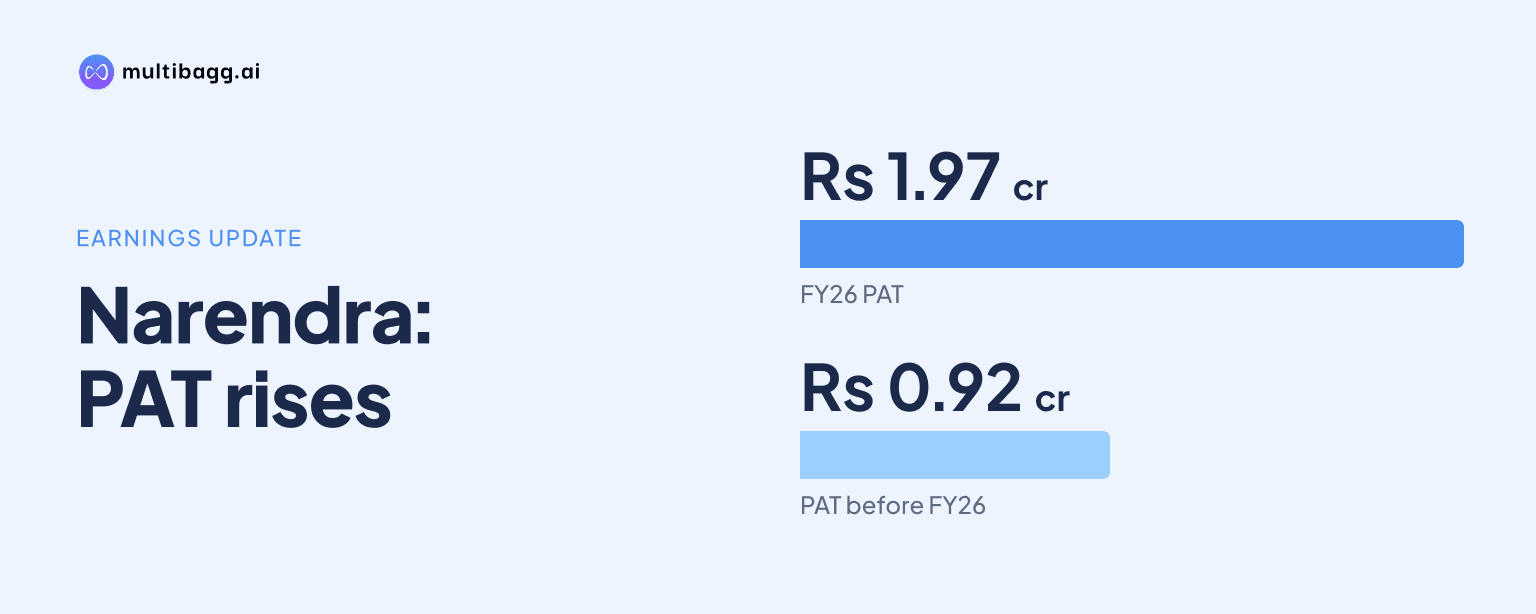
Narendra Properties Limited reported profit after tax of ₹1.97 crore for FY26, up 114% from ₹0.92 crore a year earlier, although revenue from sales declined 13% to ₹6.38 crore. The Chennai-based real estate developer’s total income rose 10% to ₹9.89 crore, with the profit increase primarily linked to higher other income.
Know Narendra Properties inside out
Results, valuation, peers and who's buying, in one view.
What did Narendra Properties report for FY26?
Narendra Properties reported a sharp year-on-year increase in profitability for the financial year ended March 31, 2026. Profit after tax increased to ₹1.97 crore from ₹0.92 crore in FY25, representing growth of 113.7% year-on-year.
Total income rose to ₹9.89 crore from ₹9.02 crore in the preceding financial year. The increase in total income came despite a decline in operating revenue from sales, which fell to ₹6.38 crore. The available financial summary attributes the rise in profit primarily to a surge in other income rather than growth in sales revenue.
The distinction is relevant because total income and revenue from operations moved in different directions during FY26. While the company reported higher overall income and a substantially higher profit, its sales-based operating income was lower than in the previous year.
Why did Narendra Properties' profit increase despite lower sales revenue?
Narendra Properties' FY26 profit increased primarily because of higher other income, according to the financial information provided. This meant that the improvement in the bottom line was not driven by a rise in property sales revenue.
Revenue from operations declined 13% to ₹6.38 crore during the year. In a real estate business, movements in sales revenue can reflect the timing of project execution, property transactions, customer collections, or recognition of income. The filing summary does not provide a detailed breakup of the other income that supported FY26 profitability.
The pattern was also visible in the first quarter of FY27. Narendra Properties reported net profit of ₹0.88 crore for the quarter, compared with ₹0.77 crore in the corresponding quarter of the previous year. The company had zero revenue from operations in that quarter and reported other income of ₹1.24 crore.
What dividend has Narendra Properties proposed for FY26?
Narendra Properties' board recommended a final dividend of ₹1 per equity share of face value ₹10 each for FY26. The proposed payout represents 10% of the fully paid-up face value of each equity share.
The dividend required shareholder approval at the company’s 31st annual general meeting, which was scheduled for September 29, 2026. The meeting was to be held through video conferencing at 9:00 am, and shareholders were to have access to remote e-voting through Central Depository Services (India) Limited.
Based on the stated share price of ₹38.90, the proposed ₹1 dividend equated to an indicated yield of about 2.57%. That calculation is price-dependent and is not a guaranteed return, as market prices can change and the dividend remains subject to the required approval process.
Got a follow-up? Ask IRIS
What other board actions did Narendra Properties take?
Narendra Properties' board approved consultancy fees involving promoters and directors and approved related-party transactions connected with such arrangements. It also reappointed Ms. Kavita Patel as an independent director for a five-year term.
The statutory auditors, M/s Sanjiv Shah & Associates LLP, issued an unmodified report on the FY26 financial statements. An unmodified audit opinion indicates that the auditors did not modify their opinion on the financial statements presented for the year.
Separately, the board considered a proposal to increase the company’s limit for investments, loans and guarantees to ₹50 crore. The reported proposal was substantially larger than the stated market capitalisation of about ₹28 crore, making the approval process and subsequent disclosures relevant for shareholders assessing capital allocation decisions.
How do the results affect Narendra Properties investors?
Narendra Properties' FY26 figures show a clear improvement in reported profit and total income, alongside a decline in revenue from sales. For investors, the source of the earnings improvement is therefore important, since other income rather than operating sales was identified as the principal driver of the profit increase.
The proposed dividend gives shareholders a potential cash distribution of ₹1 per share, subject to approval. The unmodified audit report also provides assurance that the FY26 statements were audited without a modified opinion, while the proposed ₹50 crore limit for investments, loans and guarantees places greater attention on future board decisions and disclosures.
The company had announced a board meeting on November 5, 2026, to consider unaudited financial results for the quarter ended September 30, 2026. Those results are relevant because the Q1 FY27 update showed profit supported entirely by other income despite no revenue from operations.
Conclusion
Narendra Properties delivered a 114% increase in FY26 profit after tax to ₹1.97 crore and lifted total income to ₹9.89 crore. However, sales revenue declined 13% to ₹6.38 crore, indicating that higher other income, rather than stronger operating revenue, was the main factor behind the reported earnings growth.
Investors should watch the unaudited results for the quarter ended September 30, 2026, which the board was scheduled to approve on November 5, 2026. Updates on operating revenue, the proposed ₹50 crore investment, loan and guarantee limit, and implementation of the approved related-party arrangements will remain material disclosures.