








Nexus Select Trust targets Rs 3,800 crore FY30E NOI with acquisitions

Find your next multibaggerBe a Pro Investor
Research stocks and track your picks on the go. Download the app.
Key highlights
- Nexus targets FY30E NOI of Rs 3,800 crore, compared with a management-estimated Rs 1,930 crore in FY26.
- Acquisitions are expected to contribute Rs 1,125 crore, or 60.2%, of the planned Rs 1,870 crore NOI increase.
- Organic growth is targeted to add Rs 745 crore, supported by about 50% of gross rentals expiring by FY30.
- Nexus targets 35 malls by 2030 and has six pipeline assets spanning about 4 million square feet.
powered by IRIS
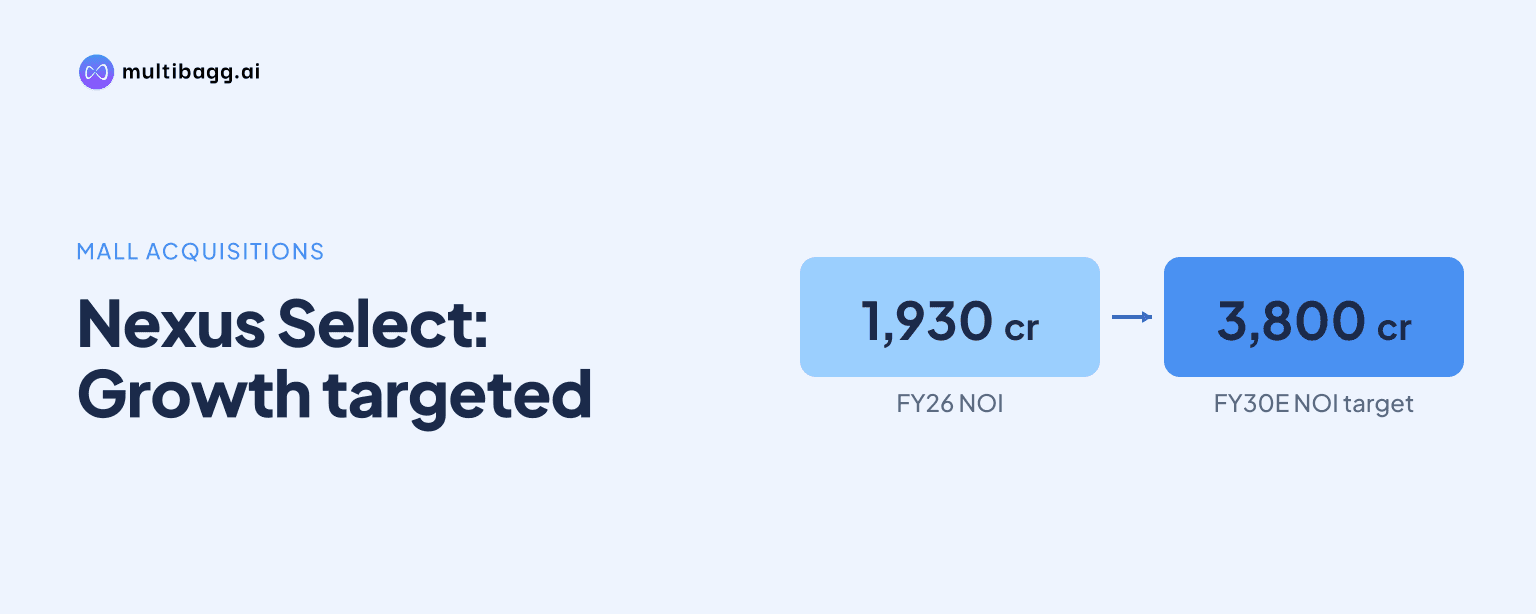
Nexus Select Trust is targeting portfolio net operating income (NOI) of Rs 3,800 crore in FY30E, up from a management-estimated Rs 1,930 crore in FY26, with Rs 1,125 crore of the planned increase expected from acquisitions. The target implies an Rs 1,870 crore increase over FY26 and is a management estimate rather than a reported outcome.
Know Nexus Select Trust inside out
Results, valuation, peers and who's buying, in one view.
How does Nexus plan to reach Rs 3,800 crore NOI by FY30?
Nexus plans to reach Rs 3,800 crore of NOI in FY30E through Rs 745 crore of incremental organic NOI and Rs 1,125 crore from future acquisitions. The management bridge starts with FY26 NOI of Rs 1,930 crore and adds the two planned growth components, resulting in an FY30E figure presented as 2X the FY26 base.
Nexus describes the plan as a balanced mix of organic growth and strategic acquisitions, although acquisitions provide the larger numerical contribution. Of the Rs 1,870 crore increase between FY26 and FY30E, acquisitions account for 60.2% and organic growth accounts for 39.8%, calculated from management’s stated bridge. Organic growth relates to the existing portfolio, while part of the acquisition contribution depends on transactions not yet announced.
What share of Nexus’s FY30 NOI growth depends on acquisitions?
Nexus expects acquisitions to supply Rs 1,125 crore of the Rs 1,870 crore targeted NOI increase by FY30E. This is Rs 380 crore more than the Rs 745 crore expected from organic levers, making acquired assets the largest single source of the planned growth from the Rs 1,930 crore FY26 base.
The Rs 1,125 crore figure includes stabilised NOI from three announced acquisitions, Diamond Plaza, Nexus Runwal Gardens Mall and Galaxy Complex, as well as potential NOI from future acquisitions through 2030 that have not been announced. Nexus does not disclose how much of the Rs 1,125 crore is attached to the three named assets and how much depends on unidentified transactions. The presentation therefore gives an aggregate acquisition objective but not the NOI contribution already associated with individual deals.
Nexus states in its disclaimer that there can be no assurance it will enter definitive arrangements for pipeline acquisition deals. It also says the FY30E NOI estimate is based on management information, assumptions and estimates, and is not audited or reviewed under IndAS or other generally accepted accounting principles. The Rs 3,800 crore endpoint is consequently management’s plan rather than a reported financial result.
Got a follow-up? Ask IRIS
Which organic levers support Nexus’s Rs 745 crore NOI plan?
Nexus expects Rs 745 crore of incremental organic NOI by FY30E from contracted growth, mark-to-market potential, turnover-linked upside, ancillary income and margin expansion. Contracted growth is described as embedded in every contract, while margin expansion is planned through cost optimisation, combining rental and cost mechanisms in the organic target.
A principal repricing mechanism is the expiry of about 50% of gross rentals by FY30, which Nexus identifies as mark-to-market potential. The presentation does not provide current rents, expected renewal rents or a separate NOI contribution from lease expiries. It therefore establishes the proportion of gross rentals becoming eligible for repricing, but not the rental uplift assumed within the Rs 745 crore organic estimate.
Turnover-linked leases are another stated mechanism, with management saying more than 88% of leases are turnover-linked. These arrangements can link rental receipts to tenant sales, distinguishing this lever from contracted escalations and lease renewals. Nexus also lists ancillary income from space on hire, ticketed experiences and kiosks, but does not allocate the FY30E organic NOI target among those sources or cost optimisation.
How does Nexus intend to expand its mall portfolio by 2030?
Nexus is targeting 35 malls by 2030, compared with 22 malls across 17 cities in its current platform. The stated expansion represents a net increase of 13 malls from the current count, although the presentation does not provide a year-by-year acquisition schedule or completion timetable for individual assets.
The acquisition pipeline contains six assets spanning about 4 million square feet. Nexus says it intends to deepen its presence across 15 existing markets and selectively enter 10 target markets: Patna, Kolkata, Guwahati, Siliguri, Jaipur, Nagpur, Ranchi, Raipur, Jamshedpur and Bhopal. The presentation does not specify which of the six pipeline assets belong to each city or whether every pipeline asset will count toward the 35-mall target.
Nexus also identifies forward purchases for supply-constrained markets and retail podiums in office or residential catchments as possible deal structures and adjacencies. These routes broaden the assets that could support the Rs 1,125 crore acquisition NOI goal, while introducing execution variables around future transactions. Management does not disclose acquisition prices, funding terms or expected stabilisation dates for the six pipeline assets.
Conclusion
Nexus’s FY30E plan combines a Rs 745 crore organic NOI increase with a larger Rs 1,125 crore acquisition contribution to move from Rs 1,930 crore in FY26 to Rs 3,800 crore. The existing portfolio has identified mechanisms, including about 50% of gross rentals expiring by FY30 and more than 88% of leases being turnover-linked, but the larger planned contribution requires acquisitions and asset stabilisation.
The next disclosed items to watch are progress toward 35 malls by 2030, development of the six-asset pipeline covering about 4 million square feet, and any disclosure separating stabilised NOI from the three announced acquisitions from potential NOI linked to unannounced deals. Those details would show how much of the Rs 1,125 crore acquisition target is connected to named assets and how much remains dependent on future transactions.

