










Nimbus targets ₹750 crore profit from six planned launches
Key highlights
- Nimbus estimates ₹750 crore of profit from six proposed launches over FY 2027-28 to FY 2029-30.
- The six-launch plan assumes ₹150 crore of initial investment and ₹2,700 crore of project revenue.
- The proposed 24-acre Govardhan project indicates ₹131 crore of profit on ₹35 crore of initial investment.
- Nimbus reported net debt of ₹267.4 crore in September 2026, versus ₹172.4 crore in March 2025.
powered by IRIS
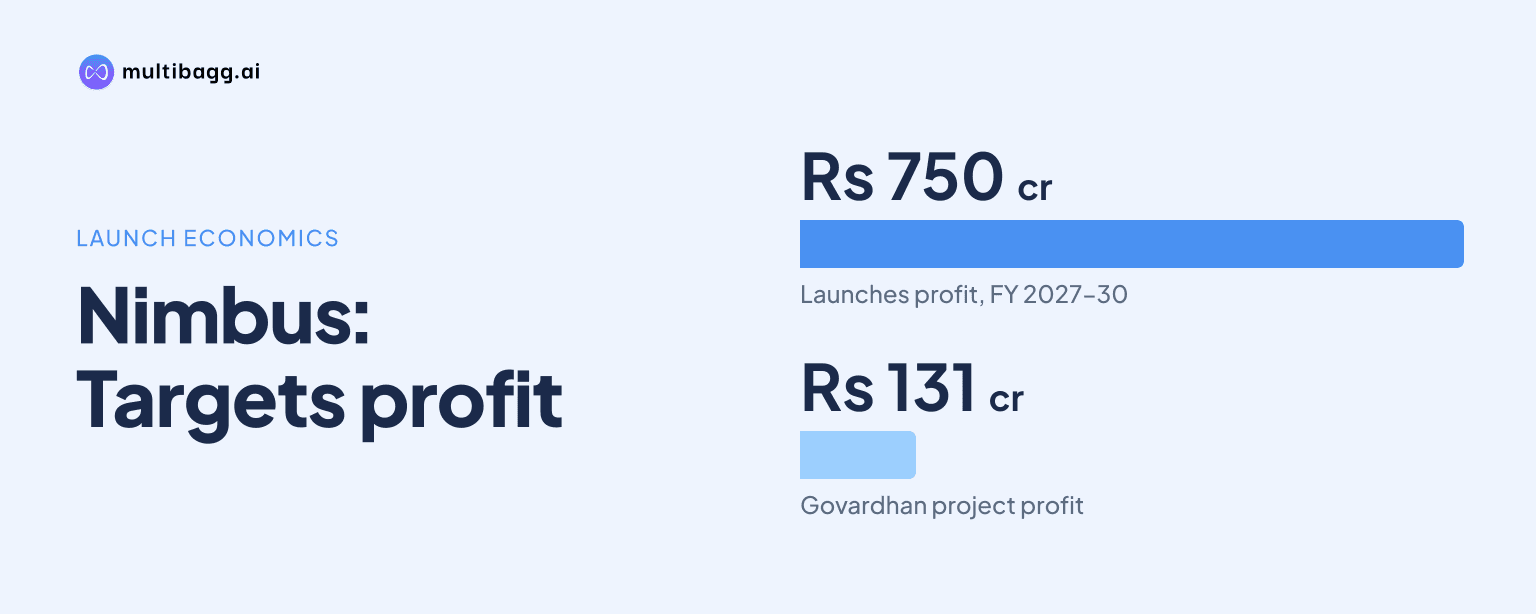
Nimbus plans six joint-development township launches over three years and estimates they could produce ₹750 crore of profit from ₹150 crore of initial investment. The plan calls for two launches a year from FY 2027-28, with projects of about 25 acres each, although Nimbus says all opportunities remain under evaluation and uncommitted.
Know Nimbus Projects inside out
Results, valuation, peers and who's buying, in one view.
What exactly is Nimbus planning over three years?
Nimbus is planning six plotted-township and joint-development projects, with two launches in each of FY 2027-28, FY 2028-29 and FY 2029-30. The company estimates each project at about 25 acres and expects delivery in about 24 months. Its identified new regions are Mathura and Vrindavan, Uttarakhand, and tier-2 cities including Meerut.
The proposed model uses a landowner revenue share rather than a full upfront land purchase. For the six-project estimates, Nimbus treats the landowners' approximately 50% share as a cost. The presentation projects about ₹450 crore of revenue, ₹225 crore of landowners' share, ₹75 crore of development cost and ₹25 crore of initial investment per project, leaving about ₹125 crore of Nimbus profit.
The proposed launch schedule would create projected revenue of ₹2,700 crore across the six projects. Nimbus estimates ₹1,350 crore for landowners' shares, ₹450 crore for development costs and ₹150 crore of initial investment, resulting in ₹750 crore of aggregate profit. These figures are estimates rather than booked sales or committed developments.
How does the proposed Govardhan project work?
Nimbus's identified near-term opportunity is a proposed integrated township in Govardhan, Mathura, on a site of about 24 acres. Land aggregation is under way, and the presentation places the site about 1.5 hours from Noida International Airport. The proposed revenue-sharing arrangement gives Nimbus 54% and landowners 46% of project revenue.
Under the illustrative Govardhan economics, Nimbus projects ₹450 crore of project revenue and a ₹243 crore share for itself under the 54:46 split. It estimates ₹77 crore of development cost and ₹35 crore of initial investment, producing ₹131 crore of Nimbus profit. This equals an indicated margin of about 54% on Nimbus's revenue share and a 3.7-times return on its ₹35 crore initial investment.
The Govardhan illustration differs from the average economics used for the six-launch plan. The road-ahead model assumes ₹25 crore of initial investment and ₹125 crore of profit per project, while Govardhan assumes ₹35 crore and ₹131 crore, respectively. Nimbus describes Govardhan as proposed and says land aggregation is still in progress.
What economics does Nimbus project for the six launches?
Nimbus projects ₹250 crore of profit in each of the three launch years, taking projected profit to ₹750 crore from FY 2027-28 through FY 2029-30. Each year includes two proposed launches, ₹900 crore of aggregate project revenue and ₹50 crore of initial investment. The figures are estimates and assume broadly similar economics for each year's two projects.
The projected returns rely on treating the landowners' roughly half share as a project cost instead of paying for all land upfront. Under the per-project estimate, projected profit of ₹125 crore equals 5.0 times the ₹25 crore initial investment. Nimbus has not disclosed executed agreements for the six opportunities, so the revenue-share structure and estimated cost profile remain assumptions in the plan.
Got a follow-up? Ask IRIS
What existing projects support Nimbus's expansion plan?
Nimbus has three projects in market totalling 4.02 million square feet and 3,146 homes, of which 2,564 homes, or 81%, were sold. Completed Express Park View II in Greater Noida had sold 1,546 of 1,630 homes, or 95%. The Palm Village on the Yamuna Expressway had sold 981 of 1,176 homes, or 83%, while The Arista Luxe in Sector 168, Noida had sold 37 of 340 homes, or 11%.
The portfolio's sales stage differs by project. Express Park View II had 84 unsold homes, compared with 195 at The Palm Village and 303 at The Arista Luxe. The two under-development projects therefore accounted for 498 of the portfolio's 582 unsold homes, while The Arista Luxe accounted for more than half of the remaining inventory despite representing 1.12 million square feet of the 4.02 million-square-foot portfolio.
Collections also varied across the three projects. Nimbus had collected ₹1,203.2 crore out of total sales value of ₹1,790.6 crore, or 67%. Express Park View II had collected 99% of its ₹765.1 crore sales value, compared with 49% of ₹869.6 crore at The Palm Village and 13% of ₹155.9 crore at The Arista Luxe.
How will Nimbus fund and schedule the plan?
Nimbus's presentation links higher borrowing to construction at The Palm Village and The Arista Luxe as well as new projects. Net debt was ₹267.4 crore in September 2026, up from ₹237.3 crore in March 2026 and ₹172.4 crore in March 2025. Net debt to equity was 0.76 times in September 2026.
Construction progress indicates further spending on the two under-development projects. The Palm Village was about 60% complete by area, with about ₹150 crore of construction cost incurred from an estimated total of ₹400 crore. The Arista Luxe was about 15% complete, with about ₹100 crore incurred from a total estimated construction cost of ₹675 crore.
Revenue from operations was ₹228.8 crore in FY26, 28% above ₹178.3 crore in FY25. FY26 recorded a ₹88 crore loss after tax, following FY25 profit after tax of ₹63.7 crore; Nimbus attributes most of the FY26 loss to ₹52.1 crore of investment losses and ₹23.8 crore of associates' losses. Pre-sales are projected to rise from ₹387.9 crore in FY27P to a peak of ₹1,689.4 crore in FY29P, including new launches, while 1H FY27 bookings were ₹235.5 crore, up 36%.
Conclusion
Nimbus's proposed expansion model would add six approximately 25-acre joint-development launches to its current project portfolio. On management's estimates, ₹150 crore of initial investment could produce ₹750 crore of profit, while the proposed Govardhan project provides an illustrative first example with ₹131 crore of projected profit on ₹35 crore of initial investment.
The next points to watch are whether land aggregation at the 24-acre Govardhan site becomes a committed project, whether Nimbus begins two launches in FY 2027-28, and how construction funding affects net debt from its September 2026 level of ₹267.4 crore. The 24-month delivery assumption and FY27P to FY30P pre-sales projections depend on execution of opportunities that Nimbus says are not yet committed.