








NTPC Limited Q2 FY27 Revenue Rises 17% to ₹45,752 Crore

Find your next multibaggerBe a Pro Investor
Research stocks and track your picks on the go. Download the app.
Key highlights
- NTPC Limited's standalone Q2 FY27 revenue from operations rose 17% to ₹45,752 crore from ₹39,167 crore.
- Standalone Q2 FY27 profit after tax increased 14% to ₹5,320 crore from ₹4,653 crore.
- Consolidated Q2 FY27 revenue was ₹54,715.69 crore, up about 20.9% from ₹45,262.10 crore.
- India's power demand grew about 15% and power generation rose about 11% in H1 FY27, according to NTPC management.
powered by IRIS
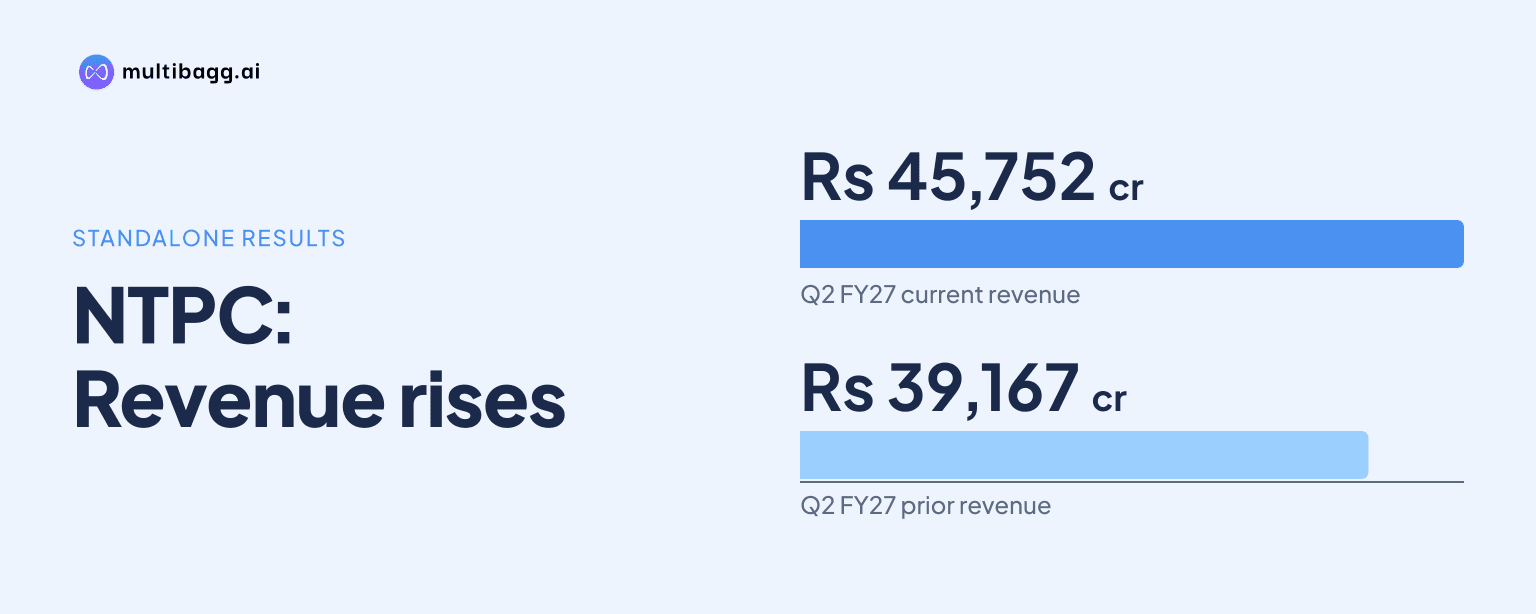
NTPC Limited reported standalone revenue from operations of ₹45,752 crore in Q2 FY27, up 17% from ₹39,167 crore a year earlier, while standalone profit after tax rose 14% to ₹5,320 crore for the quarter ended September 30, 2026. The results came amid strong growth in India’s electricity demand and generation during the first half.
Know NTPC inside out
Results, valuation, peers and who's buying, in one view.
What did NTPC Limited report for Q2 FY27?
NTPC Limited reported a 17% year-on-year increase in standalone revenue from operations to ₹45,752 crore for the July-September 2026 quarter. Revenue in the corresponding quarter of FY26 was ₹39,167 crore, resulting in an absolute increase of ₹6,585 crore.
Standalone profit after tax was ₹5,320 crore in Q2 FY27, compared with ₹4,653 crore in Q2 FY26, an increase of 14%. The company disclosed these figures during its October 31, 2026 earnings call for the quarter and half year ended September 30, 2026. Director Finance Jaikumar Srinivasan led the call, which was hosted by Nuvama Wealth Management Limited.
The reported figures distinguish between standalone and consolidated performance. NTPC disclosed consolidated revenue of ₹54,715.69 crore for Q2 FY27, compared with ₹45,262.10 crore in the year-earlier quarter. That represents a year-on-year rise of ₹9,453.59 crore, or about 20.9%.
How did NTPC perform in the first half of FY27?
NTPC's standalone revenue from operations for H1 FY27 reached ₹89,584 crore, compared with ₹81,736 crore in H1 FY26. The 10% increase indicates that the company’s September-quarter revenue growth was stronger than the growth reported for the full first half.
The company also reported adjusted profit after tax of ₹10,469 crore for H1 FY27, up 17%, according to the earnings-call material cited in the provided information. The same material attributed the half-year adjusted profit growth to efficiency gains, lower financing costs and stronger subsidiary performance.
Management said the operational and financial snapshot had been shared with stock exchanges. However, the provided material does not include detailed unit generation, capacity additions, expenses, receivables or segment-wise profit figures. Therefore, the available disclosure supports an assessment of reported revenue and profit movement, rather than a detailed operating-cost analysis.
What supported the power sector backdrop during the quarter?
India recorded about 11% year-on-year growth in power generation and about 15% growth in power demand during the first half of FY27, according to NTPC management. This sector backdrop is relevant because NTPC operates in a demand-linked electricity market and its revenue from operations rose during the same period.
The company discussed the broader Indian power sector outlook alongside the financial results. Its leadership team on the call included directors responsible for fuel, projects, operations and human resources, reflecting the operational areas that matter for a large electricity generator.
The provided information does not assign a specific share of NTPC’s revenue growth to higher generation, tariff changes, fuel-cost recovery, capacity commissioning or other individual factors. It does, however, establish that power demand and generation growth were both positive in H1 FY27 while NTPC posted higher standalone and consolidated revenue.
Got a follow-up? Ask IRIS
What are the key Q2 FY27 financial figures for NTPC?
NTPC reported higher revenue and profit across the measures disclosed for Q2 FY27, with consolidated revenue growing faster than standalone revenue. The following table summarises the financial data stated in the results-related material.
A separate source excerpt cited sales of ₹54,270 crore for the July-September 2026 period, compared with ₹44,786 crore in the corresponding 2025 quarter. As the supplied material also provides an explicitly labelled consolidated revenue figure of ₹54,715.69 crore, the table uses the labelled standalone and consolidated measures to avoid treating different reporting bases as directly comparable.
Why do these results matter for investors and the power industry?
The results show that NTPC increased standalone revenue and profit during a period when national electricity demand and generation were expanding. For investors, the 17% revenue growth and 14% rise in standalone profit after tax provide the clearest quarter-on-quarter-year comparison disclosed by management.
The difference between standalone revenue of ₹45,752 crore and consolidated revenue of ₹54,715.69 crore also underlines the relevance of NTPC’s group-level operations when assessing reported financial performance. The provided information refers to NTPC Green Energy Limited in the management presentation, but does not provide separate Q2 FY27 financial figures for that entity.
The company has fixed November 6, 2026 as the record date for payment of its first interim dividend for FY 2026-27, according to the provided announcement reference. The material does not state the dividend amount, so its financial effect cannot be quantified from the available disclosure.
Conclusion
NTPC Limited’s Q2 FY27 disclosure shows a 17% rise in standalone revenue from operations to ₹45,752 crore and a 14% increase in standalone profit after tax to ₹5,320 crore. The quarter was supported by a broader market environment in which India’s power demand grew about 15% and generation rose about 11% during H1 FY27.
Investors will next watch the first interim dividend record date of November 6, 2026 and subsequent disclosures for detailed operating metrics, project progress, fuel trends and the factors behind revenue and profitability. The available material does not provide management guidance or a detailed financial breakdown beyond the reported figures.

