










Oriana Power reports over 2.7 GWh BESS capacity pipeline
Key highlights
- Oriana Power reports over 2.7 GWh of BESS capacity, including commissioned, under-construction and allocated projects.
- Six named BESS awards total 2.45 GWh, led by a 900 MW/1,800 MWh Maharashtra project.
- Four named hybrid projects disclose a combined 450 MWh of storage capacity.
- Oriana Power reports more than 1.8 GW of solar energy assets alongside its BESS portfolio.
powered by IRIS
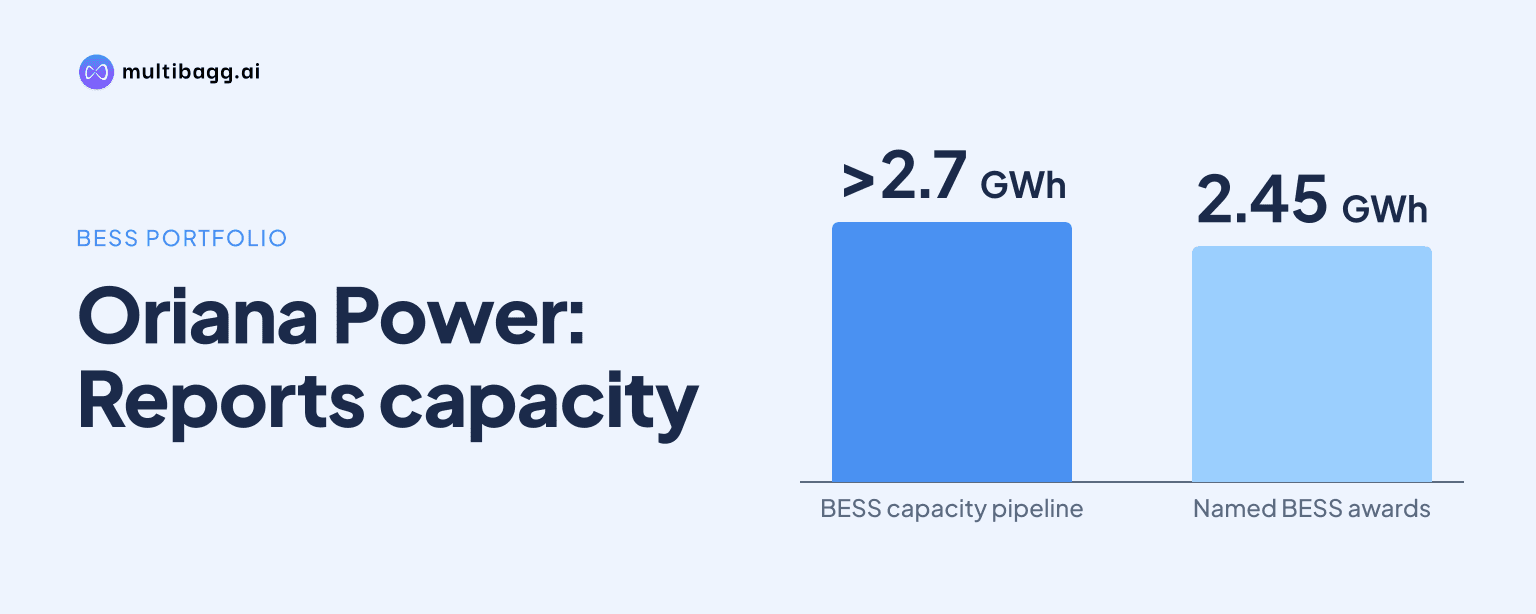
Oriana Power Limited reports over 2.7 gigawatt-hours (GWh) of battery energy storage system (BESS) capacity, including commissioned, under-construction and allocated projects. Its six named BESS awards total 2.45 GWh, while four named hybrid projects disclose a further 450 megawatt-hours (MWh) of storage whose inclusion in the headline total is not specified.
Know Oriana Power inside out
Results, valuation, peers and who's buying, in one view.
What BESS capacity does Oriana Power report?
Oriana Power reports over 2.7 GWh of BESS capacity on its storage page. The presentation states that this figure includes commissioned, under-construction and allocated capacity, but does not split the total between those project stages. One GWh equals 1,000 MWh, so the stated portfolio is above 2,700 MWh.
Oriana Power describes BESS as a system that stores surplus solar and wind energy and releases it during periods of peak demand or grid fluctuation. The company says this time-shifting mechanism supports grid stabilisation, system reliability, asset utilisation and continuity of supply for industrial and commercial users. These are intended functions of the storage product rather than reported operating results.
The 2.7-GWh figure is expressed as energy capacity, whereas power capacity is stated in megawatts (MW). This distinction matters because the presentation lists the Maharashtra State Electricity Distribution Company Limited BESS award as 900 MW and 1,800 MWh, showing both the rate at which a system can discharge and the amount of energy it can store.
How large are Oriana Power's named BESS awards?
Oriana Power's six named BESS awards total 2,450 MWh, or 2.45 GWh, based on the capacities shown for each project. Maharashtra State Electricity Distribution Company Limited accounts for 1,800 MWh, while the other five listed awards range from 100 MWh to 250 MWh.
Oriana Power's Maharashtra award represents about 73% of the 2,450 MWh total across the six named awards. The four 50 MW projects for Rajasthan, Telangana, Karnataka and Tamil Nadu each provide 100 MWh, or two hours of storage at their stated power rating, and together account for 400 MWh.
The NTPC Vidyut Vyapar award is also specified as a two-hour system, at 125 MW and 250 MWh. The 2.45-GWh sum of the named awards is at least 250 MWh below Oriana Power's over-2.7-GWh BESS headline. The presentation does not identify the projects or stages accounting for that difference, and does not state contract values, ownership structures, commissioning dates or revenue terms for these awards.
Got a follow-up? Ask IRIS
Which Oriana Power hybrid projects include battery storage?
Oriana Power lists four hybrid projects with 450 MWh of explicitly stated storage capacity: 300 MWh for SECI, 100 MWh for Wonder Cement Limited, 20 MWh for JKCL Gottan and 30 MWh for JKCL Gujarat. The presentation presents these as individual hybrid project entries rather than as a separate aggregate storage portfolio figure.
The SECI entry combines 100 MW with 50 MW/300 MWh, making its 300 MWh storage component the largest among the four disclosed hybrid projects. Wonder Cement is listed as 65.5 MW plus 100 MWh, without a separate battery power rating. JKCL Gottan is listed at 27 MW plus 10 MW/20 MWh, while JKCL Gujarat is listed at 50 MW plus 15 MW/30 MWh.
Oriana Power defines its hybrid offering as Solar+Wind, Solar+BESS and Wind+BESS configurations. The company says combining complementary generation profiles with storage where applicable is intended to raise annual energy yield, smooth output relative to single-technology plants, and use land, transmission infrastructure and common balance-of-plant more efficiently. The presentation does not say whether the 450 MWh in named hybrid projects is included in the over-2.7-GWh BESS figure, so the two amounts should not be added together.
How does BESS fit within Oriana Power's project portfolio?
Oriana Power places its over-2.7-GWh BESS capacity alongside more than 1.8 gigawatts (GW) of solar energy assets. Both figures include commissioned, under-construction and allocated capacity, but they measure different things: the solar figure is generating power capacity in GW, while the BESS figure is stored energy capacity in GWh.
The solar project list includes 234 MW for Damodar Valley Corporation, 128 MW for Dalmia Cement, 100 MW for Maharashtra State Electricity Distribution Company Limited and 52 MW for Bharat Petroleum Corporation Limited. Maharashtra State Electricity Distribution Company Limited therefore appears in both portfolios, with a 100 MW solar project and the 900 MW/1,800 MWh BESS award.
Oriana Power says it creates a separate special-purpose vehicle (SPV) for every project because customers, states, lenders and contract terms can differ. The company says each SPV has its own approvals, grid connectivity, lender security and cash flows, while different commercial operation dates, loan tenors and repayment schedules can be tracked over 15 to 25 years. The presentation does not identify which SPVs hold the reported BESS or hybrid capacities.
Conclusion
Oriana Power's presentation shows storage as a substantial disclosed business line alongside more than 1.8 GW of solar assets. The company reports over 2.7 GWh of BESS capacity, while the six named BESS awards add to 2.45 GWh and four named hybrid projects specify 450 MWh. The 1,800 MWh Maharashtra State Electricity Distribution Company Limited project is the largest individual storage award disclosed.
The key next point to watch is a project-stage breakdown of the over-2.7-GWh BESS figure, because Oriana Power currently combines commissioned, under-construction and allocated capacity. Clarification on whether the 450 MWh of disclosed hybrid storage is included in that total, together with commercial operation dates for the 900 MW/1,800 MWh Maharashtra award, would show how much of the stated capacity is moving toward operation.