










Orkla India Q2 revenue rises 19.4% as margin declines
Key highlights
- Orkla India’s Q2 FY27 revenue from operations increased 19.4% to Rs 776 crore.
- Spices revenue rose 25.1% to Rs 498 crore, while Convenience Foods revenue grew 7.7% to Rs 271 crore.
- Q2 FY27 EBITDA margin declined 100 basis points year on year to 15.9% amid elevated input costs.
- Digital commerce grew 23.0% and represented 10.0% of domestic revenue in Q2 FY27.
powered by IRIS
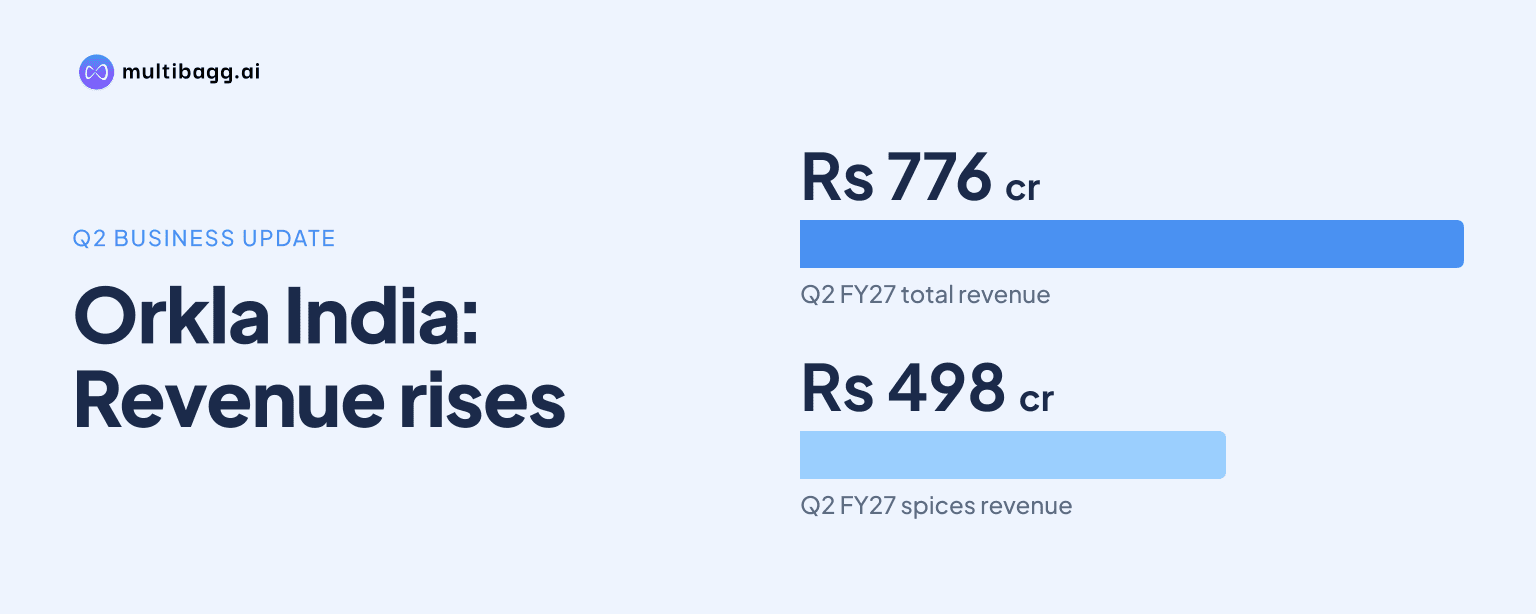
For Q2 FY27 ended September 30, 2026, Orkla India Limited reported revenue from operations of Rs 776 crore, up 19.4% year on year, while profit after tax before exceptional items rose 19.2% to Rs 91 crore despite its earnings before interest, tax, depreciation and amortisation margin declining 100 basis points to 15.9%.
Know Orkla India inside out
Results, valuation, peers and who's buying, in one view.
What did Orkla India report for Q2 FY27?
Orkla India reported Q2 FY27 revenue from operations of Rs 776 crore, compared with Rs 650 crore in Q2 FY26, and EBITDA of Rs 124 crore, compared with Rs 110 crore. Revenue growth of 19.4% exceeded EBITDA growth of 12.6%, resulting in a 15.9% EBITDA margin versus 16.9% a year earlier. EBITDA is calculated by the company using profit for the period and specified adjustments, including finance costs, depreciation, amortisation and tax expense.
Product sales rose 18.4% in Q2 FY27 and volume increased 2.9%, while revenue from operations also includes items such as production-linked incentives, export incentives and scrap sales. PAT before exceptional items, net of tax, was Rs 91 crore, up from Rs 77 crore, while the PAT margin was unchanged at 11.8%. The Q2 revenue result followed 10.4% growth in revenue from operations in Q1 FY27, according to Orkla India.
Which businesses and markets drove Orkla India’s growth?
Orkla India’s spices business was the largest stated category, with revenue rising 25.1% year on year to Rs 498 crore in Q2 FY27. Convenience Foods revenue increased 7.7% to Rs 271 crore. Spices therefore grew faster than Convenience Foods during the quarter, while the company said the festive calendar’s shift to Q3 affected the latter category.
Domestic revenue rose 20.0% to Rs 623 crore, ahead of international revenue growth of 11.7% to Rs 145 crore. These stated domestic and international revenues are separate from the Rs 776 crore consolidated revenue-from-operations measure, which includes product sales and other operating revenue. Orkla India said international growth was achieved despite a volatile geopolitical environment, without quantifying country-level performance.
How did margins and first-half earnings change?
Orkla India’s Q2 FY27 EBITDA margin fell to 15.9% from 16.9% in Q2 FY26 as input costs remained elevated, although EBITDA increased Rs 14 crore to Rs 124 crore. This was a 100-basis-point year-on-year reduction, with one basis point equal to one-hundredth of a percentage point. The company did not disclose individual commodity costs or a product-wise margin split.
For H1 FY27, revenue from operations increased 15.1% to Rs 1,435 crore from Rs 1,247 crore in H1 FY26, while EBITDA rose 7.8% to Rs 239 crore from Rs 221 crore. The first-half EBITDA margin was 16.6%, down from 17.8%, a 120-basis-point decrease. PAT before exceptional items, net of tax, rose 14.4% to Rs 178 crore from Rs 156 crore, while the PAT margin moved to 12.4% from 12.5%.
Got a follow-up? Ask IRIS
How is Orkla India using digital commerce and innovation?
Orkla India said digital commerce revenue grew 23.0% year on year in Q2 FY27 and accounted for 10.0% of domestic revenue. The company reported domestic revenue of Rs 623 crore for the quarter but did not disclose digital-commerce revenue in rupees. Digital commerce grew 33.6% outside South India, faster than the channel’s overall 23.0% growth rate.
The company introduced 15 innovations in Q2 FY27 as part of a portfolio-diversification effort across its food categories. Orkla India said Project Bolt has helped build capabilities for expansion beyond South India through innovation and digital commerce. Its portfolio includes blended and pure spices, plus convenience foods such as ready-to-cook products, ready-to-eat meals and vermicelli, sold under the MTR, Eastern and Rasoi Magic brands.
What does Orkla India expect in the next quarter?
Orkla India’s management expects Q3 FY27 to capture a significant share of seasonal demand because festive activity extends into that quarter. Managing Director and Chief Executive Officer Sanjay Sharma said the company sees headroom in core markets and in markets reached through digital commerce, including Generation Z consumers. This is management’s expectation rather than a quantified revenue or profit forecast.
The Kerala distribution restructuring remains a multi-quarter transformation, according to Orkla India, and management said benefits are expected to build progressively. The company said initiatives already implemented have shown encouraging results, but it did not provide a completion date, cost figure, or quantified sales and margin benefits. The next reported result will show whether the 20.0% domestic-revenue growth and 15.9% Q2 EBITDA margin continue through the festival-heavy quarter.
Conclusion
Orkla India combined 19.4% Q2 revenue growth with 19.2% growth in PAT before exceptional items, net of tax, led by 25.1% spices growth and 20.0% domestic-revenue growth. However, EBITDA grew more slowly than revenue, and the margin reduced from 16.9% to 15.9% amid elevated input costs. The first-half figures show the same pattern, with revenue up 15.1% and EBITDA margin down 120 basis points to 16.6%.
The next point to watch is Q3 FY27, when management expects extended festive activity to contribute a significant share of seasonal demand. Other disclosed markers are digital commerce, which represented 10.0% of domestic revenue after growing 23.0% in Q2, and the Kerala distribution restructuring, whose benefits management says will build progressively over multiple quarters.