










Parag Milk Foods Q2 revenue reaches ₹1,241 crore, PAT falls
Key highlights
- Parag’s Q2FY27 consolidated revenue reached ₹1,241 crore, up 23.1% year on year.
- Q2FY27 EBITDA excluding the prior-year one-off rose 37.2% to ₹101 crore, with margin increasing to 8.1%.
- Reported Q2FY27 PAT declined 7.9% to ₹42 crore, while PAT excluding the prior-year one-off increased 41.5%.
- Parag’s new-age business grew 71% to ₹154 crore in Q2FY27 and accounted for 12% of turnover.
powered by IRIS
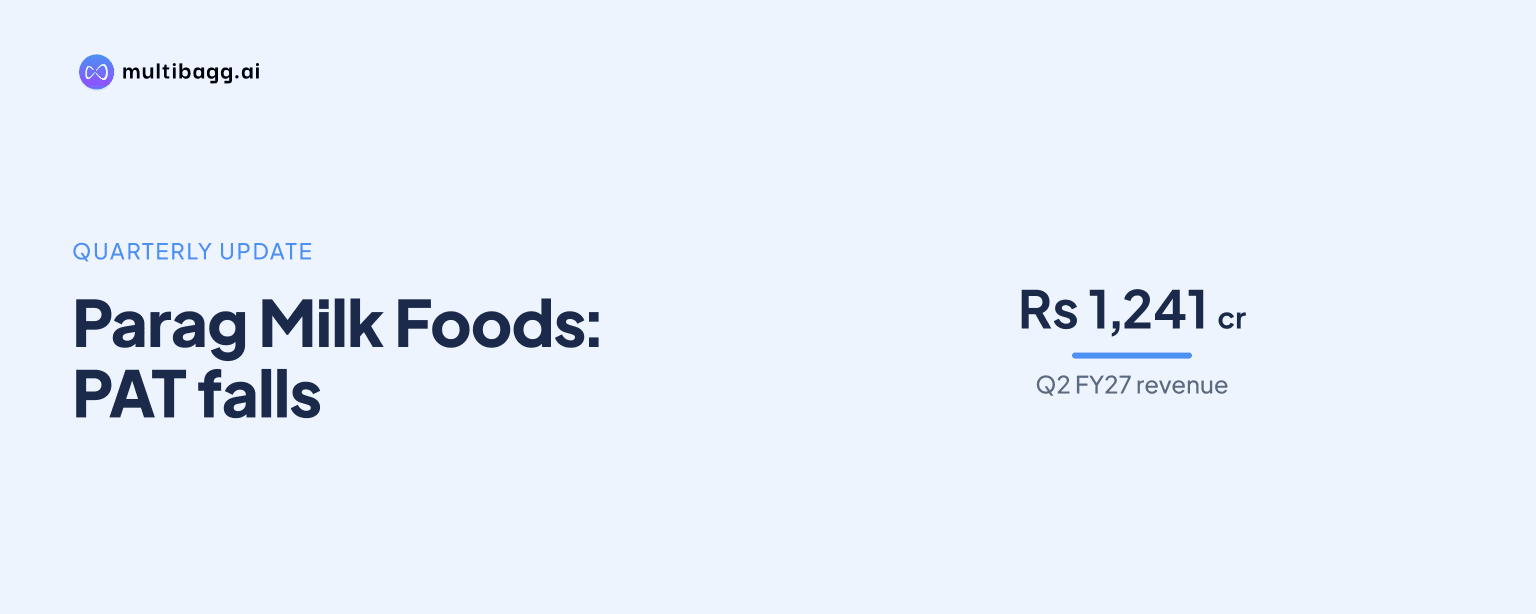
Parag reported its highest-ever Q2 consolidated revenue of ₹1,241 crore in Q2FY27, up 23.1% year on year, but reported profit after tax fell 7.9% to ₹42 crore as Q2FY26 included an approximately ₹16 crore Foreign Currency Convertible Bonds accounting reversal and current tax affected FY27 earnings.
Know Parag Milk Foods inside out
Results, valuation, peers and who's buying, in one view.
What did Parag report for Q2FY27?
Parag reported consolidated revenue of ₹1,241 crore in Q2FY27, compared with ₹1,008 crore in Q2FY26. The 23.1% increase was accompanied by 12% volume growth and 23% value growth. Gross margin increased 24.0% to ₹323 crore from ₹260 crore, while gross margin as a share of revenue increased to 26.0% from 25.8%.
Earnings before interest, tax, depreciation and amortisation, or EBITDA, excluding the prior-year one-off, rose 37.2% to ₹101 crore from ₹73 crore. EBITDA margin increased to 8.1% from 7.3%. Profit before tax, or PBT, excluding the prior-year item, increased 59.8% to ₹55 crore from ₹35 crore, and its margin rose to 4.4% from 3.4%.
Parag’s Q2FY27 revenue was also ₹296 crore above the ₹945 crore reported in Q1FY27. The presentation records year-on-year revenue growth in each of the past five quarters: 15% in Q2FY26, 14% in Q3FY26, 3% in Q4FY26, 11% in Q1FY27 and 23% in Q2FY27.
Why did Parag’s reported Q2 profit fall?
Parag’s reported profit after tax, or PAT, declined to ₹42 crore in Q2FY27 from ₹46 crore in Q2FY26 because the earlier period included an approximately ₹16 crore gain from reversal of mark-to-market accounting on conversion of Foreign Currency Convertible Bonds, or FCCBs, into equity. The presentation also says current tax began affecting earnings in FY27, and reported PAT margin fell to 3.4% from 4.5%.
On a comparison excluding the prior-year one-off, Q2FY27 PAT rose 41.5% to ₹42 crore from ₹30 crore. The adjusted PAT margin increased to 3.4% from 2.9%. This differs from the 59.8% increase in adjusted PBT because management attributed the lower growth at the PAT level to the current-tax impact.
The first-half comparison shows the same distinction. Reported H1FY27 PAT declined 12.5% to ₹64 crore from ₹73 crore in H1FY26, while PAT excluding the prior-year one-off rose 11.9% from ₹57 crore to ₹64 crore. Reported PAT margin was 2.9% in H1FY27, compared with 3.9% a year earlier.
Which Parag categories drove Q2FY27 revenue?
Parag’s flagship categories generated the largest share of Q2FY27 turnover, contributing ₹778 crore, or 63%, after growing 20% year on year. The group includes ghee, cheese, paneer and curd. Its contribution was one percentage point below the 64% share in Q2FY26, despite the larger revenue base of ₹1,241 crore.
New-age business was the fastest-growing consumer category disclosed in Q2FY27, increasing 71% to ₹154 crore and accounting for 12% of turnover. This business includes Avvatar and Pride of Cows. Its turnover share rose from 3% in Q2FY23 to 12% in Q2FY27, while flagship categories moved from 67% to 63% over that five-year Q2 comparison.
Ingredients contributed ₹197 crore, or 16% of Q2FY27 turnover, after growing 52%. In contrast, liquid milk revenue declined 11% to ₹84 crore and its turnover share reduced to 7% from 9% in Q2FY26. Other businesses declined 41% to ₹27 crore and represented 2% of turnover, compared with 5% a year earlier.
Got a follow-up? Ask IRIS
How did Parag perform in H1FY27?
Parag reported its highest-ever H1 consolidated revenue of ₹2,185 crore, up 17.5% from ₹1,859 crore in H1FY26. First-half volume growth was 8% and value growth was 18%. Gross margin increased to ₹581 crore from ₹493 crore, while the gross-margin percentage edged up to 26.6% from 26.5%.
H1FY27 EBITDA excluding the prior-year one-off increased 22.6% to ₹170 crore from ₹139 crore, and its margin rose to 7.8% from 7.5%. Adjusted PBT increased 32.6% to ₹84 crore from ₹64 crore, lifting the margin to 3.9% from 3.4%. These pre-tax measures grew faster than the 17.5% revenue increase.
The H1FY27 category mix broadly followed the Q2 pattern. Flagship categories generated ₹1,358 crore and 62% of turnover, up 16%, while new-age business rose 66% to ₹273 crore and retained a 12% share. Ingredients increased 38% to ₹338 crore, whereas liquid milk declined 10% to ₹164 crore and others declined 43% to ₹52 crore.
What changed in Parag’s cash flow and balance sheet?
Parag’s consolidated net debt was ₹678 crore at 30 September 2026, compared with ₹484 crore at 31 March 2026. Gross debt increased to ₹741 crore from ₹540 crore, while net worth increased to ₹1,310 crore from ₹1,259 crore. Cash and bank surplus was ₹58 crore at 30 September 2026, compared with ₹57 crore at the March year-end.
Operating cash flow was negative ₹95 crore in H1FY27 despite operating cash profit of ₹171 crore. Working-capital changes used ₹265 crore, including an inventory increase of ₹161 crore from March 2026. Inventory days rose to 71 from 70, receivable days increased to 25 from 23, and net working-capital days rose to 73 from 68.
Conclusion
Parag’s Q2FY27 outcome combined record revenue of ₹1,241 crore with increases in gross margin, EBITDA margin and adjusted PAT margin. Flagship categories remained the main revenue base at 63% of turnover, while new-age business grew 71% to ₹154 crore. Reported PAT nevertheless fell to ₹42 crore because the prior-year comparison included an approximately ₹16 crore FCCB-related accounting gain and FY27 current tax affected earnings.
The next disclosed matter to watch is whether Parag converts first-half operating cash profit of ₹171 crore into positive operating cash flow after the ₹265 crore working-capital build-up. The presentation also identifies the Pride of Cows brand identity refresh, retaining its one-farm, single-origin positioning, but gives no financial target or timetable for the refresh’s effect.