










PEL Targets Missile Integration Beyond Propellants by 2030
Key highlights
- PEL states it supplies 100% of solid-propellant requirements for MRSAM, LRSAM and Astra.
- PEL’s Vision 2030 plan includes increased missile integration and products such as mines, ammunition and bombs.
- PEL reports supplying more than 2,500 Akash booster grains and more than 450 sustainer grains.
- PEL cites an FY27 defence budget of Rs 7.85 lakh crore, with Rs 1.39 lakh crore earmarked for domestic defence industries.
powered by IRIS
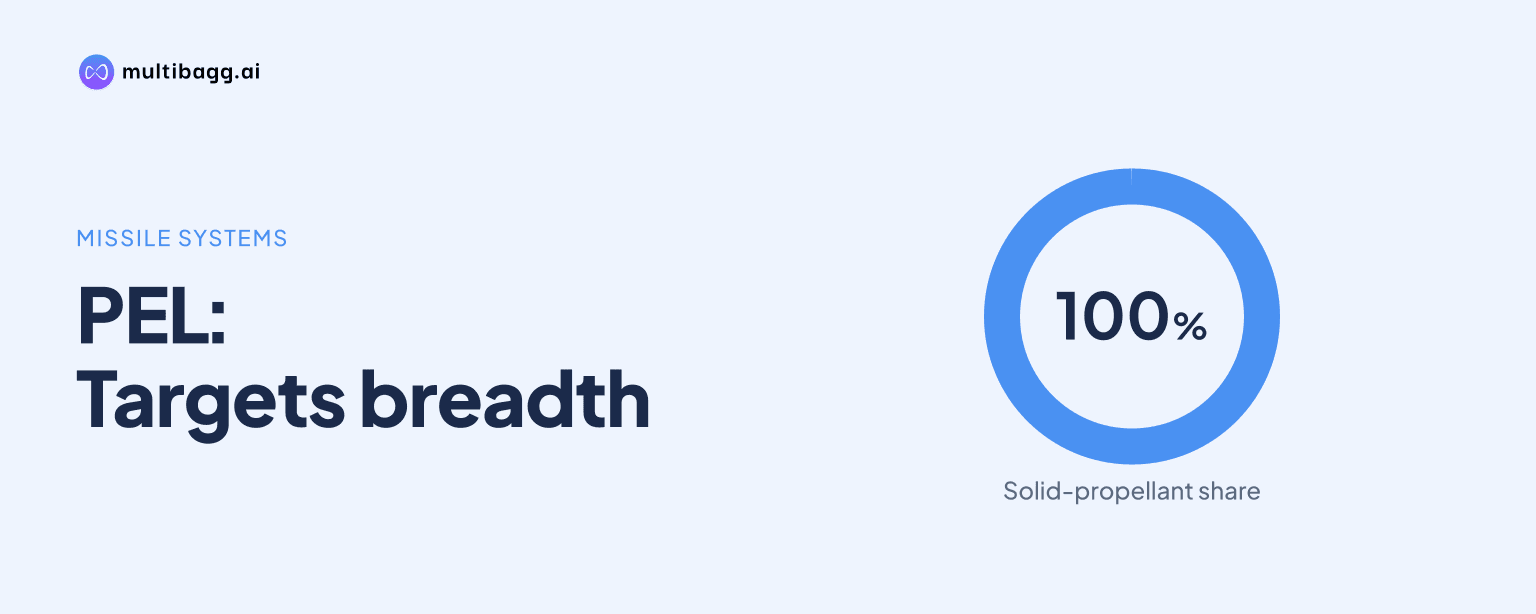
Premier Explosives Limited’s Vision 2030 calls for increased missile integration and new defence products beyond propellants, supported by its stated supply of 100% of solid-propellant requirements for MRSAM, LRSAM and Astra. PEL also plans capacity additions in RDX, HMX, TNT and AP to meet increased demand.
Know Premier Explosives inside out
Results, valuation, peers and who's buying, in one view.
How is PEL changing its defence growth strategy?
PEL’s strategy is to increase participation in missile integration as a strategic partner in DRDO schemes while remaining an important player in industrial explosives. The Vision 2030 plan places missile integration alongside capacity enhancement, product-range expansion and higher exports in industrial and defence explosives.
PEL plans to enhance production capacity for high-explosive raw materials including RDX, HMX, TNT and AP. The presentation links this capacity programme to increased demand, but does not disclose production volumes, capital expenditure, commissioning dates or a numerical capacity target.
Exports are another stated element of the plan. Management says PEL intends to increase export contribution in industrial and defence explosives, where the presentation says margins are higher, although it gives no export-revenue target, country list or deadline for the planned increase.
What missile capabilities does PEL already have?
PEL already has roles across six missile programmes in production, ranging from complete propellant supply to rocket-motor integration. It reports 100% of solid-propellant requirements for MRSAM for the Indian Army, LRSAM for the Indian Navy and Astra for the Indian Air Force, with DRDO and Bharat Dynamics Limited listed as clients.
The company’s role differs across the remaining programmes. For Akash, PEL reports supplies of more than 2,500 booster grains and more than 450 sustainer grains; for Agni, it supplies pyrogen igniters for all stages; and for Brahmos, it reports production and integration of rocket motors.
The Brahmos activity is PEL’s stated existing example of production and integration, whereas MRSAM, LRSAM and Astra are described as full propellant-supply roles. This distinction indicates that the Vision 2030 integration objective builds on a different capability from the company’s supply of solid propellants, though no programme revenue or order value is disclosed.
Which new defence products does PEL plan to offer?
PEL plans to expand its product portfolio into mines, ammunition and bombs under its Vision 2030 product-range objective. Its Indian Army offering lists anti-personnel mines, anti-armoured vehicle mines, medium- and large-calibre ammunition, warheads, surface-to-air missiles, unmanned aerial vehicles, drones and loitering missiles.
For Indian Air Force requirements, PEL lists chaffs and flares, air-to-air missiles, air-to-surface missiles, missile refurbishment and canopy severance systems. It also identifies air target imitators for the Indian Army, adding a training-related product to the planned set of missiles, mines, ammunition and aircraft systems.
The proposed offering is broader than PEL’s reported current contributions of propellants, booster grains, sustainer grains, igniters and Brahmos rocket motors. However, the presentation does not state whether the listed mines, ammunition, bombs, drones or refurbishment services are in production, under qualification, contracted or scheduled for launch.
Got a follow-up? Ask IRIS
What domestic defence demand does PEL cite for its plan?
PEL cites an FY27 defence budget of Rs 7.85 lakh crore, up 15.2% from FY26 Budget Estimates, including capital outlay of Rs 2.19 lakh crore. It also cites approximately 75% of the FY27 capital-acquisition budget, or Rs 1.39 lakh crore, as earmarked for domestic defence industries.
The presentation lists Rs 2.28 lakh crore of capital procurement contracts signed in FY26 and acquisition approvals worth Rs 6.81 lakh crore. These are wider sector figures rather than PEL orders, and the company does not identify any share of the contracts or approvals that relates to its propellants, missile integration or planned product lines.
PEL also cites defence production of Rs 1.78 lakh crore in FY26, up 15.6% year on year, and defence exports of Rs 38.42 thousand crore, up 62.7% year on year, to more than 80 countries. The presentation says private-sector companies accounted for 24% of FY26 defence production and 45.2% of defence exports, while the government targets annual production of Rs 3 lakh crore and defence exports of Rs 50 thousand crore by 2029.
How does research support PEL’s planned expansion?
PEL says it collaborates with Gulbarga University, Indian Institute of Technology Madras and BITS Pilani on high-energy materials research. Its laboratories are certified by the Department of Scientific and Industrial Research and accredited by the National Accreditation Board for Testing and Calibration Laboratories, according to the presentation.
The company says it has developed solid propellants for several missiles, including combustion-stable propellants for LRSAM, MRSAM and Astra. Those three programmes are also the ones for which PEL reports 100% of solid-propellant requirements, although it does not disclose research expenditure, development dates or the capacity created by the collaborations.
PEL further cites the sixth Positive Indigenous List, notified in August 2026, covering 405 additional items with estimated business potential of Rs 3.07 thousand crore. The presentation does not specify which of those 405 items, if any, relate to PEL’s planned mines, ammunition, bombs, missiles or other listed products.
Conclusion
PEL’s disclosed strategy combines existing propellant and missile-component work with an intended move into greater missile integration and a wider defence portfolio. Its full propellant supply for MRSAM, LRSAM and Astra, together with Brahmos rocket-motor production and integration, provides the operational context for the Vision 2030 plan.
The next point to watch is progress on capacity enhancement for RDX, HMX, TNT and AP, as PEL has not provided volumes, investment amounts or commissioning dates. Investors can also watch for disclosed programme wins, production status or contracts for the mines, ammunition, bombs, drones and missile offerings included in its planned portfolio.