










Persistent Systems Approves ₹9,000 Crore Debt Fund Raising
Key highlights
- Persistent Systems approved up to ₹8,000 crore of non-convertible debentures through private placement.
- The company also approved commercial paper issuance of up to ₹1,000 crore, taking the total authorised debt programme to ₹9,000 crore.
- The filing history links both debt instruments to long-term financing for the proposed Nagarro SE acquisition.
- ICRA assigned [ICRA]AA+ with Rating Watch with Negative Implications to proposed ₹5,000 crore NCDs on 9 October 2026.
powered by IRIS
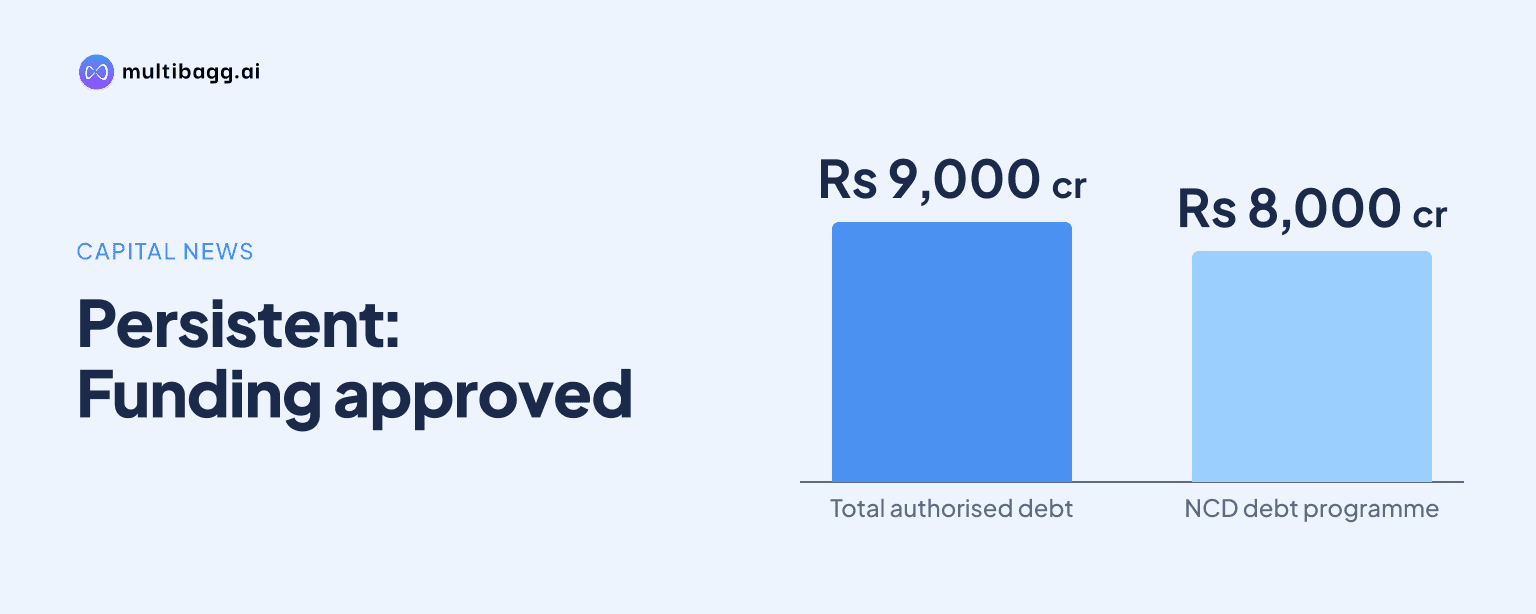
Persistent Systems Ltd approved a fund-raising programme of up to ₹9,000 crore on 15 October 2026, comprising up to ₹8,000 crore in non-convertible debentures and up to ₹1,000 crore in commercial paper. The approval provides a framework for debt financing linked to the company’s proposed acquisition of Nagarro SE.
Know Persistent Systems inside out
Results, valuation, peers and who's buying, in one view.
What did Persistent Systems approve?
Persistent Systems approved the private-placement issuance of non-convertible debentures, or NCDs, of up to ₹8,000 crore and commercial paper, or CP, of up to ₹1,000 crore. The combined approved borrowing limit is therefore ₹9,000 crore.
The approval was disclosed on 15 October 2026, while the company’s exchange filing dated 16 October stated that the terms of the NCD and CP issuance had been approved. The proposed NCD securities are intended to be listed on the National Stock Exchange of India Ltd, according to the filing history available in the source material.
NCDs are fixed-income instruments issued by companies to borrow from investors and do not convert into equity shares. Commercial paper is generally a shorter-tenure borrowing instrument. The mix allows Persistent to use debt instruments with potentially different maturity profiles rather than relying on a single source of funding.
Why is Persistent Systems raising debt?
Persistent stated in its filing history that both the NCD and CP issuances form part of long-term debt financing related to its acquisition of Germany-based Nagarro SE. The approved facilities are consequently significant because they establish the company’s potential funding capacity for a transaction that requires substantial capital.
Reporting cited in the source material said Persistent was considering raising more than ₹6,000 crore through NCDs with varying tenures as it finalised financing for the Nagarro acquisition. It also said the proceeds could replace an 18-month bridge-financing commitment secured from Barclays. The company’s approved limit is larger than that reported NCD amount, and the final drawdown, pricing and allocation have not been specified in the material provided.
A person familiar with the financing, as cited in the report, said NCD maturities could range from one to five years, with an average maturity of roughly three years. The same report indicated that a smaller portion could be raised through one-year commercial paper. These are reported financing details and not final terms disclosed by Persistent in the cited approval.
What are the proposed debt terms and credit-rating details?
The final coupon, maturity schedule and amount actually issued were not disclosed in the approval. The source report indicated that the NCDs were likely to be priced between 8.75% and 9.50% and could be underwritten by HSBC and Barclays, but both banks declined to comment.
ICRA had assigned an [ICRA]AA+ rating with Rating Watch with Negative Implications to proposed NCDs of ₹5,000 crore on 9 October 2026, while reaffirming the issuer rating. This rating action preceded the company’s later approval for NCDs of up to ₹8,000 crore. Investors should note that the ₹5,000 crore rated instrument amount and the ₹8,000 crore board-approved limit are different figures.
The rating-watch status is relevant because ratings agencies may reassess credit quality as transaction financing and other developments become clearer. The available material does not disclose final covenants, the final debt outstanding after issuance, or a management target for post-transaction debt-to-equity.
Got a follow-up? Ask IRIS
How does the financing affect Persistent Systems investors?
The approval does not itself confirm that Persistent has issued the full ₹9,000 crore or that the company has drawn the entire amount. It authorises the company to raise funds within those limits through private placements, subject to the eventual terms and execution of each instrument.
For equity investors, the planned borrowing adds a financing dimension to the proposed Nagarro transaction. Debt can reduce the immediate need for equity funding, but it also creates interest-payment and refinancing obligations. The significance of the programme will depend on the final amount raised, the cost of borrowing, maturity profile and the financial contribution of the acquired business after the transaction closes.
The source material also records that Persistent later approved a qualified institutional placement of up to USD 450 million, or ₹4,264.61 crore, at a floor price of ₹5,550 per share. That QIP approval is separate from the 15 October debt-fund-raising decision. Together, the disclosures show that the company has considered both equity and debt financing routes in connection with its broader funding requirements.
What should investors monitor after the approval?
Investors should monitor exchange disclosures on the actual NCD and CP issuances, including the amount raised, coupon rates, redemption dates, investor participation and use of proceeds. These details will determine the company’s eventual interest burden and repayment schedule more precisely than the currently approved ceiling.
The progress of the Nagarro SE acquisition is also central to assessing the financing structure. The available material links the borrowings to the acquisition, but it does not provide a confirmed post-transaction debt-to-equity target or final debt covenant schedule. Further rating-agency updates will be relevant as the financing and transaction terms are finalised.
Conclusion
Persistent Systems has approved a sizeable debt-fund-raising framework of up to ₹9,000 crore, led by ₹8,000 crore of NCDs and supported by up to ₹1,000 crore of commercial paper. The approval is tied in the company’s filings to financing for the proposed Nagarro SE acquisition and marks a material step in arranging transaction-related funding.
The next disclosures to watch are the final NCD and CP terms, the actual amount issued and any updates on the Nagarro transaction. Investors should also track rating actions, particularly because ICRA’s proposed NCD rating carried a Rating Watch with Negative Implications.