








PGInvIT has limited acquisitions, pursues Rs 500 crore bids

Find your next multibaggerBe a Pro Investor
Research stocks and track your picks on the go. Download the app.
Key highlights
- PGInvIT says transmission acquisition opportunities are limited at present.
- The sector pipeline includes 91 IST TBCB assets under construction, including 44 being developed by private players.
- PGInvIT's proposed consortium with POWERGRID targets TBCB projects worth around Rs 500 crore and remains under approval.
- PGInvIT had Rs 1,059.90 crore of external term-loan debt outstanding on September 30, 2026.
powered by IRIS
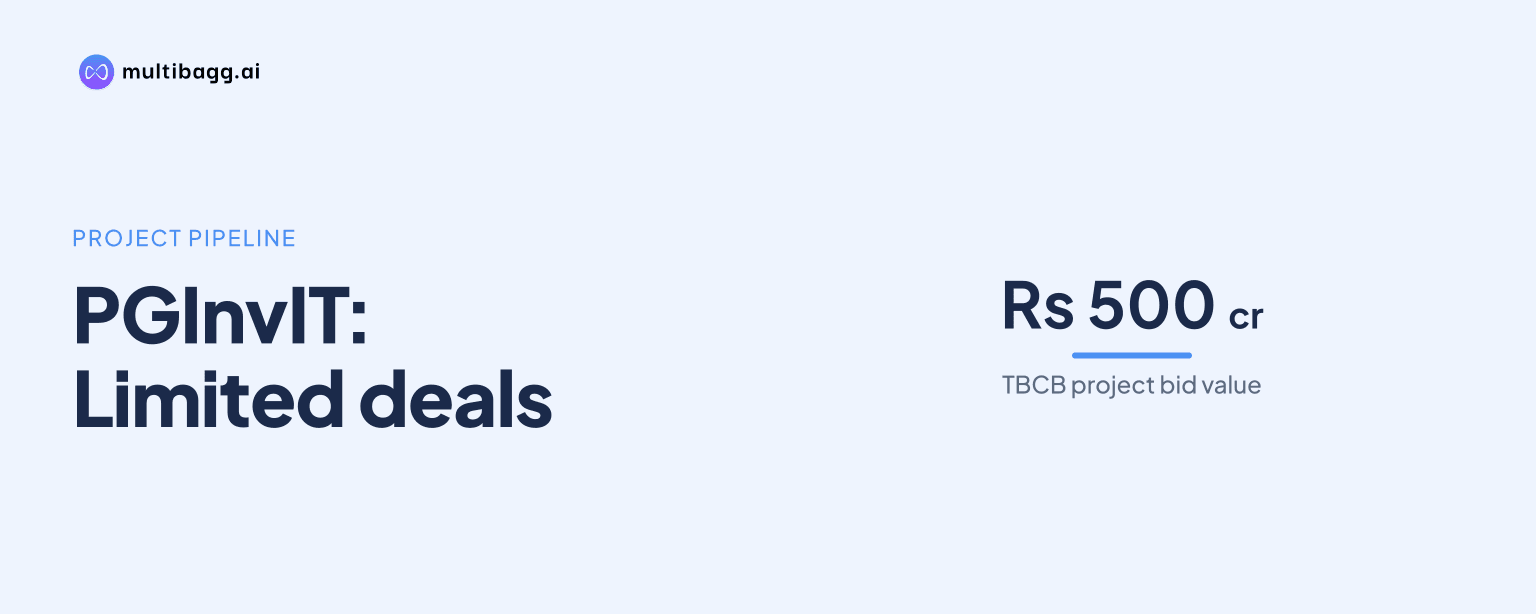
POWERGRID Infrastructure Investment Trust (PGInvIT) says transmission acquisition opportunities are limited at present, while a proposed consortium with POWERGRID for tariff-based competitive bidding projects worth around Rs 500 crore is under approval. The presentation identifies 91 IST TBCB assets under construction and state-utility monetisation discussions as possible, but not committed, growth channels.
Know Powergrid Infrastructure Investment Trust inside out
Results, valuation, peers and who's buying, in one view.
What acquisition opportunities does PGInvIT see now?
PGInvIT sees limited acquisition opportunities in transmission at present. Its business outlook does not identify a completed external acquisition, a signed asset-sale agreement or a timeline for a purchase, while it describes the Rs 500 crore POWERGRID consortium proposal as still being under approval with authorities.
PGInvIT identifies three possible routes for expansion: asset sales by other developers, monetisation by state utilities and TBCB bids with POWERGRID. TBCB means tariff-based competitive bidding, and the presentation lists 91 IST TBCB assets under construction, including 44 being developed by private players, as a potential future source of projects.
The current constraint differs from PGInvIT’s existing portfolio cash generation. The five special purpose vehicles, or SPVs, reported combined net distributable cash flows, or NDCF, of Rs 615.60 crore in H1FY27, while the acquisition discussion concerns assets that may become available after construction, monetisation or competitive bidding.
How large is the future transmission development pool?
The disclosed development pool consists of 91 IST TBCB assets under construction, of which 44 are being developed by private players. PGInvIT also says more assets are at various stages of bidding, but provides no commissioning dates, asset values, sale processes or indication that a developer has agreed to transfer any project to PGInvIT.
The presentation places this pool alongside three large transmission-sector plans, each with a different target period. These plans show the scale of planned sector spending, but PGInvIT does not state that it will own, bid for or acquire any specified portion of the investments.
The 900-gigawatt integration plan, at about Rs 7,93,000 crore, is larger than the Brahmaputra plan’s about Rs 1,91,000 crore and the Green Energy Corridor Phase-III scheme’s about Rs 1,86,000 crore. PGInvIT cites increasing energy demand, the renewable-energy push, and policy and regulatory reforms as power-sector drivers, without assigning revenue or assets from these plans to the trust.
What is PGInvIT’s POWERGRID consortium proposal?
PGInvIT is pursuing a consortium with POWERGRID for TBCB bidding for projects worth around Rs 500 crore, and the proposal is under approval with authorities. POWERGRID is Power Grid Corporation of India Limited, according to the presentation glossary, and the stated Rs 500 crore refers to the projects being pursued rather than an acquired portfolio.
The presentation does not disclose the consortium’s ownership split, project locations, bid timetable, tariff terms, financing structure or the authorities involved in the approval process. It also does not say that a bid has been submitted, won or awarded, so the proposal remains a stated growth route rather than a committed acquisition.
This approach differs from purchasing an asset from another developer. A developer sale would transfer an existing project when it becomes available, whereas the POWERGRID route would seek new projects through TBCB; both sit alongside the 91 under-construction assets cited in PGInvIT’s business outlook.
Got a follow-up? Ask IRIS
Can state-utility monetisation add assets to PGInvIT?
State-utility monetisation could create another asset source, but PGInvIT says the CEA and PGInvIT are interacting with stakeholders to finalise modalities and encourage states to monetise assets. The presentation does not name a state utility, identify an asset, state a transaction value or give a completion date for this process.
The state route is therefore at an earlier disclosed stage than the around-Rs-500-crore consortium proposal, which is under approval, while current third-party transmission acquisition opportunities are described as limited. The 91 IST TBCB assets, including 44 privately developed projects, are also not presented as a state-monetisation pipeline.
PGInvIT attributes the 91-asset construction figure to CEA reports. However, the presentation does not rank developer asset sales, state monetisation and consortium bidding by expected contribution, nor does it estimate how many projects could enter PGInvIT through any of the three mechanisms.
How could PGInvIT finance future acquisitions?
PGInvIT says debt-funded acquisitions are enabled by significant capacity for leveraging debt, lender confidence, a consistent payment track record and AAA credit ratings from CARE, CRISIL and ICRA since its initial public offer. This is management’s stated financing framework and not a disclosed borrowing commitment for the proposed Rs 500 crore projects.
As of September 30, 2026, PGInvIT had Rs 1,059.90 crore of external term-loan borrowings outstanding across two facilities. The March 2022 loan had Rs 558.30 crore outstanding and reset quarterly against the three-month Treasury bill, while the December 2024 loan had Rs 501.60 crore outstanding and reset monthly against the repo rate.
The December 2024 facility had a 7.00% rate, compared with 6.56% for the March 2022 facility, and both have 16-year tenors. PGInvIT says about 69% of its debt repayment is scheduled after 10 years, while its H1FY27 consolidated total income was Rs 642.30 crore and operating expenses were Rs 42 crore.
What does PGInvIT’s distribution record show?
PGInvIT shows a Rs 3.00-per-unit distribution for Q2FY27, unchanged from every quarter from Q3FY22 through Q2FY27. The Q2FY27 amount comprised Rs 1.69 of interest, Rs 0.62 of dividend, Rs 0.68 of repayment of SPV debt and Rs 0.01 of treasury income.
Total distributions since the initial public offer were Rs 64.50 per unit, and management’s distribution guidance for FY2026-27 is Rs 12 per unit. The distribution policy requires at least 90% of distributable income to be paid to unitholders and requires distributions to be declared and made at least once every quarter.
PGInvIT’s own H1FY27 NDCF was Rs 546.10 crore, including Rs 322.20 crore of interest income, Rs 146.90 crore of dividend income and Rs 125.70 crore of SPV debt repayment. The presentation does not link this H1FY27 cash flow to a specific acquisition or to financing for the consortium proposal.
Conclusion
PGInvIT’s disclosed growth strategy combines limited current transmission acquisition opportunities with three potential channels: developer asset sales, state-utility monetisation and TBCB bids with POWERGRID. The 91 assets under construction, including 44 developed by private players, indicate a future project pool, but the presentation does not identify any asset that PGInvIT has agreed to acquire.
The next item to watch is the approval process for the proposed POWERGRID consortium’s projects worth around Rs 500 crore. Further disclosures on state-monetisation modalities, projects from the 91-asset set becoming sale candidates, and management’s FY2026-27 distribution guidance of Rs 12 per unit would clarify how the stated growth routes develop.

