










Pricol receivables reach Rs 812.77 crore by September 2026
Key highlights
- Pricol trade receivables rose to Rs 812.77 crore in H1 FY27 from Rs 577.80 crore at FY26.
- Pricol short-term borrowings increased to Rs 428.58 crore in H1 FY27 from Rs 265.76 crore at FY26.
- Pricol inventories reached Rs 676.67 crore and trade payables reached Rs 757.93 crore in H1 FY27.
- Pricol total current assets were Rs 1,696.28 crore and total current liabilities were Rs 1,484.57 crore in H1 FY27.
powered by IRIS
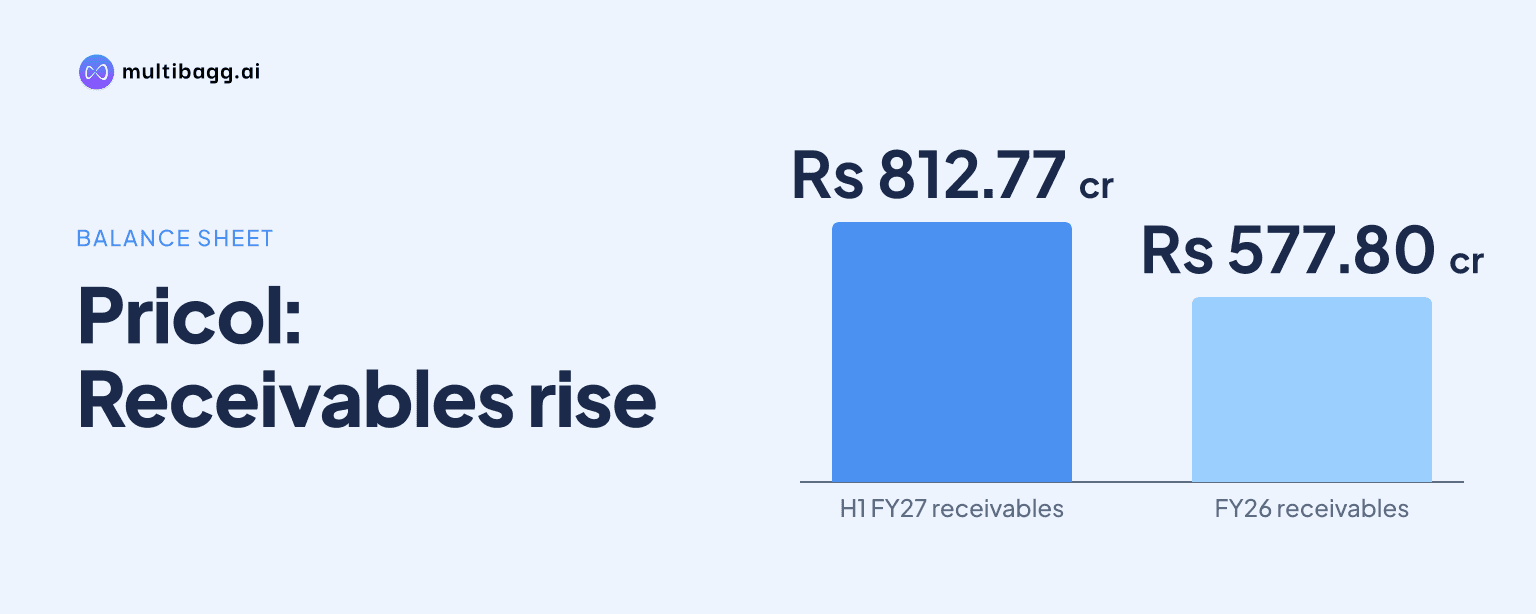
Pricol Limited (Pricol) reported trade receivables of Rs 812.77 crore in H1 FY27, up Rs 234.97 crore from FY26, while short-term borrowings reached Rs 428.58 crore, up Rs 162.82 crore. The consolidated balance sheet also showed inventories of Rs 676.67 crore and trade payables of Rs 757.93 crore.
Know Pricol inside out
Results, valuation, peers and who's buying, in one view.
What changed in Pricol’s working-capital assets?
Pricol’s current assets increased by Rs 404.06 crore from FY26 to Rs 1,696.28 crore in H1 FY27, led by higher trade receivables and inventories. Trade receivables rose from Rs 577.80 crore at FY26 to Rs 812.77 crore, while inventories increased from Rs 539.33 crore to Rs 676.67 crore. These two items together represented Rs 1,489.44 crore of current assets in H1 FY27.
The movement extended the growth recorded in the prior financial year. Trade receivables were Rs 472.74 crore at FY25, meaning the H1 FY27 balance was Rs 340.03 crore higher than the FY25 level. Inventories were Rs 362.63 crore at FY25, making the H1 FY27 balance Rs 314.04 crore higher over that period. Cash and cash equivalents, by comparison, rose by Rs 2.84 crore from FY26 to Rs 120.74 crore.
Pricol also reported Rs 74.79 crore of other current assets in H1 FY27, compared with Rs 47.20 crore at FY26. Other bank balances declined from Rs 1.00 crore to Rs 0.12 crore, while current investments rose from Rs 6.86 crore to Rs 9.18 crore. The presentation does not provide receivables days, customer credit terms, collection targets or a stated reason for the increase in receivables.
How did Pricol’s current liabilities and funding change?
Pricol’s total current liabilities increased by Rs 414.27 crore from FY26 to Rs 1,484.57 crore in H1 FY27, slightly exceeding the Rs 404.06 crore increase in total current assets. Trade payables rose by Rs 211.70 crore to Rs 757.93 crore, while short-term borrowings increased by Rs 162.82 crore to Rs 428.58 crore. These two categories accounted for Rs 1,186.51 crore of current liabilities at H1 FY27.
Short-term borrowings had already risen from Rs 200.83 crore at FY25 to Rs 265.76 crore at FY26. The H1 FY27 amount was therefore Rs 227.75 crore above FY25 and was higher than Pricol’s Rs 82.22 crore of long-term borrowings. The balance sheet identifies borrowing categories but does not link the additional short-term borrowing to specific inventory purchases, customer balances or operating requirements.
Other financial liabilities increased from Rs 108.33 crore at FY26 to Rs 131.03 crore in H1 FY27. Short-term provisions rose from Rs 43.40 crore to Rs 50.75 crore, and current tax liabilities, net of related assets, increased from Rs 59.61 crore to Rs 64.16 crore. Other current liabilities were Rs 45.27 crore in H1 FY27, compared with Rs 42.13 crore at FY26.
Got a follow-up? Ask IRIS
How did Pricol’s longer-term balance-sheet positions change?
Pricol’s total equity rose by Rs 151.27 crore from FY26 to Rs 1,406.16 crore in H1 FY27. Share capital remained unchanged at Rs 12.19 crore across FY25, FY26 and H1 FY27, while other equity increased from Rs 1,242.70 crore at FY26 to Rs 1,393.97 crore. Pricol reported total comprehensive income of Rs 151.27 crore for H1 FY27.
Non-current liabilities declined by Rs 7.51 crore from FY26 to Rs 142.60 crore in H1 FY27, despite higher lease liabilities. Long-term borrowings declined by Rs 14.94 crore to Rs 82.22 crore, whereas lease liabilities increased by Rs 8.08 crore to Rs 19.48 crore. Long-term provisions fell from Rs 12.00 crore to Rs 11.82 crore and deferred tax liabilities declined from Rs 24.83 crore to Rs 24.66 crore.
Total assets and total equity and liabilities both reached Rs 3,033.33 crore in H1 FY27, compared with Rs 2,475.30 crore at FY26. Total non-current assets increased by Rs 153.97 crore to Rs 1,337.05 crore, alongside the Rs 404.06 crore increase in current assets. Equity represented Rs 1,406.16 crore of the H1 FY27 funding total, while current liabilities represented Rs 1,484.57 crore.
Which asset categories grew outside Pricol’s working capital?
Pricol’s property, plant and equipment increased by Rs 136.43 crore from FY26 to Rs 996.51 crore in H1 FY27. Right-of-use assets rose by Rs 10.14 crore to Rs 83.19 crore, while capital work in progress declined by Rs 14.42 crore to Rs 97.08 crore. The combined movements occurred within total non-current assets of Rs 1,337.05 crore.
Other non-current assets increased from Rs 8.15 crore at FY26 to Rs 39.61 crore in H1 FY27. In contrast, goodwill declined from Rs 41.79 crore to Rs 36.81 crore and other intangible assets decreased from Rs 63.69 crore to Rs 55.34 crore. The presentation does not provide a project-level explanation for the rise in property, plant and equipment or other non-current assets.
Pricol’s total assets rose by Rs 558.03 crore from FY26, following a Rs 525.94 crore increase between FY25 and FY26. Property, plant and equipment of Rs 996.51 crore was the largest non-current asset category in H1 FY27. Trade receivables of Rs 812.77 crore were the largest current asset category, ahead of inventories at Rs 676.67 crore.
Conclusion
Pricol’s H1 FY27 balance sheet shows that the rise in operating assets was accompanied by larger current obligations and short-term funding. Receivables increased to Rs 812.77 crore, inventories reached Rs 676.67 crore, trade payables rose to Rs 757.93 crore and short-term borrowings reached Rs 428.58 crore. At the same time, total equity increased to Rs 1,406.16 crore and total assets reached Rs 3,033.33 crore.
What to watch next is whether subsequent disclosures explain the movement in receivables, inventory and short-term borrowing through collection metrics, credit terms or funding plans. The presentation does not disclose targets for receivables, inventory, debt reduction or capital spending, leaving the next reported balance-sheet changes as the available measure of whether these H1 FY27 balances persist.