










Protean says key RFP rollouts near completion after Q2 profit fall
Key highlights
- Protean’s Q2FY27 revenue from operations increased 8% year-on-year to Rs 271 crore.
- Q2FY27 PAT fell 31% year-on-year to Rs 16 crore after Rs 10 crore of RFP implementation investment.
- Protean had rolled out 187 Aadhaar Seva Kendra centres across 27 states and union territories as of October 2026.
- Identity Services revenue rose 24% to Rs 27 crore, while Tax Services revenue increased 13% to Rs 121 crore.
powered by IRIS
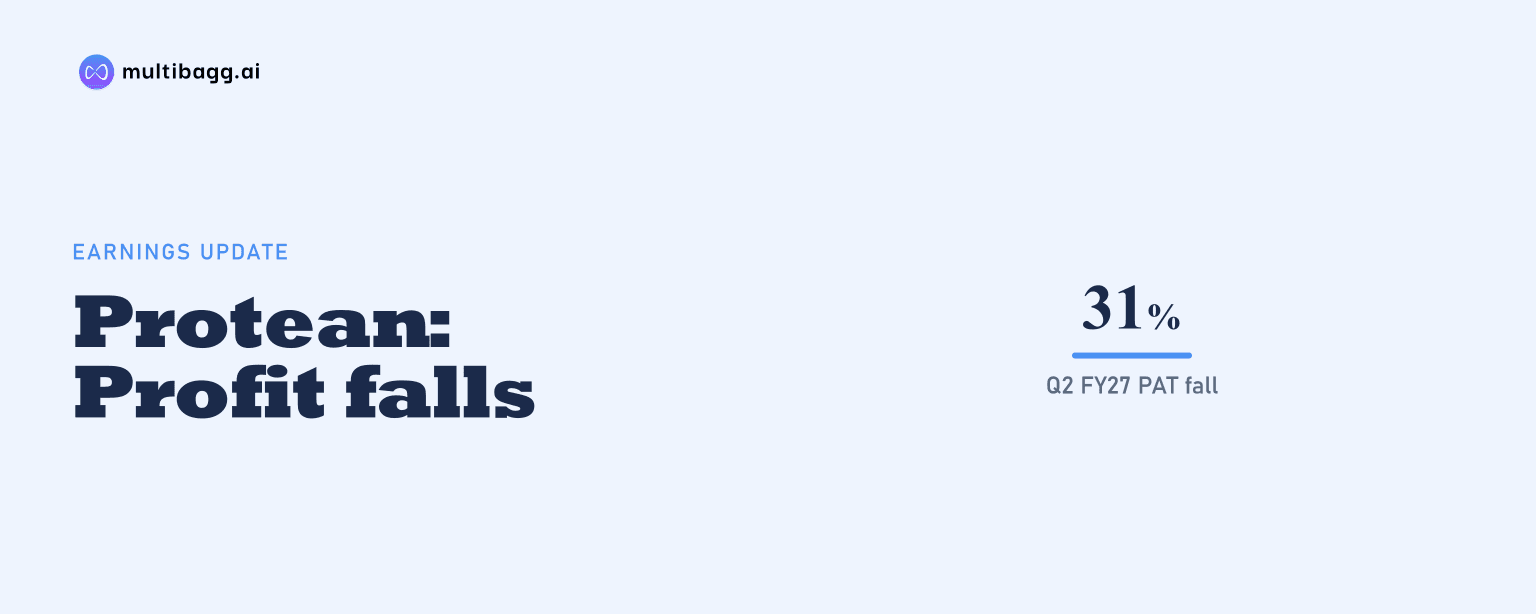
Protean eGov Technologies Limited said its CERSAI CKYCRR 2.0 and Aadhaar Seva Kendra mandates were almost fully rolled out as of October 2026, while Q2FY27 profit after tax fell 31% year-on-year to Rs 16 crore after Rs 10 crore of upfront investment in a key request-for-proposal, or RFP, project.
Know Protean eGov Technologies inside out
Results, valuation, peers and who's buying, in one view.
Why did Protean’s Q2FY27 profit decline?
Protean reported profit after tax, or PAT, of Rs 16 crore for Q2FY27, down 31% from Rs 24 crore in Q2FY26, after making Rs 10 crore of upfront investment for a key RFP project. PAT margin was 6% in the quarter, while Protean calculated normalised PAT at Rs 24 crore and normalised PAT margin at 8% after excluding the investment impact.
Revenue from operations rose 8% year-on-year to Rs 271 crore in the quarter ended September 30, 2026, from Rs 251 crore in Q2FY26. Revenue was also 8% higher than Rs 251 crore in Q1FY27, while PAT increased from Rs 6 crore in the preceding quarter, though it remained below the Rs 24 crore reported a year earlier.
Earnings before interest, tax, depreciation and amortisation, or EBITDA, was Rs 43 crore in Q2FY27, compared with Rs 44 crore in Q2FY26. EBITDA margin was 15%; excluding the Rs 10 crore implementation investment, Protean said EBITDA would have been Rs 53 crore, up 22% year-on-year, with an 18% margin.
Are Protean’s key RFP mandates close to completion?
Protean said the investment phase for its key RFP project was near completion and revenue generation from that project would accrue thereafter. It identified CERSAI CKYCRR 2.0 and Aadhaar Seva Kendra, or ASK, as its two key RFP mandates and said both were almost close to full rollout as of October 2026.
Protean had rolled out 187 ASK centres across 27 states and union territories by October 2026. Most of those centres were operational, and management said it foresaw greater predictability in ASK revenue in coming quarters, although the filing gave no revenue target, completion date or project-specific commercial terms.
New Initiatives generated Rs 42 crore in Q2FY27, or 16% of total revenue, compared with Rs 43 crore in Q2FY26 and Rs 42 crore in Q1FY27. The segment’s H1FY27 revenue nevertheless rose 56% to Rs 84 crore from Rs 54 crore in H1FY26, showing that first-half growth exceeded the quarter’s year-on-year movement.
Management said Protean had started seeing early traction in commercial adjacencies around the RFP projects and would pursue them aggressively. This is a management plan rather than reported project income because the announcement does not separately disclose revenue from CERSAI CKYCRR 2.0, ASK or related offerings.
Got a follow-up? Ask IRIS
Which businesses drove Protean’s Q2FY27 revenue growth?
Protean’s Tax Services and Identity Services were the fastest-growing disclosed segments in Q2FY27, rising 13% and 24% year-on-year, respectively. Tax Services generated Rs 121 crore against Rs 107 crore a year earlier, while Identity Services generated Rs 27 crore against Rs 22 crore.
Tax Services revenue also increased 22% sequentially from Rs 100 crore in Q1FY27. Protean reported a sequential market-share gain of 332 basis points, with one basis point equal to one-hundredth of a percentage point, and a 66% share of India’s PAN ecosystem; it issued 1.3 crore PAN cards during the quarter.
Assisted-mode applications accounted for more than 70% of Protean’s PAN issuances in Q2FY27. In Identity Services, 26% combined volume growth across four digital-identity facets supported revenue growth, while RISE with Protean processed 3.3 crore transactions and eSignPro added more than 25 enterprise customers in its first quarter of full monetisation.
What changed in Protean’s CRA Services business?
Protean’s central recordkeeping agency, or CRA, Services business, covering the National Pension System, Atal Pension Yojana and Unified Pension Scheme, generated Rs 80 crore in Q2FY27. That was 2% above Rs 78 crore in Q2FY26 but 2% below Rs 82 crore in Q1FY27; H1FY27 revenue increased 5% to Rs 161 crore from Rs 154 crore a year earlier.
Protean onboarded 47 lakh new subscribers in Q2FY27, 15% more than in the prior-year quarter, and said it held 95% market share among newly onboarded subscribers. It also added more than 1,400 corporates, its highest quarterly addition to date, and reported a 97% combined market share across the three pension schemes.
Under NPS Vatsalya, Protean added about 1.5 lakh subscribers in Q2FY27, its highest quarterly addition under the scheme. The subscriber and corporate additions were reported alongside 2% CRA Services revenue growth, while the filing did not provide a separate revenue figure for NPS Vatsalya.
Protean reported zero debt and about Rs 750 crore of cash and marketable securities as of September 30, 2026. Management said its stated priorities for the second half include Digital Public Infrastructure 2.0 capabilities, artificial-intelligence-led enterprise bundled solutions, global markets and disciplined capital allocation with a focus on profitability.
Conclusion
Protean’s Q2FY27 results combined 8% revenue growth to Rs 271 crore with a 31% decline in PAT to Rs 16 crore after Rs 10 crore of RFP implementation investment. The disclosed shift is that CERSAI CKYCRR 2.0 and ASK are nearing rollout completion, but the filing does not quantify the revenue expected from either mandate.
The next results will show whether the 187 ASK centres operating across 27 states and union territories deliver the revenue predictability management expects. Investors can also watch for evidence of income from commercial adjacencies, alongside management’s disclosed plans to develop DPI 2.0, enterprise solutions and international opportunities.