










Q-Line Biotech: CARE flags Rs 22.97 crore tracing limits
Key highlights
- CARE reported no IPO-object deviation for Q-Line in the quarter ended September 30, 2026.
- Q-Line transferred Rs 22.97 crore from the monitoring account to its current account before Q2FY27 deployment.
- CARE said commingling limited direct end-use tracing of Rs 22.97 crore and required reliance on certificates.
- Q-Line’s June 30, 2026 statement showed Rs 115.10 crore of IPO proceeds remained unutilised.
powered by IRIS
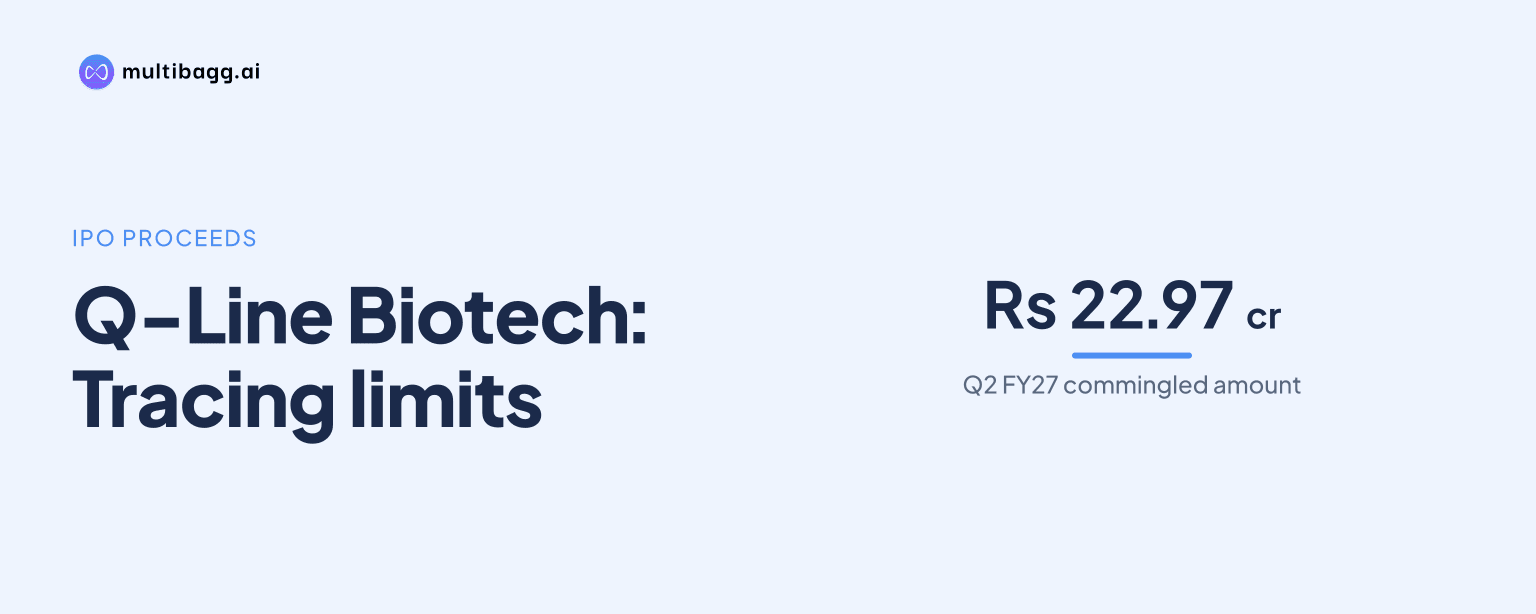
Q-Line Biotech Limited’s September-quarter IPO monitoring report recorded no deviation, but CARE Ratings Limited said Rs 22.97 crore routed through a current account could not be directly traced after commingling, leaving it reliant on management and Chartered Accountant certificates for end-use confirmation.
Know Q-Line Biotech inside out
Results, valuation, peers and who's buying, in one view.
What did CARE report on Q-Line’s IPO proceeds in Q2FY27?
CARE reported no deviation from the objects of Q-Line’s Rs 214.48 crore initial public offering, or IPO, for the quarter ended September 30, 2026. The monitoring agency marked the range of deviation as not applicable and said it considered management certification, bank statements and a Chartered Accountant certificate dated November 5, 2026.
The agency said Q-Line transferred the full Rs 22.97 crore utilised during Q2FY27 from its monitoring account to its current account before deploying it. The management and Chartered Accountant certificates identified Rs 9.50 crore for working-capital requirements and Rs 13.47 crore for repayment or prepayment of borrowings. CARE issued its monitoring report on November 12, 2026.
CARE also stated that it does not perform an audit or independently verify every certification, statement and document it receives. Its report said the monitoring conclusion was based on information provided by Q-Line and on sources CARE considered accurate and reliable, rather than on an audit of end-use transactions.
Why could CARE not directly trace Q-Line’s Rs 22.97 crore deployment?
CARE said it could not directly ascertain the end use of Rs 22.97 crore because the IPO proceeds were mixed with other cash flows after their transfer to Q-Line’s current account. Although CARE reviewed bank statements, it said commingling limited its ability to trace the issue proceeds directly to final deployment and required reliance on management and Chartered Accountant certificates.
Q-Line said HDFC Bank could not enable net banking for the monitoring account, so it routed working-capital payments through its current account. The board’s comments said this included an advance income-tax payment of Rs 7.50 crore. The certificates reviewed by CARE recorded Rs 9.50 crore as use for working-capital requirements.
For the Rs 13.47 crore debt repayment or prepayment, Q-Line said HDFC Bank’s IPO banking team declined a request to transfer the loan-closure amount directly from the monitoring account to the loan account. Q-Line said the bank’s loan team required a cheque in HDFC Bank’s favour, while the cheque facility was available only on the current account, leading to the transfer and subsequent cheque payment.
How was Q-Line’s Rs 214.48 crore IPO allocated?
Q-Line allocated Rs 214.48 crore of gross IPO proceeds among four disclosed objects: Rs 93.50 crore for working capital, Rs 90 crore for repayment of certain borrowings, Rs 5.09 crore for general corporate purposes and Rs 25.89 crore for issue-related expenses. CARE identified the offer as an SME IPO that ran from May 21, 2026 to May 25, 2026.
The earlier utilisation statement as of June 30, 2026 showed Rs 99.38 crore deployed, entirely for borrowing repayment and issue-related expenses. No utilisation was recorded for working capital or general corporate purposes at that date, and Rs 115.10 crore remained unutilised in the IPO account.
The June 30 statement, certified by R K Jagetiya & Co. on August 9, 2026, reported no revision to any IPO object. It treated payments from the IPO escrow account at gross amounts including applicable goods and services tax, or GST. Its treatment of tax deducted at source depended on whether that tax was paid through the IPO account.
Got a follow-up? Ask IRIS
What changed between Q1FY27 and Q2FY27?
The reported use of IPO proceeds changed between the two periods. By June 30, 2026, Q-Line had used Rs 76.44 crore for borrowing repayment and Rs 22.94 crore for issue expenses, while Q2FY27 included Rs 9.50 crore of working-capital use and Rs 13.47 crore for borrowing repayment or prepayment.
The evidence trail available to CARE also changed in Q2FY27. The June 30 utilisation statement was prepared from actual deployment through the IPO escrow account, whereas CARE said the Q2FY27 amount was first moved from the monitoring account to the current account. Bank statements supported the transfer, but the agency used management and Chartered Accountant certificates to link the Rs 22.97 crore to disclosed objects.
CARE said management certification indicated no change in the means of finance for the disclosed IPO objects. It also said no major deviation was observed in Q2FY27, while shareholder approval for a material deviation was not applicable because no material deviation was reported.
What was Q-Line’s earlier bank-charge matter?
CARE recorded that bank charges of Rs 98 lakh relating to facilities from Vivriti Capital Limited and Oxyzo Financial Company were paid from the monitoring account during Q1FY27. The agency said this was a deviation from the offer-document objects because prepayment of borrowings was to be funded from Q-Line’s internal accruals.
During Q2FY27, Q-Line reversed the Rs 98 lakh of bank charges to the monitoring account. CARE noted that the amount had already been reported as utilised in Q1FY27, distinguishing the earlier matter from its Q2FY27 conclusion that no major deviation was observed.
CARE also referred to disclosures involving Q-Line’s erstwhile associate, POCT. Q-Line divested its 49% stake in POCT on March 20, 2025, after which POCT ceased to be an associate. CARE said possible regulatory inquiries or liabilities related to the period when POCT was an associate could not be completely ruled out, while Q-Line said no liability had crystallised as of the board comments.
Conclusion
Q-Line’s Q2FY27 monitoring report found no deviation from its IPO objects, but it documented a traceability limitation for Rs 22.97 crore that was first routed through a current account. CARE could review the transfer and supporting records, yet said it could not directly trace commingled proceeds to final use and therefore relied on management and Chartered Accountant certifications.
The next relevant disclosure is whether later utilisation reporting provides an updated balance from the Rs 115.10 crore unutilised as of June 30, 2026, including the Rs 93.50 crore initially allocated to working capital. Investors can also watch for any further information on the reversed Rs 98 lakh bank charges and the unresolved POCT matter, for which CARE said potential regulatory inquiries or liabilities could not be fully ruled out.