










Radhe Developers reviewer flags absent Ind AS 19 gratuity provision
Key highlights
- Radhe Developers’ reviewer said no gratuity provision was made for the quarter ended September 30, 2026.
- The reviewer said the missing provision was not in accordance with Ind AS 19.
- The November 6, 2026 report says the reviewer did not review the September-quarter results and other financial information.
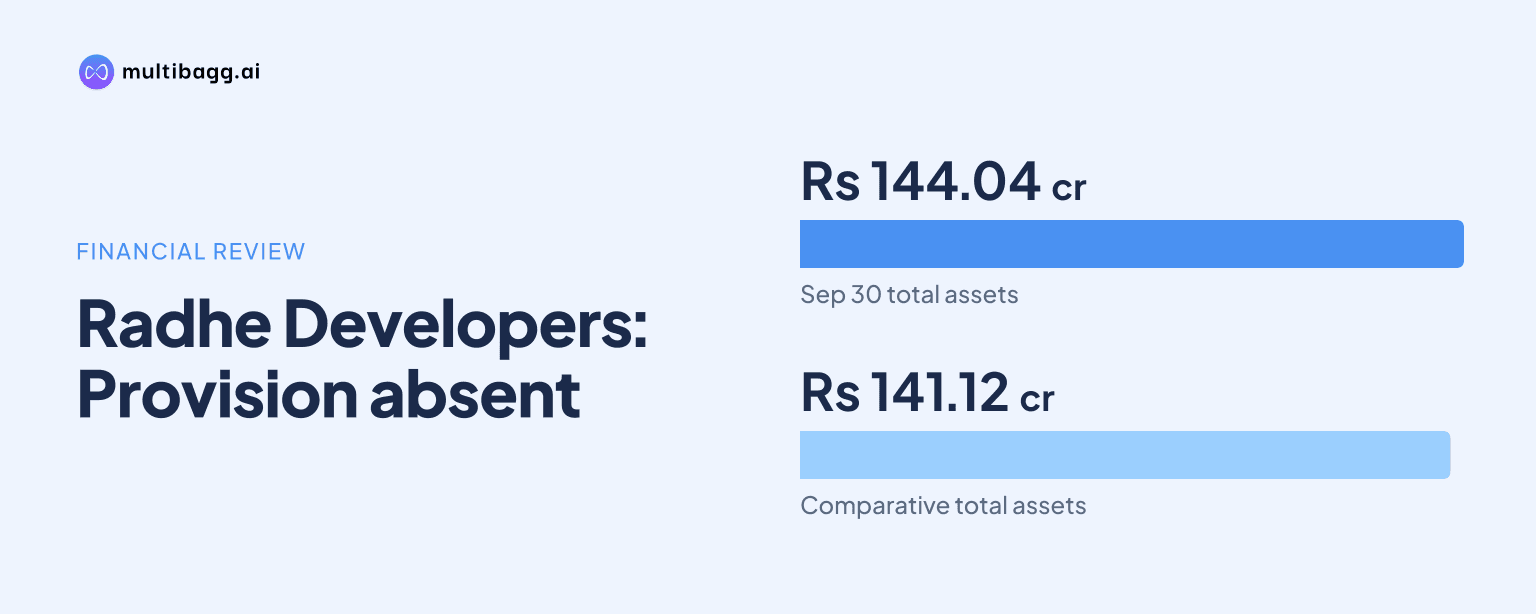
- Radhe Developers reported total assets of Rs 144.0444 crore at September 30, 2026, versus Rs 141.115 crore in the comparative balance-sheet column.
powered by IRIS
Radhe Developers (India) Limited’s reviewer said the quarter ended September 30, 2026 included no gratuity provision, a treatment stated to be inconsistent with Indian Accounting Standard 19, or Ind AS 19. The limited-review report dated November 6, 2026 also says the reviewer did not review the accompanying quarterly financial results and other financial information.
Know Radhe Developers (India) inside out
Results, valuation, peers and who's buying, in one view.
What did Radhe Developers’ reviewer flag?
Radhe Developers’ reviewer flagged that no provision had been made for gratuity in the quarterly results for the period ended September 30, 2026. The reviewer stated that the absence of this provision was not in accordance with the accounting prescribed under Ind AS 19, making it the specific exception identified in the report dated November 6, 2026.
The filing does not disclose a rupee value for the gratuity provision that was not recorded at September 30, 2026. It also does not quantify an effect on quarterly profit, employee-benefit expense, liabilities, total equity or cash flow. The report therefore identifies an accounting departure, but does not provide figures from which readers can calculate the financial impact.
The balance sheet does show non-current provisions of Rs 24.56 lakh and current provisions of Rs 11.69 lakh at September 30, 2026. However, Radhe Developers does not identify either balance as gratuity in the supplied filing. Those reported provisions cannot therefore be used to infer that a gratuity liability was recognised despite the reviewer’s express observation.
Did the reviewer audit Radhe Developers’ September 2026 results?
No. Radhe Developers’ reviewer said the work was conducted under Standard on Review Engagement 2410, or SRE 2410, and that no audit was performed or audit opinion expressed. The report describes a review as relying principally on inquiries of company personnel and analytical procedures, providing less assurance than an audit.
The report says the reviewer planned and performed work to obtain moderate assurance that the financial statements were free from material misstatement. This description relates to the limited-review framework applied to the unaudited statement submitted under Regulation 33 of the Securities and Exchange Board of India, or SEBI, Listing Obligations and Disclosure Requirements Regulations, 2015.
Separately, the reviewer stated that it had not reviewed the accompanying financial results and other financial information for the quarter ended September 30, 2026. According to the report, that information was presented solely on the basis of information compiled by management and approved by the Board of Directors, an explicit limitation readers must consider alongside the stated Ind AS 19 exception.
What rules did Radhe Developers cite for the results?
Radhe Developers said its results for the quarter and half year ended September 30, 2026 were prepared under the Companies (Indian Accounting Standards) Rules, 2015. The company said those rules were prescribed under Section 133 of the Companies Act, 2013 and read with the relevant rules issued under that law.
The company also said the results were prepared in terms of Regulation 33 of the SEBI Listing Obligations and Disclosure Requirements Regulations, 2015. The reviewer referred to SEBI Circular CIR/CFD/CMD1/80/2019 dated July 19, 2019 when describing the disclosure requirements applicable to the unaudited September-quarter statement.
After setting out the scope of its work, the reviewer said nothing had come to its attention to indicate that the statement failed to disclose required information or contained a material misstatement, except for the gratuity matter. This wording does not quantify the matter at September 30, 2026, and it does not state that management had corrected the omission before the Board approval on November 6, 2026.
Got a follow-up? Ask IRIS
What do the September 2026 balance-sheet figures show?
Radhe Developers reported total assets of Rs 144.0444 crore at September 30, 2026, compared with Rs 141.115 crore in the comparative balance-sheet column. The increase was Rs 2.9294 crore. Inventories increased by Rs 2.98 crore to Rs 55.7483 crore, while cash and cash equivalents rose by Rs 11.56 lakh to Rs 38.70 lakh.
Borrowings were Rs 24.7213 crore at September 30, 2026, compared with Rs 22.3819 crore in the comparative balance-sheet column, an increase of Rs 2.3394 crore. Other equity declined by Rs 2.3686 crore to Rs 12.9301 crore, whereas equity share capital remained unchanged at Rs 54.8882 crore in both columns.
The balance sheet also reported other non-current assets of Rs 33.74 crore at September 30, 2026, unchanged from the comparative column. Other financial assets were Rs 38.3614 crore, compared with Rs 38.462 crore, while property, plant and equipment was Rs 4.9394 crore, down from Rs 5.4023 crore.
How did Radhe Developers approve and classify the results?
Radhe Developers said its Audit Committee reviewed the financial results for the quarter ended September 30, 2026 before the Board of Directors approved them on Friday, November 6, 2026. The company also said it had restated or regrouped corresponding previous-period figures where necessary to make them comparable.
Management classified Radhe Developers’ operations as Construction, its only reportable segment, under Ind AS 108, Operating Segments. The company said this classification reflected how senior management reviewed operations. The supplied results therefore do not provide a separate segment comparison beyond the single Construction business.
Radhe Developers also stated that consolidated financial statements were not applicable to the company. This means the September 30, 2026 filing presents the company’s stated standalone financial reporting position. The reviewer’s gratuity observation concerns the quarterly results presented on that basis, rather than a disclosed consolidated set of results.
The cash-flow statement reported cash and cash equivalents of Rs 38.70 lakh at the end of the September 30, 2026 period, against Rs 27.14 lakh in the comparative balance-sheet column. That increase in cash does not resolve the unquantified gratuity matter because the filing does not disclose the amount, timing or accounting entry associated with the missing provision.
Conclusion
The filing’s central finding is narrow but clear: Radhe Developers’ quarterly results for September 30, 2026 did not include a gratuity provision that the reviewer said was required under Ind AS 19. The report pairs that exception with two scope statements: the work was not an audit, and the reviewer said it had not reviewed the accompanying quarterly results and other financial information.
The unresolved matter is the amount and financial-statement effect of the omitted gratuity provision. Readers should watch for a subsequent Radhe Developers disclosure that quantifies the provision, revises the September 30, 2026 figures, or explains whether the issue has been addressed after the Board approved the quarter and half-year results on November 6, 2026.