










Rajasthan Tube shifts legacy dues to its outgoing promoter
Key highlights
- Rajasthan Tube’s MoU makes Harish Chand Jain responsible for liabilities incurred before 28 June 2025.
- The MoU identifies approximately Rs 2.47 crore of SBI facilities, including a Rs 1.70 crore cash-credit limit.
- Debtor recoveries and security deposits existing on 28 June 2025 are to be used first against the SBI facilities.
- A GST payment shortfall after applying debtor receivables is to be borne by Harish Chand Jain under the MoU.
powered by IRIS
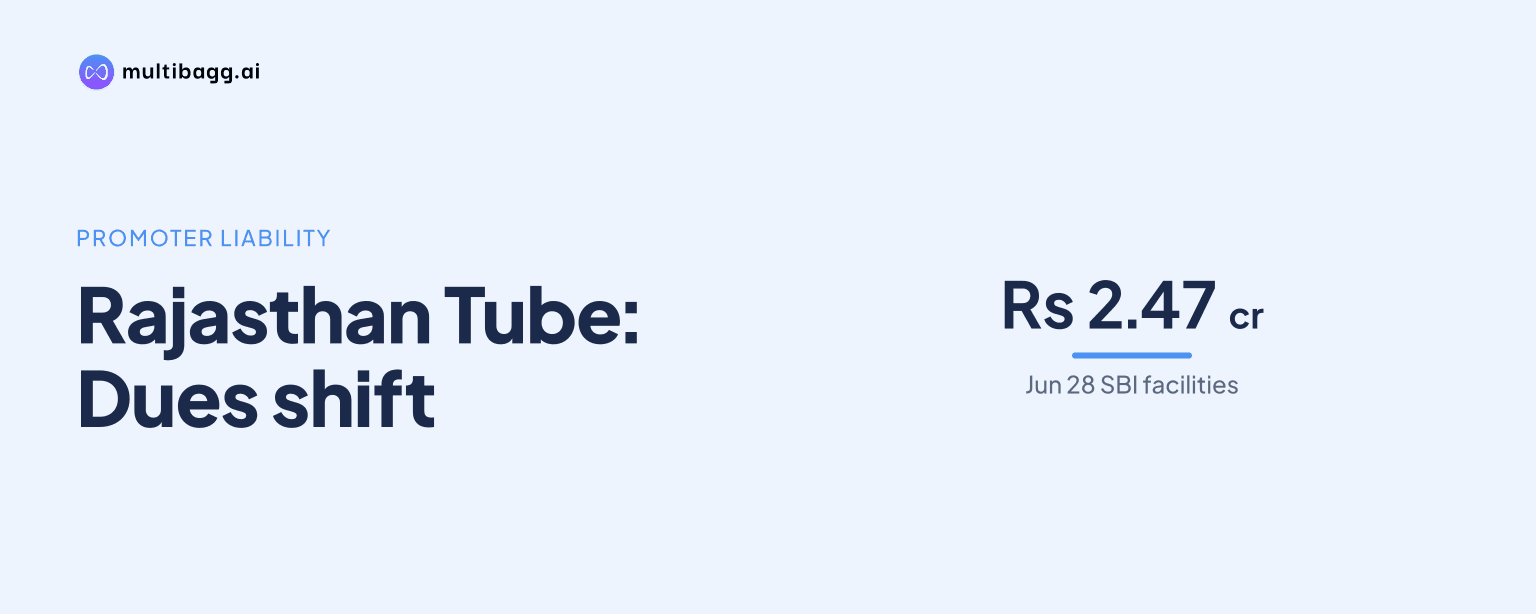
Rajasthan Tube Manufacturing Company Limited’s 28 June 2025 memorandum of understanding assigns liabilities incurred before the handover to outgoing promoter Harish Chand Jain, while identifying approximately Rs 2.47 crore of State Bank of India facilities in the company’s books. Incoming management assumes obligations arising from the effective date, subject to specific terms for bank debt, guarantees and a pending GST case.
Know Rajasthan Tube Manufacturing Co inside out
Results, valuation, peers and who's buying, in one view.
Which Rajasthan Tube liabilities remain with the outgoing promoter?
All Rajasthan Tube debts, dues, claims and liabilities incurred before 28 June 2025 are Harish Chand Jain’s responsibility under the memorandum of understanding, or MoU. The MoU defines liabilities to include financial, statutory, legal, contractual and contingent obligations, extending the allocation beyond recorded borrowings or trade payables.
Rajasthan Tube said it had no liabilities, including sundry creditors, in its books as at 28 June 2025 except two State Bank of India, or SBI, facilities and a contingent liability reported in its balance sheet for the year ended 31 March 2025. The MoU does not disclose the amount or nature of the contingent liability, so the document does not allow its potential financial effect to be quantified.
The allocation changes from 28 June 2025. Harish Chand Jain is responsible for liabilities incurred before that date, while the incoming management, comprising Chanchal, Pankaj Jain, Mahendra Kumar Modi and Prashant Sharma, takes responsibility for debts, dues, claims and liabilities arising on or after the effective date.
How will Rajasthan Tube settle its SBI facilities?
Rajasthan Tube will apply recoveries from debtors and security deposits existing on 28 June 2025 to its Rs 1.70 crore cash-credit limit and approximately Rs 0.77 crore working-capital term loan. The MoU assigns Harish Chand Jain the task of realising those debtors and deposits and using the proceeds to repay the SBI facilities.
Harish Chand Jain must pay any amount left after those recoveries are applied against the approximately Rs 2.47 crore of specified SBI borrowings. In the opposite scenario, if debtor and security-deposit recoveries exceed the outstanding cash-credit limit and term loan, Rajasthan Tube and the incoming management must pay the surplus to him.
This repayment mechanism differs from the MoU’s general division by date. While incoming management assumes Rajasthan Tube’s operations, administration, finances and liabilities from 28 June 2025, the identified SBI debt is linked to receivables and deposits that existed at handover, with the outgoing promoter carrying the collection shortfall.
The MoU also covers personal guarantees given by Harish Chand Jain to banks for Rajasthan Tube. If the company wishes to retain the cash-credit facility after 28 June 2025, incoming management agrees to take necessary steps to revoke and replace his guarantees with new-management guarantees, and the MoU says he will not be liable for their invocation after that date.
Who bears Rajasthan Tube’s GST litigation costs and shortfall?
Rajasthan Tube must bear litigation costs, fees and expenses for its pending Goods and Services Tax, or GST, appeal before the Additional Commissioner of Central GST, while Harish Chand Jain will pursue the matter. The company and incoming management must issue him an irrevocable power of attorney to appear, file documents and take necessary steps in the appeal.
The arrangement also applies to later proceedings before a tribunal, High Court or Supreme Court arising from the same GST matter. Harish Chand Jain is to pursue those proceedings, while Rajasthan Tube must provide cooperation, documentation and support; the MoU says the company will be responsible for its inaction if it fails to cooperate.
If the GST outcome is adverse, Rajasthan Tube must first use receivables from various debtors to pay the resulting GST dues. If those receivables leave a shortfall, Harish Chand Jain must bear it; if the outcome favours Rajasthan Tube, any corresponding benefit or refund is payable to him under the MoU.
The GST terms therefore separate litigation funding from the final financial outcome. Rajasthan Tube pays the costs of the appeal and first applies debtor receivables to an adverse liability, but the outgoing promoter bears any remaining shortfall and receives any refund or benefit from a successful result.
Got a follow-up? Ask IRIS
What control and indemnity terms apply after 28 June 2025?
Rajasthan Tube’s incoming management assumed full and exclusive control over management, operations, administration, finances and liabilities from 28 June 2025, according to the MoU. The incoming side confirmed receipt of production, sales, purchase, administration, plant and machinery, and related records as part of the handover.
The MoU says the outgoing directors were to resign on 28 June 2025, with the board to record and accept those resignations and file Form DIR-12 with the Registrar of Companies within the prescribed statutory period. The reconstituted board could designate new banking and legal signatories, while incoming management was to update bank mandates, statutory registers and communications with authorities.
For post-handover matters, incoming management agreed to indemnify Harish Chand Jain against liabilities, claims, penalties, costs and proceedings connected with Rajasthan Tube’s affairs after 28 June 2025. The indemnity specifically refers to matters involving GST, income tax, labour authorities, the Employees’ Provident Fund Organisation, the Registrar of Companies, Securities and Exchange Board of India and Reserve Bank of India.
The indemnity also applies if Harish Chand Jain’s personal guarantee is invoked for liabilities arising after 28 June 2025 or for liabilities not disclosed before that date. Separately, he represented that, to the best of his knowledge and belief, pre-handover liabilities, statutory obligations and ongoing litigation had been disclosed to incoming management.
How would a Rajasthan Tube MoU dispute be resolved?
A Rajasthan Tube dispute under the MoU must first go through mutual negotiations within 30 days after written notice is given by either party. If the matter remains unresolved after that period, it must be referred to arbitration under the Arbitration and Conciliation Act, 1996.
The MoU provides for a sole arbitrator appointed by mutual consent. If the parties cannot agree within 15 days after arbitration is initiated, the appointment is to follow Section 11 of the Arbitration and Conciliation Act, 1996; Jaipur, Rajasthan is both the seat and venue, and proceedings will be conducted in English.
Arbitration costs will be shared equally unless the arbitrator decides otherwise, and an award will be final, binding and enforceable, according to the MoU. Subject to arbitration, Jaipur courts have exclusive jurisdiction over disputes, including disagreements over debtor recoveries, the SBI facilities, guarantees or GST-related obligations.
Conclusion
Rajasthan Tube’s 28 June 2025 MoU separates historical and future liabilities but makes targeted exceptions for the approximately Rs 2.47 crore SBI facilities and the pending GST matter. Harish Chand Jain remains responsible for pre-handover liabilities, an SBI repayment shortfall after collections, and any residual GST shortfall, while incoming management takes obligations arising from the effective date.
The next items to watch are recovery of the debtors and security deposits assigned to the SBI repayment, steps to replace the outgoing promoter’s bank guarantees, and the result of the GST appeal before the Additional Commissioner of Central GST. Any implementation dispute first requires a 30-day negotiation period before arbitration in Jaipur.