










Rajesh Power aligns with India’s Rs 1.86 lakh crore GEC-III plan
Key highlights
- GEC-III has a Rs 1.86 lakh crore project outlay to support up to 135 GW of renewable-energy evacuation and 50 GWh of battery storage.
- Rajesh Power’s unexecuted order book stood at Rs 3,647 crore on 30 September 2026, with distribution accounting for 71% and transmission for 29%.
- During H1 FY27, Rajesh Power installed 2,747 ring main units, 310 distribution transformers and laid 10,815 kilometres of MVCC cable.
- Rajesh Power’s 65 MW, 130 MWh BESS project has a two-hour discharge duration, a 12-year BESPA and a commissioning target within 18 months of March 2026.
powered by IRIS
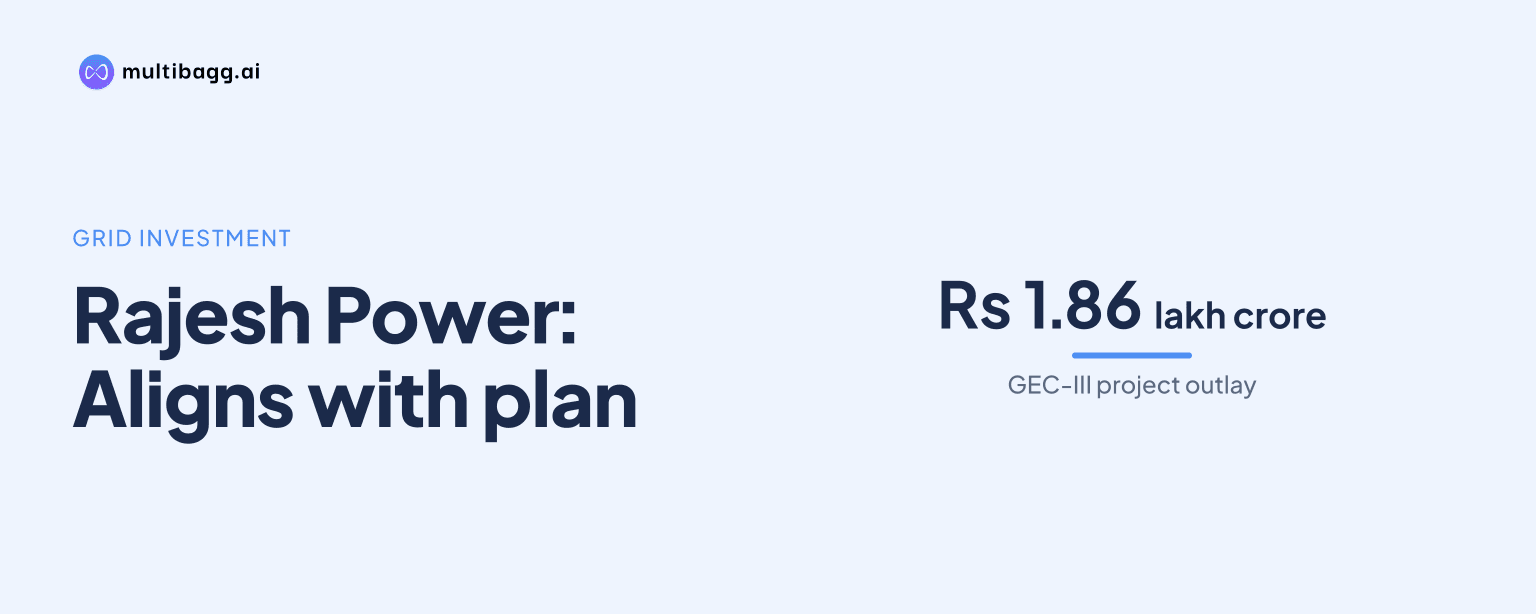
Rajesh Power Services Limited is positioning its transmission, distribution, underground-cabling and storage capabilities for India’s grid-modernisation agenda and the approved GEC-III scheme. The largest disclosed opportunity is GEC-III’s Rs 1.86 lakh crore project outlay, which is intended to support evacuation of up to 135 gigawatts (GW) of renewable energy and 50 gigawatt-hours (GWh) of battery storage.
Know Rajesh Power Services inside out
Results, valuation, peers and who's buying, in one view.
How does Rajesh Power fit the proposed grid-modernisation policy?
Rajesh Power fits the proposed policy direction through its transmission and distribution activities, while the Draft National Electricity Policy 2026 identifies capacity expansion, reliability, sustainability and financial viability as priorities. The Ministry of Power’s draft targets per-capita electricity consumption of 2,000 kilowatt-hours (kWh) by 2030 and more than 4,000 kWh by 2047, alongside transmission expansion and renewable-energy integration.
The draft proposes large-scale transmission expansion, renewable and conventional transmission tariff parity by 2030, and optimised right-of-way (RoW) compensation. It also proposes single-digit aggregate technical and commercial (AT&C) losses, underground cabling and N-1 network redundancy in cities with populations above 10 lakh by 2032. Rajesh Power says these measures align with its extra-high-voltage and high-voltage lines, substations, engineering, procurement and construction (EPC) work, and urban distribution capability; this is its stated positioning rather than a disclosed award forecast.
What is the size and purpose of the GEC-III opportunity?
GEC-III is a government-approved scheme to strengthen Intra-State Transmission Systems (InSTS) and deploy battery energy storage systems (BESS). Its Rs 1.86 lakh crore project outlay includes Rs 1,36,000 crore for InSTS development and Rs 50,000 crore for 50 GWh of BESS, while the transmission system is intended to evacuate up to 135 GW of renewable power across states and Union Territories.
The scheme is intended to manage renewable intermittency, transmission congestion, peak-hour curtailment and demand during non-solar hours. Rajesh Power says GEC-III can create an opportunity pipeline in intra-state transmission, grid strengthening and renewable-power evacuation. The Rs 1,36,000 crore InSTS allocation is larger than the Rs 50,000 crore BESS allocation, linking more directly to Rajesh Power’s established transmission, substation and cable work, while storage corresponds with its newer BESS activity.
What execution record supports Rajesh Power’s positioning?
Rajesh Power’s H1 FY27 work included installation of 2,747 ring main units (RMUs) and 310 distribution transformers, taking cumulative installations to 17,247 RMUs and 6,510 transformers. These distribution assets correspond with the Draft National Electricity Policy 2026’s proposed focus on urban network reliability, underground cabling and N-1 redundancy.
During H1 FY27, Rajesh Power laid 905 kilometres of low-tension and high-tension 11 kilovolt cables, 10,815 kilometres of medium-voltage covered conductor (MVCC) cable and 157 kilometres of extra-high-voltage cable. Cumulative cable lengths were 11,405 kilometres for low- and high-tension cable, 34,815 kilometres for MVCC cable and 2,707 kilometres for extra-high-voltage cable. It also commissioned four air-insulated substations, taking its cumulative total to 104, and reported about 25,000 kilometres of MVCC cable under execution.
Got a follow-up? Ask IRIS
How do storage and digital systems extend Rajesh Power’s opportunity set?
Rajesh Power has a 65 megawatt (MW), 130 megawatt-hour (MWh) utility-scale BESS project developed through subsidiary Rajesh Power Projects Private Limited. The project has a two-hour discharge duration and a 12-year Battery Energy Storage Purchase Agreement (BESPA), providing exposure to the grid-flexibility functions that GEC-III assigns to 50 GWh of planned BESS capacity.
Gujarat Urja Vikas Nigam Limited awarded the BESS project through Phase VII competitive bidding at a tariff of Rs 1.89 lakh per MW per month. The project is backed by viability gap funding from the Power System Development Fund and has a commissioning target within 18 months of the March 2026 BESPA. Separately, group investee HKRP Innovations Limited reports centralising more than 2,400 distribution substations on a single supervisory control and data acquisition (SCADA) platform and monitoring more than 40,000 nodes and 15,000 MW, connecting Rajesh Power to the draft policy’s SCADA indigenisation and grid-operations measures.
What does Rajesh Power’s order book show about its current base?
Rajesh Power reported an unexecuted order book of Rs 3,647 crore on 30 September 2026, compared with Rs 3,326 crore on 1 April 2026. During H1 FY27, it received Rs 1,250 crore of fresh orders and executed Rs 929 crore of projects. It separately disclosed Rs 458 crore of orders received in October 2026, after the 30 September order-book date.
Power distribution accounted for Rs 2,579 crore, or 71%, of the 30 September 2026 order book, while power transmission represented Rs 1,068 crore, or 29%. Distribution orders include work for government and private distribution companies, turnkey projects and original equipment manufacturer services, while transmission work includes state transmission utilities and extra-high-voltage enhancement projects. The split shows distribution is the larger current segment, whereas GEC-III is described as a future pipeline across intra-state transmission, grid strengthening and renewable evacuation.
Conclusion
Rajesh Power’s disclosed opportunity case combines the Rs 1.86 lakh crore GEC-III programme with proposed electricity-policy measures on transmission expansion, urban distribution, storage and digital grid operations. Its H1 FY27 installation of 2,747 RMUs, 10,815 kilometres of MVCC cable and four air-insulated substations provides operating evidence across the infrastructure categories identified in its policy positioning.
The next disclosed milestones are the BESS project’s target commissioning within 18 months of the March 2026 BESPA and any future tender or contract disclosures tied to GEC-III. Rajesh Power has not disclosed the value, timing or conversion rate of GEC-III-related orders, while the draft policy’s proposed 2032 urban-cabling and redundancy measures remain subject to policy implementation.