










Rajesh Power Services Ltd says underground EPC shortens cycles
Key highlights
- Rajesh Power says underground EPC projects are completed in 18 to 24 months, versus multi-year conventional transmission EPC cycles.
- HKRP SCADA manages more than 1,500 substations, while the company’s services span 1.1 kV to 400 kV.
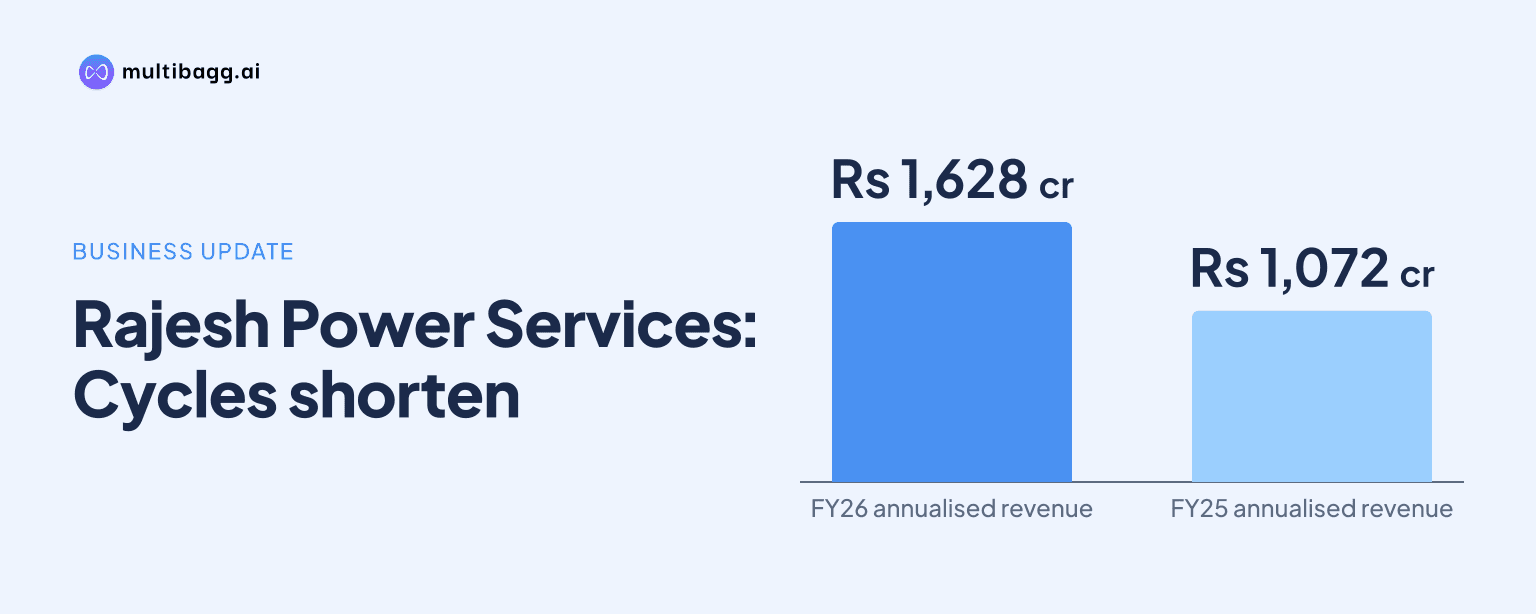
- FY26 annualised revenue rose to Rs 1,628 crore from Rs 1,072 crore in FY25, while EBITDA increased to Rs 197 crore from Rs 124 crore.
- Rajesh Power cites a 65 MW/130 MWh GUVNL battery-storage project with a 12-year tariff as its disclosed BESS activity.
powered by IRIS
Rajesh Power Services Ltd says its underground-cabling focus reduces the right-of-way exposure associated with conventional transmission projects and supports completion within 18 to 24 months rather than traditional multi-year transmission engineering, procurement and construction, or EPC, cycles. The company is extending this model across transmission, battery storage and grid-management technology.
Know Rajesh Power Services inside out
Results, valuation, peers and who's buying, in one view.
Why does Rajesh Power use underground cabling?
Rajesh Power uses underground cabling because it says these are typically right-of-usage projects with minimal delays and regulatory issues compared with conventional transmission projects requiring right-of-way. Its stated distinction is structural: the company aims to limit exposure to right-of-way processes while executing transmission and distribution, or T&D, work.
Rajesh Power says its projects are completed in 18 to 24 months, compared with multi-year traditional transmission EPC projects. The presentation does not disclose an average cost, margin or completion time for conventional projects, so its comparison is limited to the stated difference in project duration and right-of-way exposure.
The company offers services across 1.1 kilovolts to 400 kilovolts, including transmission, distribution, operations and maintenance, underground cabling and gas-insulated switchgear, or GIS, specialisation. Its full-stack EPC scope runs from design and supply through construction and commissioning, allowing it to combine cable work with associated grid infrastructure.
How does Rajesh Power combine EPC with grid technology?
Rajesh Power combines EPC with grid technology through HKRP supervisory control and data acquisition, or SCADA, systems that it says manage more than 1,500 substations. The company also lists integrated hardware and software for ring main units, or RMUs, fault passage indicators, or FPIs, and feeder remote terminal units, or FRTUs, across field networks.
Its advanced distribution management system, or ADMS, is intended to enable end-to-end digital grid operations, while digital tools and automation are identified as project-efficiency mechanisms. Rajesh Power describes this combination of field hardware, control systems and EPC delivery as an integrated power-infrastructure and technology platform.
The platform has different disclosed stages. Battery energy storage system, or BESS, EPC is operational, while distribution intelligence has an order secured for SCADA, full ADMS and RMU, FPI and FRTU hardware. Artificial intelligence, or AI, based demand forecasting is in pilot stages with distribution companies, or discoms, and the company says it is advancing towards data-centre EPC.
Got a follow-up? Ask IRIS
Where is Rajesh Power expanding this execution model?
Rajesh Power identifies Gujarat as an operational T&D market, citing emerging mega solar clusters and upcoming grid-infrastructure projects. The presentation does not quantify the Gujarat opportunity, but positions the state as the operating base for its transmission and distribution model.
Other Indian states are also designated operational for transmission. Rajesh Power says it is replicating its Gujarat-proven approach pan-India, with a focused scope of GIS substations and last-mile extra-high-voltage, or EHV, cable under right-of-usage rather than right-of-way arrangements.
International territories are likewise marked operational, with Rajesh Power describing its plan as exporting the integrated capability stack to overseas grid-modernisation markets. The presentation provides no country list, contract value, commissioning date or revenue contribution, leaving the scale and timing of international work undisclosed.
The 65-megawatt and 130-megawatt-hour GUVNL BESPA is the most specific disclosed storage activity, with a 12-year tariff. Rajesh Power presents BESS EPC as operational for both grid and renewable applications, but does not state a target for further storage projects or indicate whether the cited project will be replicated.
What financial change has accompanied Rajesh Power's expansion?
Rajesh Power reported annualised revenue of Rs 1,628 crore in FY26, up from Rs 1,072 crore in FY25 and Rs 285 crore in FY24. Annualised earnings before interest, tax, depreciation and amortisation, or EBITDA, increased to Rs 197 crore in FY26 from Rs 124 crore in FY25, while EBITDA margin rose to 12.1% from 11.6%.
Profit after tax, or PAT, increased to Rs 143 crore in FY26 from Rs 97 crore in FY25, although PAT margin moved down to 8.8% from 9.0%. The company reports that FY23 and FY24 figures are standalone, whereas FY25 figures are consolidated following HKRP Innovations Limited's conversion from a limited liability partnership to a public limited company on July 20, 2024.
Rajesh Power adopted Indian Accounting Standards, or Ind AS, effective April 1, 2025, and says the half year ended September 30, 2024 and year ended March 31, 2025 were restated for Ind AS compliance. Return on capital employed rose from 39.67% in FY25 to 43.65% in FY26, while return on equity declined from 36.48% to 35.26% and debt to equity increased from 0.29 to 0.31.
Conclusion
Rajesh Power's stated model combines underground, right-of-usage cable work with GIS, distribution infrastructure and digital-grid systems to shorten project cycles relative to multi-year conventional transmission EPC. Its operating platform spans 1.1 kilovolts to 400 kilovolts, while HKRP SCADA manages more than 1,500 substations and FY26 annualised revenue reached Rs 1,628 crore.
The next disclosed markers are pan-India replication of the GIS-substation and last-mile EHV cable model, work in operational international territories and the progress of AI demand-forecasting pilots with discoms. BESS EPC is already operational through the 65-megawatt and 130-megawatt-hour GUVNL BESPA with a 12-year tariff, while data-centre EPC remains an area the company says it is advancing towards.