










Reliance Communications Limited loses spectrum amid ₹41,309 crore debt
Key highlights
- RCom reported total financial indebtedness of ₹41,309 crore as of September 2026.
- The DoT terminated spectrum held by RCom and RTL across 13 circles on October 5.
- RCom reported ₹27,673 crore of bank and institutional loans as of September 2026.
- The ED has provisionally attached ₹19,344 crore of assets against group outstanding loans of ₹40,185 crore.
powered by IRIS
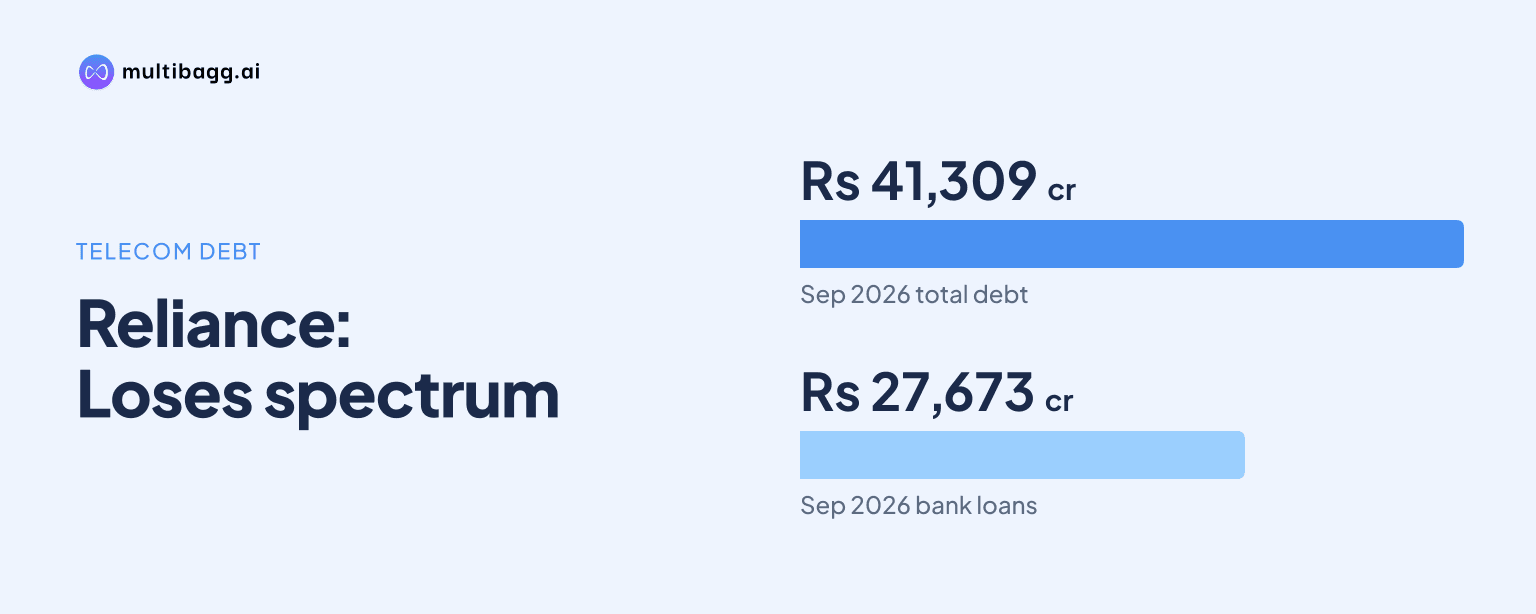
Reliance Communications Limited lost all spectrum blocks held with Reliance Telecom across 13 circles on October 5 after the Department of Telecommunications terminated the assignments, while RCom reported total financial indebtedness of ₹41,309 crore as of September 2026. The action removes a key operating asset during the telecom company’s long-running insolvency process.
Know Reliance Communications inside out
Results, valuation, peers and who's buying, in one view.
Why did RCom lose its spectrum?
RCom lost the spectrum after the Department of Telecommunications, or DoT, terminated every block held by RCom and its subsidiary Reliance Telecom Limited, or RTL, across 13 telecom circles on October 5. The department had issued a show-cause notice in July concerning unpaid spectrum instalments, damages and missed rollout obligations. The termination came on the day RCom’s creditors held a meeting.
Spectrum is a government-assigned airwave resource needed to provide mobile telecom services. Its withdrawal is significant because RCom is already in corporate insolvency resolution and has been unable to complete a sale or restructuring of its business under the Insolvency and Bankruptcy Code, or IBC. The loss of spectrum narrows the assets available within the resolution process.
RCom’s telecom business was demerged and listed in March 2006. The company filed for bankruptcy in February 2019 after it could not sell assets to repay debt, and its affairs were taken over by a resolution professional in June 2019. Control then effectively moved to its committee of creditors.
What is RCom’s debt and default position?
RCom reported total financial indebtedness of ₹41,309 crore as of September 2026, including ₹27,673 crore of bank and institutional loans. The figure excludes unprovided interest, which adds to the underlying obligations that creditors have claimed during the insolvency process.
In a separate disclosure for March 31, 2026, RCom reported ₹28,826 crore outstanding and in default on loans and revolving facilities from banks and financial institutions. Its total financial indebtedness at that date was ₹40,410 crore. The company said all lender claims are being dealt with under the IBC process and were treated as defaults for the disclosure.
The March filing also said RCom had not provided for interest of ₹39,085 crore on bank and financial institution loans and ₹3,781 crore on non-convertible debentures. These disclosures show the difference between debt reported in the financial statements and the wider creditor claims, including interest that has not been booked in the accounts.
Got a follow-up? Ask IRIS
What investigations and bank actions involve RCom?
RCom is facing scrutiny connected with alleged diversion and laundering of bank loans across entities owned by Anil Ambani. The Enforcement Directorate, or ED, has attached movable and immovable assets of firms linked to him in the Reliance Home Finance Limited, Reliance Commercial Finance Limited and RCom bank fraud matters.
The ED has made a series of provisional attachments totalling ₹19,344 crore against group outstanding loans of ₹40,185 crore, according to the information provided. Those attachments relate to the agency’s investigations and should not be treated as a measure of RCom’s own reported financial indebtedness, which is disclosed separately by the company.
On September 8, 2026, RCom told stock exchanges that Canara Bank had classified RTL as a wilful defaulter. The bank’s Review Committee made the decision on August 31, 2026, and its letter also said RCom’s promoter, in his capacity as erstwhile chairman and director, had been classified under Reserve Bank of India guidelines.
How does the spectrum cancellation affect creditors and investors?
The spectrum cancellation affects the asset base available to RCom’s creditors because spectrum had been part of the group’s telecom operations across 13 circles. The DoT action followed the cited payment and rollout defaults, while resolution plans for RCom and RTL have already been approved by their respective committees of creditors and remain pending before the National Company Law Tribunal’s Mumbai Bench.
For investors, the key point is that RCom remains listed on the BSE and NSE but is under the IBC process. The company has stated that its debts will be resolved under the Code. The source material does not provide a current share-price reaction to the DoT action, so no direct market-price impact can be established from these disclosures.
The company’s financial stress has been visible for years. Earlier disclosures cited delayed payments on ₹375 crore of non-convertible debentures, a quarterly loss of ₹966 crore and gross debt of ₹45,733 crore at the end of a March reporting period. Proposed asset sales and a merger with Aircel were intended to reduce debt, but RCom subsequently entered insolvency.
Conclusion
The loss of spectrum adds an operational setback to RCom’s prolonged insolvency and debt resolution. It follows DoT notices on spectrum-related dues and obligations, while the company continues to report significant bank debt, unprovided interest and creditor claims. Separate ED investigations and Canara Bank’s wilful-defaulter classification of RTL add to the regulatory and legal backdrop.
The next disclosed milestones are the pending National Company Law Tribunal decisions on the creditor-approved resolution plans for RCom and RTL. Creditors, investors and other stakeholders will also watch for further DoT, insolvency, bank and investigative-agency actions concerning the group’s assets, liabilities and resolution process.