










Ridhi Synthetics Schedules November 13 Q2 FY27 Results Meeting
Key highlights
- Ridhi Synthetics has scheduled its Q2 FY27 board meeting for November 13, 2026.
- The meeting will consider unaudited results for the quarter and half year ended September 30, 2026.
- The supplied Q2 FY27 summary lists consolidated total income of ₹110 crore and net profit of ₹2.68 crore.
- The trading window has been closed since October 1, 2026, and reopens 48 hours after results are declared.
powered by IRIS
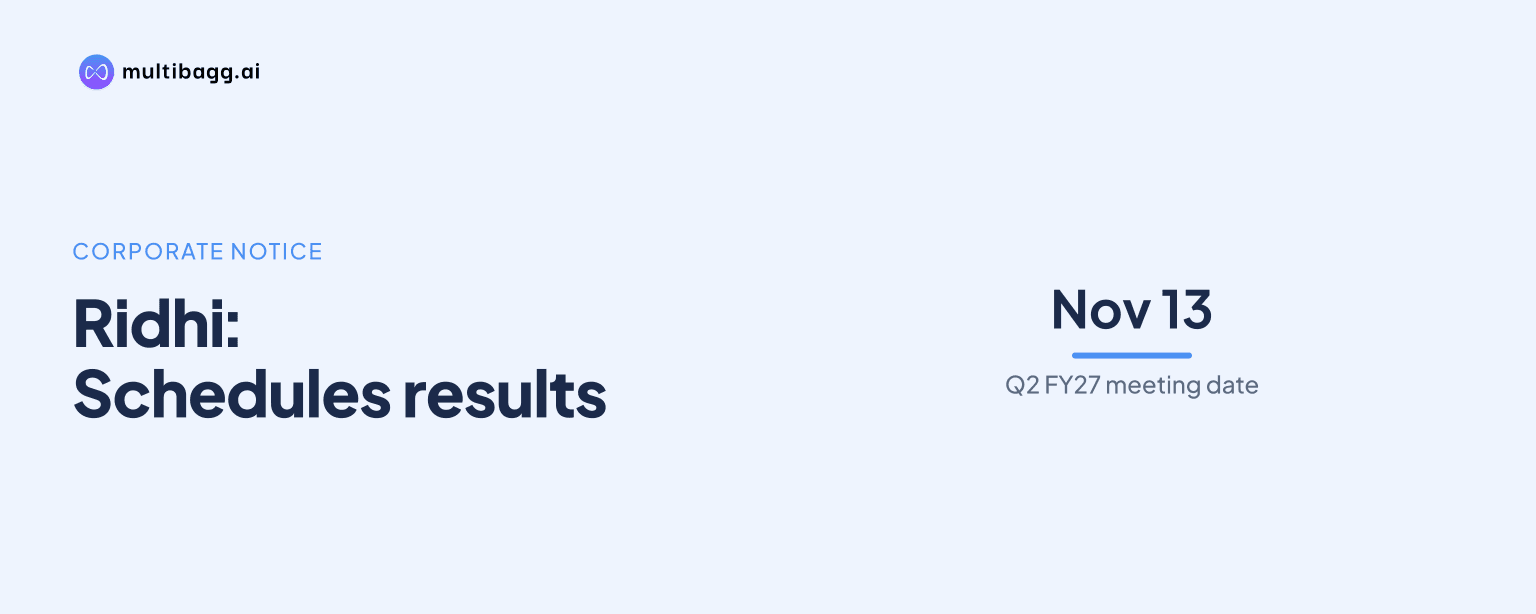
Ridhi Synthetics Limited has scheduled a board meeting for November 13, 2026, to consider Q2 FY27 and half-year results ended September 30, while its trading window will reopen 48 hours after the results are declared. The meeting is important because it is the company’s formal process for approving the unaudited financial statements for the September quarter.
Know Ridhi Synthetics inside out
Results, valuation, peers and who's buying, in one view.
When will Ridhi Synthetics consider its Q2 FY27 results?
Ridhi Synthetics will hold its board meeting on Friday, November 13, 2026, according to the board-meeting intimation dated November 5, 2026. The stated agenda is to consider and approve unaudited financial results for the quarter and half year ended September 30, 2026.
The meeting covers Q2 FY27, which represents the July-September 2026 quarter, and H1 FY27, covering the six months ended September 30. The agenda also permits the board to take up other business, described in the filing as matters considered inter alia, with the Chair’s permission.
The available notice does not mention a dividend, bonus issue, fund raising, acquisition, or any other specific corporate action. Its focus is the review and approval of the financial results.
What is the board meeting expected to approve?
The board is expected to approve Ridhi Synthetics’ unaudited financial results for Q2 FY27 and H1 FY27. These statements will set out the company’s financial performance for the relevant periods after consideration by its directors.
A board meeting intimation is not itself a results announcement. Investors generally need to rely on the financial-results filing made after board approval for the final reported income, expenses, profit or loss, balance-sheet items, and any management disclosures accompanying the results.
The materials identify the company as listed on the BSE under scrip code 504365. They also state that the registered office is at Nariman Point, Mumbai. The notice was signed in the supplied material by a company representative, although the extracts carry different signatory references.
What Q2 FY27 figures are disclosed in the available material?
The supplied material separately lists consolidated Q2 FY27 total income of ₹110 crore and net profit of ₹2.68 crore. It compares total income with ₹114 crore in Q2 FY26, a decline of 3.5%, while net profit is compared with ₹3.69 crore a year earlier, down 27.4%.
The same extract places profit before tax at ₹3.83 crore for Q2 FY27, against ₹5.33 crore in Q2 FY26. It also states that total income was 4.8% higher sequentially. These figures are presented in the material as consolidated results for the quarter ended September 30, 2026.
However, the board-meeting notice itself says the directors are to consider and approve unaudited results. Investors should therefore verify the final exchange filing and the reporting basis when it is released, particularly because the supplied material contains both a meeting notice and a separate financial-data summary.
Got a follow-up? Ask IRIS
How does the trading-window closure affect Ridhi Synthetics investors?
Ridhi Synthetics’ trading window has been closed from October 1, 2026, and will reopen after 48 hours from the declaration of the financial results. The restriction is stated to be under the SEBI (Prohibition of Insider Trading) Regulations, 2015, including Regulation 9 and Schedule B.
Such a closure applies to designated persons and others covered by the company’s code of conduct, rather than imposing a general trading ban on all public-market investors. It is designed to restrict dealing by individuals who may possess unpublished price-sensitive information before the results are made public.
For investors, the practical significance is that the company has initiated the usual compliance process around a scheduled quarterly disclosure. The reopening timetable is linked to the actual declaration of results, not simply to the date on which the board meets.
Why should investors examine the final Q2 filing closely?
Investors should examine the final Q2 filing closely because the available data points to lower year-on-year consolidated income and profit. The supplied summary shows total income lower by ₹4 crore from ₹114 crore in Q2 FY26, while net profit was lower by ₹1.01 crore from ₹3.69 crore.
The company’s earlier Q1 FY27 information in the material described revenue of ₹0.12 crore and profit of ₹0.30 crore, with the profit increase attributed to other income. That disclosure is described separately and should not be directly compared with the listed consolidated Q2 figures without confirming the entity and accounting basis in the official results documents.
The final filing will be relevant for understanding whether income trends, other income, operating costs, and taxation influenced the September-quarter outcome. The current notice does not provide management commentary, segment-level details, or any outlook.
Conclusion
Ridhi Synthetics has formally scheduled its November 13 board meeting to consider unaudited Q2 FY27 and H1 FY27 results, while complying with an insider-trading window closure from October 1. The supplied material also lists consolidated Q2 income of ₹110 crore and net profit of ₹2.68 crore, but investors should treat the board-approved exchange filing as the definitive disclosure.
The next item to watch is the financial-results announcement following the board’s consideration, along with the stated reopening of the trading window 48 hours after declaration. The final documents should clarify the reported financial basis and provide the figures investors can use for period-on-period assessment.