










RKEC Projects posts ₹39.6 crore Q2 loss despite revenue growth
Key highlights
- RKEC Projects reported a consolidated Q2 FY27 net loss of ₹39.6 crore despite 66.0% year-on-year revenue growth to ₹51.5 crore.
- The company's Q2 FY27 operating loss was ₹54.4 crore, resulting in an operating margin of negative 105.7%.
- RKEC Projects reported a consolidated H1 FY27 loss of ₹56.9 crore on revenue of ₹68.8 crore.
- The company disclosed ₹29.87 crore of encashed bank guarantees after termination of a ₹186.68 crore Maharashtra Maritime Board contract.
powered by IRIS
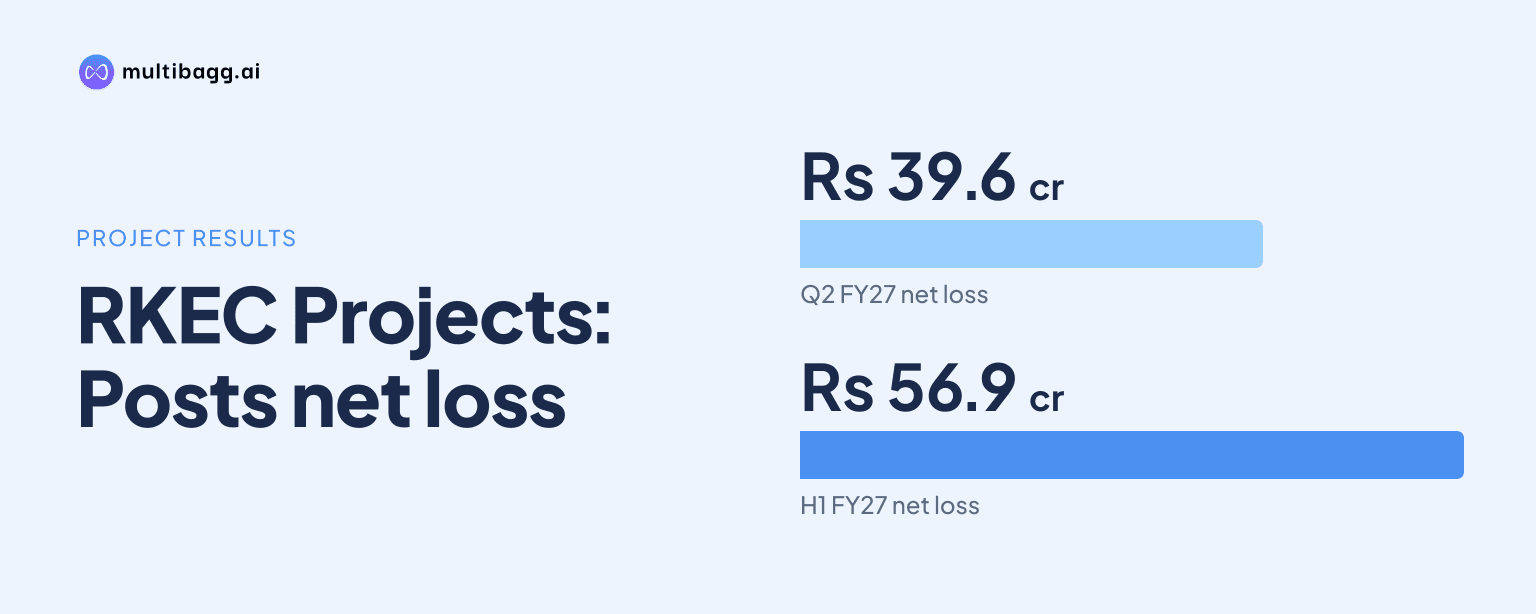
RKEC Projects Ltd reported a consolidated net loss of ₹39.6 crore in Q2 FY27 despite revenue from operations rising 66.0% year-on-year to ₹51.5 crore, as the company recorded an operating loss of ₹54.4 crore and an operating margin of negative 105.7%.
Know RKEC Projects inside out
Results, valuation, peers and who's buying, in one view.
What were RKEC Projects' Q2 FY27 results?
RKEC Projects Ltd reported total income of ₹56.7 crore for the quarter ended September 2026, including ₹51.5 crore of revenue from operations and ₹5.2 crore of other income. Revenue increased from ₹31.0 crore in Q2 FY26 and ₹17.3 crore in Q1 FY27, reflecting year-on-year growth of 66.0% and sequential growth of 197.4%.
The revenue increase did not translate into profitability. The company reported a profit before exceptional items and tax loss of ₹49.2 crore, against a profit of ₹2.3 crore in the corresponding quarter a year earlier. Its consolidated net loss widened to ₹39.6 crore, compared with a net profit of ₹1.7 crore in Q2 FY26 and a loss of ₹17.3 crore in Q1 FY27.
Why did RKEC Projects' profitability deteriorate?
RKEC Projects' profitability deteriorated because its operating result turned sharply negative even as quarterly revenue recovered. Operating profit, measured before other income, was a loss of ₹54.4 crore in Q2 FY27, compared with an operating profit of ₹0.8 crore in Q2 FY26. The operating margin fell by about 10,810 basis points year-on-year to negative 105.7%.
The operating loss also widened from ₹25.2 crore in Q1 FY27. However, the margin improved sequentially from negative 145.5% because revenue rose faster than the reported operating loss. The quarter's tax line was negative ₹9.6 crore, compared with positive tax of ₹0.6 crore in Q2 FY26 and negative tax of ₹6.5 crore in the preceding quarter.
The company reported a consolidated H1 FY27 loss of ₹56.9 crore on revenue of ₹68.8 crore. This follows a difficult first quarter, when revenue from operations fell 77.23% year-on-year to ₹17.3 crore and the company reported a consolidated net loss of ₹17.3 crore.
What contract and banking issues did RKEC Projects disclose?
RKEC Projects disclosed the termination of its ₹186.68 crore Maharashtra Maritime Board Radio Jetty contract, with a balance contract value of ₹183.15 crore lost. The notes to the financial results also state that bank guarantees of ₹29.87 crore related to the contract were encashed.
The company further disclosed cases in the Debt Recovery Tribunal involving bank dues. It also noted unpaid tax deducted at source and goods and services tax obligations, alongside a tax contingency of ₹20 crore. These disclosures are material because they add to the financial and operational issues facing the construction company during the half year.
RKEC Projects has completed projects across Andhra Pradesh, Tamil Nadu, Gujarat, Odisha, Rajasthan, Maharashtra, Puducherry, Kerala, Manipur and Uttar Pradesh. Its operations are therefore linked to public and infrastructure-project execution across several states, making contract administration, funding access and working-capital management relevant to its performance.
Got a follow-up? Ask IRIS
How did the losses affect RKEC Projects' financial position?
RKEC Projects' net worth fell to ₹111.8 crore at the end of September 2026 from ₹168.8 crore in March 2026. The reduction occurred during a half year in which the company reported losses, contract-related disclosures and banking matters.
For investors, the results show that the recovery in Q2 revenue was not sufficient to offset the scale of operating costs and losses reported for the period. Revenue growth alone does not establish an improvement in earnings quality when operating margins remain substantially negative. The company had reported positive operating margins in earlier reported quarters, including 2.4% in Q2 FY26, before losses emerged in FY27.
The board meeting held on November 14, 2026 also approved a preferential share allotment plan. The available disclosure did not provide the allotment terms. The proposal is relevant in the context of the lower net worth, but its financial effect cannot be assessed until the company discloses the size, price, recipients and other conditions of the proposed issue.
What should investors monitor after RKEC Projects' Q2 results?
Investors should monitor RKEC Projects' future filings for updates on the Maharashtra Maritime Board contract termination, the encashed bank guarantees, Debt Recovery Tribunal matters, unpaid tax obligations and the ₹20 crore tax contingency. These matters could remain relevant to cash flows, liabilities and project operations.
Investors may also track whether revenue growth is sustained and whether the company can reduce its operating losses. Q2 revenue was higher than both the year-earlier and preceding quarters, but the operating loss was also larger than in Q1 FY27. Updates on the preferential allotment terms will be important for assessing potential equity issuance and its implications for shareholders.
Conclusion
RKEC Projects reported higher Q2 FY27 revenue but a ₹39.6 crore consolidated net loss, with a negative operating margin of 105.7%. The H1 FY27 loss of ₹56.9 crore, fall in net worth to ₹111.8 crore, and disclosures concerning a terminated contract, bank guarantees, bank dues and tax matters highlight the pressure on its financial position.
The next disclosures to watch are the terms of the board-approved preferential allotment and further updates on the Maharashtra Maritime Board contract, the Debt Recovery Tribunal cases and tax liabilities. The company has not disclosed the allotment terms, leaving the potential capital impact unresolved.