










Rolex Rings operating cash flow falls as working capital rises
Key highlights
- Rolex Rings generated Rs 70.487 crore of operating cash flow in the half year ended September 30, 2026, versus Rs 84.706 crore a year earlier.
- Inventory and trade receivables used Rs 64.026 crore and Rs 45.437 crore of cash, respectively, during the half year.
- Rolex Rings spent Rs 182.146 crore on its completed 10,000,000-share buyback, including Rs 2.146 crore of costs.
- Net profit after tax increased to Rs 134.078 crore from Rs 93.494 crore in the prior-year half.
powered by IRIS
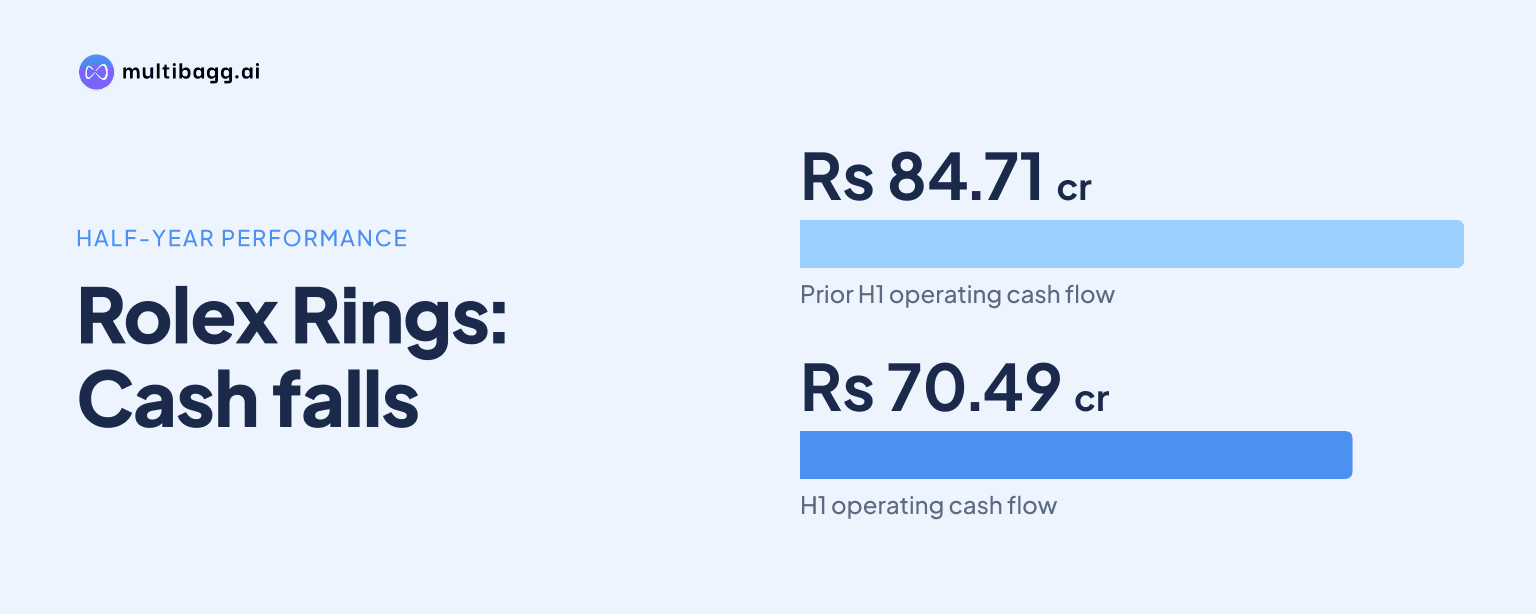
Rolex Rings Limited generated Rs 70.487 crore of operating cash flow in the half year ended September 30, 2026, down from Rs 84.706 crore a year earlier, as working-capital movements used Rs 73.689 crore of cash despite net profit rising to Rs 134.078 crore from Rs 93.494 crore.
Know Rolex Rings inside out
Results, valuation, peers and who's buying, in one view.
Why did Rolex Rings’ operating cash flow decline?
Rolex Rings’ operating cash flow declined because the cash absorbed by working capital and higher tax payments outweighed the increase in operating profit. Net cash generated from operating activities was Rs 70.487 crore for the half year ended September 30, 2026, compared with Rs 84.706 crore in the half year ended September 30, 2025.
Profit increased over the same periods. Net profit after tax rose by Rs 40.584 crore to Rs 134.078 crore, while profit before tax rose to Rs 178.946 crore from Rs 127.088 crore. The cash-flow statement recorded operating profit before working-capital changes of Rs 176.256 crore, up from Rs 128.035 crore, placing the subsequent cash reduction in balance-sheet movements and taxes rather than in the operating-profit measure.
Direct taxes paid, net of refunds, rose to Rs 32.080 crore from Rs 29.433 crore. More importantly, cash generated from operations before taxes fell to Rs 102.567 crore from Rs 114.139 crore even though operating profit before working-capital changes increased by Rs 48.221 crore. This difference shows that the higher reported profit was not fully converted into cash during the six-month period.
Which working-capital items used Rolex Rings’ cash?
Rolex Rings’ largest working-capital cash uses were a Rs 64.026 crore increase in inventories and a Rs 45.437 crore increase in trade receivables. These outflows were partly offset by Rs 37.150 crore of cash generated from increased trade payables and Rs 0.033 crore from other financial liabilities, other liabilities and provisions.
The balance sheet supports the direction of those movements. Inventories stood at Rs 299.010 crore at September 30, 2026, versus Rs 234.984 crore at March 31, 2026, while trade receivables rose to Rs 266.847 crore from Rs 219.627 crore. The inventory balance increased by Rs 64.026 crore, the same amount shown as an inventory cash outflow in the cash-flow statement.
Trade payables, combining the two disclosed creditor categories, were Rs 129.100 crore at September 30, 2026, compared with Rs 92.053 crore at March 31, 2026. Loans, other financial assets and other assets used Rs 1.409 crore of cash in the half year. Overall, working-capital movements used Rs 73.689 crore in the 2026 half year, against a Rs 13.104 crore cash contribution in the corresponding 2025 period.
Got a follow-up? Ask IRIS
How did the buyback affect Rolex Rings’ financing cash flow?
Rolex Rings’ completed buyback was the principal financing cash outflow, using Rs 182.146 crore in the half year ended September 30, 2026. Interest paid was Rs 0.934 crore, and net cash used in financing activities totalled Rs 183.080 crore, compared with Rs 14.995 crore in the corresponding 2025 half year.
The board approved the buyback on April 23, 2026, and shareholders approved it through a postal ballot on May 31, 2026. The programme covered up to 10,000,000 equity shares, representing 3.76% of paid-up equity share capital, at Rs 180 per share for aggregate consideration not exceeding Rs 180 crore. Rolex Rings concluded the buyback during the quarter ended September 30, 2026.
The reported Rs 182.146 crore outflow included Rs 2.146 crore of transaction costs. Rolex Rings said Rs 179 crore was used from share premium and Rs 2.146 crore from retained earnings, while a Rs 1 crore capital redemption reserve was created from retained earnings. Paid-up share capital declined by Rs 1 crore, and total equity was Rs 1,165.695 crore at September 30, compared with Rs 1,213.577 crore at March 31.
What happened to Rolex Rings’ cash and investments?
Rolex Rings ended September 30, 2026 with cash and cash equivalents of Rs 72.980 crore, compared with Rs 69.306 crore at the beginning of the financial year. The cash-flow statement records a Rs 2.892 crore net increase in cash and cash equivalents and a Rs 0.782 crore adjustment for unrealised foreign-currency gain at the end of the period.
Investing activities generated Rs 116.485 crore of net cash in the half year, according to the cash-flow statement. The statement included Rs 211.463 crore of proceeds from redemption of current investments and Rs 12.679 crore of purchases of property, plant and equipment and intangible assets, including capital work in progress.
Current investments fell to Rs 178.602 crore at September 30, 2026, from Rs 288.246 crore at March 31, 2026. The movement in investments helped provide cash alongside operating inflows while the buyback was completed. At the same time, the composition of current assets shifted toward inventories of Rs 299.010 crore and receivables of Rs 266.847 crore.
Conclusion
Rolex Rings reported higher profit in the half year ended September 30, 2026, but operating cash flow fell because receivables, inventories and other working-capital items consumed Rs 73.689 crore rather than supplying cash as they did a year earlier. The Rs 182.146 crore buyback then accounted for almost all financing cash outflows, while investment redemptions supported the period-end cash balance of Rs 72.980 crore.
The next point to watch is whether the September 30 balances of Rs 299.010 crore in inventories and Rs 266.847 crore in trade receivables convert into operating cash in subsequent results. Rolex Rings has disclosed that the 10,000,000-share buyback was concluded during the September quarter, so that programme does not remain an approved future buyback outflow.