










Rubfila auditors challenge ₹14.09 crore contingency provision
Key highlights
- Rubfila's contingency provision rose from ₹13.49 crore at 31 March 2026 to ₹14.09 crore at 30 September 2026.
- Auditors said the ₹30 lakh September-quarter charge lowered profit before tax by ₹30 lakh and profit after tax by ₹22.45 lakh.
- Auditors quantified the after-tax understatement of other equity at ₹10.5438 crore, after a ₹3.5462 crore deferred-tax asset.
- Rubfila said the provision began at ₹15 lakh per quarter in financial year 2014-15 and was later increased to ₹30 lakh per quarter.
powered by IRIS
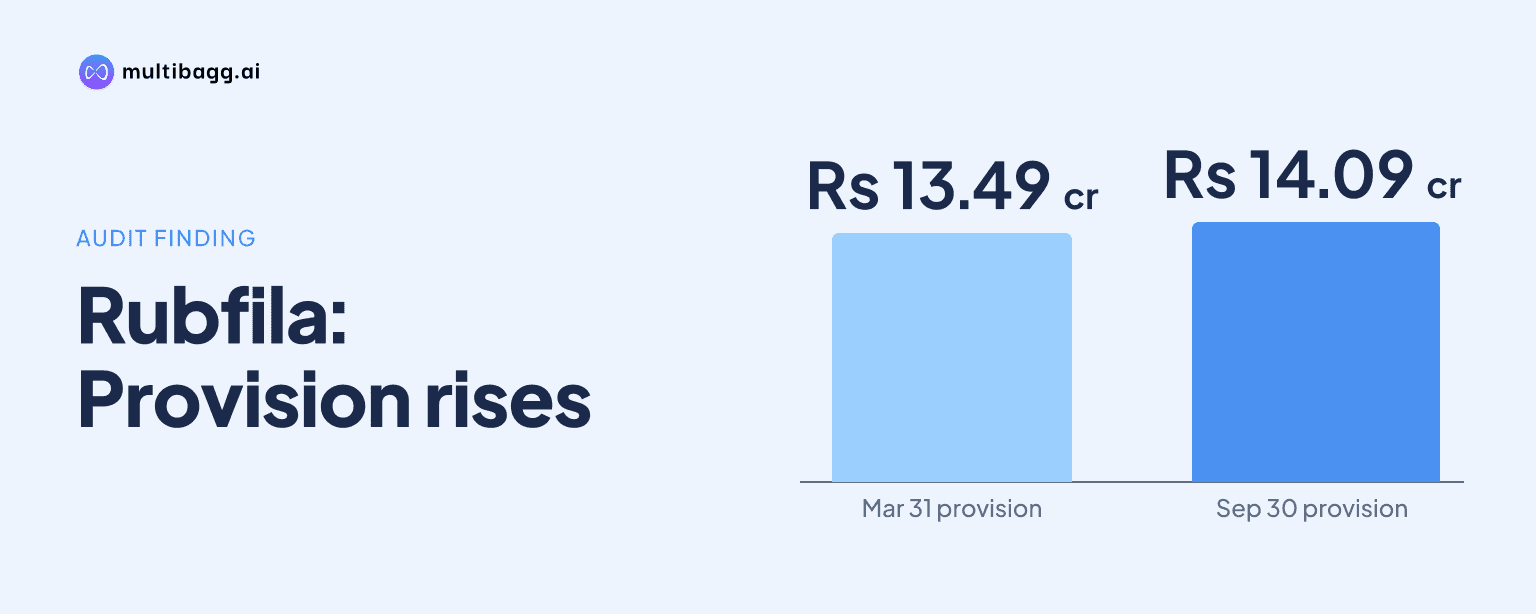
Rubfila International Limited received a qualified review conclusion for the quarter ended 30 September 2026 after auditors said its ₹14.09 crore contingency provision lacked an identifiable present obligation. The balance was accumulated through profit-and-loss charges over the preceding 11 years and increased by ₹60 lakh in the half year from ₹13.49 crore at 31 March 2026.
Know Rubfila International inside out
Results, valuation, peers and who's buying, in one view.
Why did Rubfila receive a qualified conclusion?
Rubfila received the qualified conclusion because Mohan & Mohan Associates said the ₹14.09 crore provision did not meet the recognition requirements of Indian Accounting Standard 37, or Ind AS 37, at 30 September 2026. The auditors said no past event giving rise to a present obligation had been established despite specific inquiries about the balance.
The auditors also said they could identify no claimant, counter-party, demand or proceeding linked to the ₹14.09 crore provision as at 30 September 2026. They said the results did not disclose the nature of an obligation, the expected timing of any cash outflow, or the basis on which the amount had been determined, as required under Ind AS 37 together with Ind AS 34 on interim reporting.
The standalone and consolidated limited-review reports, dated 12 November 2026, reached the same qualified conclusion on this matter. A limited review under Standard on Review Engagements 2410 provides moderate assurance and is narrower than an audit, but the auditors stated that, except for the provision matter, nothing had come to their attention indicating a material misstatement in the interim results.
How did Rubfila's contingency provision build up?
Rubfila's contingency provision rose by ₹60 lakh during the half year ended 30 September 2026, from ₹13.49 crore at 31 March 2026 to ₹14.09 crore. The increase included a ₹30 lakh charge in the September 2026 quarter, while the auditors reported no utilisation, reversal or reclassification in any year or in that half year.
The ₹14.09 crore balance was accumulated through charges to the statement of profit and loss over the preceding 11 years. Of that balance, ₹13.49 crore before tax related to periods up to 31 March 2026, meaning nearly all of the amount existed before the ₹60 lakh charge recorded in the first half of financial year 2026-27.
Management said the practice began in financial year 2014-15, initially at ₹15 lakh a quarter, or ₹60 lakh a year, and was later increased to ₹30 lakh a quarter, or ₹1.20 crore a year. Rubfila said the Board determined the amounts after considering perceived uncertainties in its legal and regulatory environment.
Got a follow-up? Ask IRIS
What would removing the provision change in Rubfila's results?
Removing the ₹30 lakh September-quarter charge would raise Rubfila's standalone and consolidated profit before tax by ₹30 lakh, according to the auditors. They said profit after tax would be higher by ₹22.45 lakh for the quarter ended 30 September 2026 and by ₹44.90 lakh for the half year if the ₹60 lakh first-half charge had not been recognised.
The qualification-impact statement showed that standalone net profit for the September 2026 quarter would be ₹5.264 crore rather than the reported ₹5.0395 crore. Earnings per share would be ₹0.97 rather than ₹0.93, while total income would remain unchanged because the adjustment concerns expenditure rather than revenue.
At 30 September 2026, the auditors said provisions were overstated and other equity was understated by ₹14.09 crore before tax effects. After the related deferred-tax asset of ₹3.5462 crore, the stated net understatement of other equity was ₹10.5438 crore; the same quantified matter appeared in both the standalone and consolidated reports.
How has Rubfila responded and what will it disclose next?
Rubfila said its Board considers the provision commensurate with the company's size and prudent in view of perceived legal and regulatory uncertainties. The Audit Committee and Board considered the issue again on 12 November 2026 and decided to continue the provision, despite the auditors' view that no identifiable obligation supported it under Ind AS 37.
Management said it has consistently described the provision's nature in the accounts and would stop further charges when the Board considers the aggregate amount adequate. The filing does not state a monetary threshold or date for that decision, although the current quarterly charge was ₹30 lakh in the quarter ended 30 September 2026.
The next financial results will show whether Rubfila makes another quarterly charge, reverses any part of the ₹14.09 crore balance, or identifies a claimant, demand, proceeding or past event that supports a present obligation. Those items address the unresolved basis cited by the auditors, rather than the arithmetic of the ₹30 lakh September-quarter charge.
Conclusion
The qualification affects the accounting treatment of a cumulative ₹14.09 crore balance rather than an identified claim emerging in the September 2026 quarter. If the provision were removed, Rubfila's reported standalone September-quarter net profit would increase from ₹5.0395 crore to ₹5.264 crore, while net worth would increase from ₹290.8868 crore to ₹301.4306 crore.
The key next event is Rubfila's future assessment of whether the accumulated provision is adequate, following the Board's 12 November 2026 decision to continue it. Investors should watch for a further ₹30 lakh quarterly charge or disclosures that identify the obligation, timing of an outflow and valuation basis requested by the auditors.