










Ruby Mills textile profit falls as costs rise in September
Key highlights
- Ruby Mills' textile segment result fell to Rs 64.29 lakh in September 2026 from Rs 1.98 crore in June 2026.
- Textile revenue increased to Rs 70.70 crore in September 2026 from Rs 57.56 crore in June 2026.
- Ruby Mills said it passed increased input costs to customers from September 10, 2026.
- Real estate and related activities included Rs 77.94 crore of profit on sale of property in September 2026.
powered by IRIS
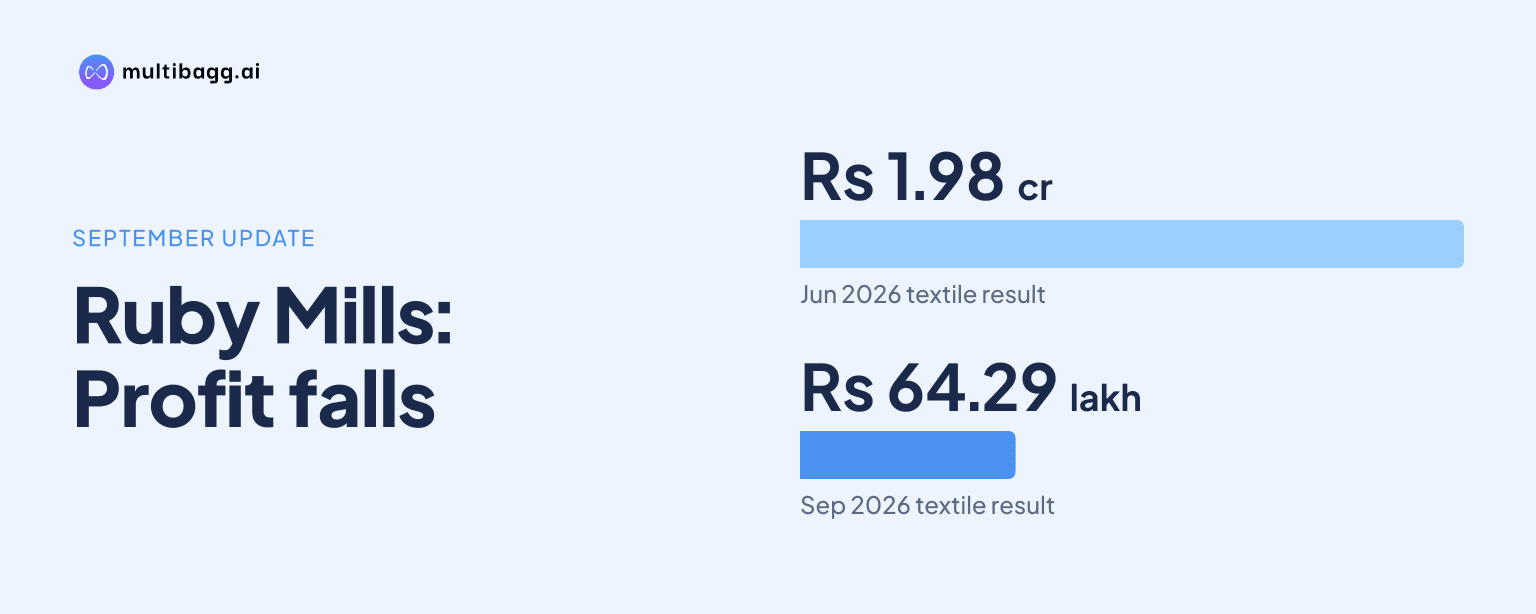
The Ruby Mills Limited reported textile segment profit of Rs 64.29 lakh for the quarter ended September 30, 2026, down from Rs 1.98 crore in the preceding quarter despite textile revenue rising to Rs 70.70 crore. Ruby Mills attributed the reduction largely to higher input costs and said it passed the cost increase to customers from September 10, 2026.
Know Ruby Mills inside out
Results, valuation, peers and who's buying, in one view.
Why did Ruby Mills' textile profit decline?
Ruby Mills said higher input costs were largely responsible for the decline in textile-segment profit in the September 2026 quarter. Textile segment result, which the filing defines as profit or loss before tax and interest from each segment, was Rs 64.29 lakh for the quarter ended September 30, 2026, compared with Rs 1.98 crore for the quarter ended June 30, 2026. The sequential reduction was Rs 1.34 crore.
The filing does not provide a separate textile raw-material-cost breakdown, a unit-cost measure, or the share of the September quarter affected before the price pass-through. At the consolidated level, cost of materials consumed increased to Rs 28.60 crore in the September quarter from Rs 27.66 crore in the June quarter. Total consolidated expenses increased to Rs 118.20 crore from Rs 88.76 crore, but these figures include both textile and real estate operations.
The contrast between revenue and result indicates that higher textile sales did not offset the costs identified by management during the quarter. Ruby Mills reported Rs 70.70 crore of textile revenue in September 2026 while earning Rs 64.29 lakh of segment result, compared with Rs 57.56 crore of revenue and Rs 1.98 crore of segment result in June 2026.
How did Ruby Mills' textile revenue change in September 2026?
Ruby Mills' textile revenue rose to Rs 70.70 crore in the quarter ended September 30, 2026 from Rs 57.56 crore in the quarter ended June 30, 2026. The Rs 13.14 crore sequential increase coincided with the Rs 1.34 crore decline in segment result, illustrating the margin pressure described in the filing.
For the half year ended September 30, 2026, textile revenue was Rs 128.25 crore and textile segment result was Rs 2.63 crore. The full-year figures for the year ended March 31, 2026 were Rs 292.27 crore of textile revenue and Rs 32.18 crore of textile segment result. These full-year numbers are not a like-for-like half-year comparison, but they show the scale of the September half-year result relative to the prior reported annual period.
Ruby Mills said comparative figures for the quarter and half year ended September 30, 2025 were not applicable because two wholly owned subsidiaries, Ruby GreenTech T Private Limited and Ruby GreenTech K Private Limited, were incorporated on March 18, 2026. The filing consequently provides June 2026 as the directly presented quarterly comparison for the September 2026 textile figures.
What did Ruby Mills change on September 10, 2026?
Ruby Mills said it passed the input-cost increase to customers with effect from September 10, 2026. The September quarter therefore included sales before and after the stated pricing action, although the filing does not quantify the price increase or identify the textile products and customer categories affected.
The announced response was a price pass-through rather than a disclosed cost-reduction programme. Ruby Mills did not state a textile-profit target, an expected timing for cost recovery, or a revised margin objective. The filing also does not disclose what proportion of September-quarter textile sales was billed after September 10.
The next reported textile segment result will provide the disclosed financial measure for evaluating a full period after the customer pricing change. The September 2026 segment result of Rs 64.29 lakh covers only 21 days from September 10 to September 30 under the revised pricing timing stated by Ruby Mills.
Got a follow-up? Ask IRIS
Which segment drove Ruby Mills' consolidated September profit?
Ruby Mills' real estate and related segment generated Rs 81.23 crore of segment result in the September 2026 quarter, compared with Rs 64.29 lakh from textiles. The real estate result included Rs 77.94 crore of profit on sale of property, which was included in other income and related to the real estate business.
Consolidated revenue from operations was Rs 104.96 crore in the September quarter, comprising Rs 70.70 crore from textiles and Rs 34.26 crore from real estate and related activities. Other income was Rs 82.48 crore, including the Rs 77.94 crore property-sale profit. The real estate property sale was therefore the principal disclosed component of other income for the quarter.
Consolidated profit before tax was Rs 69.23 crore in the September quarter, compared with Rs 16.19 crore in the June quarter. Profit for the period was Rs 50.44 crore, compared with Rs 11.70 crore in June 2026. Those consolidated increases should not be read as evidence of improved textile profitability because the textile segment result fell while the real estate segment recorded the property-sale profit.
How much capital was employed in Ruby Mills' textile segment?
Ruby Mills reported textile capital employed of Rs 246.07 crore at September 30, 2026, compared with Rs 242.21 crore at June 30, 2026 and Rs 246.18 crore at March 31, 2026. The September figure was derived from textile segment assets of Rs 310.61 crore and textile segment liabilities of Rs 64.55 crore.
Real estate and related capital employed was Rs 225.67 crore at September 30, 2026, down from Rs 267.16 crore at June 30, 2026. The textile segment had Rs 20.39 crore more capital employed than real estate and related activities at September end, despite real estate recording the larger quarterly segment result because of the Rs 77.94 crore property-sale profit.
Total group capital employed was Rs 728.33 crore at September 30, 2026, compared with Rs 684.97 crore at June 30, 2026. Total segment assets were Rs 1,376.60 crore at September 30, while total segment liabilities were Rs 648.27 crore, resulting in the reported capital-employed amount.
Conclusion
Ruby Mills reported a divergence in the September 2026 quarter: textile revenue increased by Rs 13.14 crore sequentially, but textile segment profit declined by Rs 1.34 crore to Rs 64.29 lakh. Management attributed the reduction largely to input costs. At group level, the Rs 77.94 crore profit on sale of property in real estate and related activities was a major contributor to consolidated September profit.
The key next disclosure is whether the September 10, 2026 customer price pass-through changes textile segment profitability after a full reporting period at revised prices. Ruby Mills disclosed no price-rise percentage, recovery target or estimated profit benefit, leaving the magnitude and timing of any textile-margin recovery unresolved in the filing.