










Safari Industries approves Rs 230 crore capacity expansion plan
Key highlights
- Safari Industries approved up to Rs 230 crore for infrastructure, warehouse land and machinery on November 5, 2026.
- The programme targets combined output of approximately 18 lakh luggage pieces per month after completion.
- Safari Industries reported Q2FY27 revenue of Rs 582.22 crore, up 9.1%, and PAT of Rs 36.93 crore.
- Safari Industries declared a Rs 2 interim dividend per equity share, payable on or before December 5, 2026.
powered by IRIS
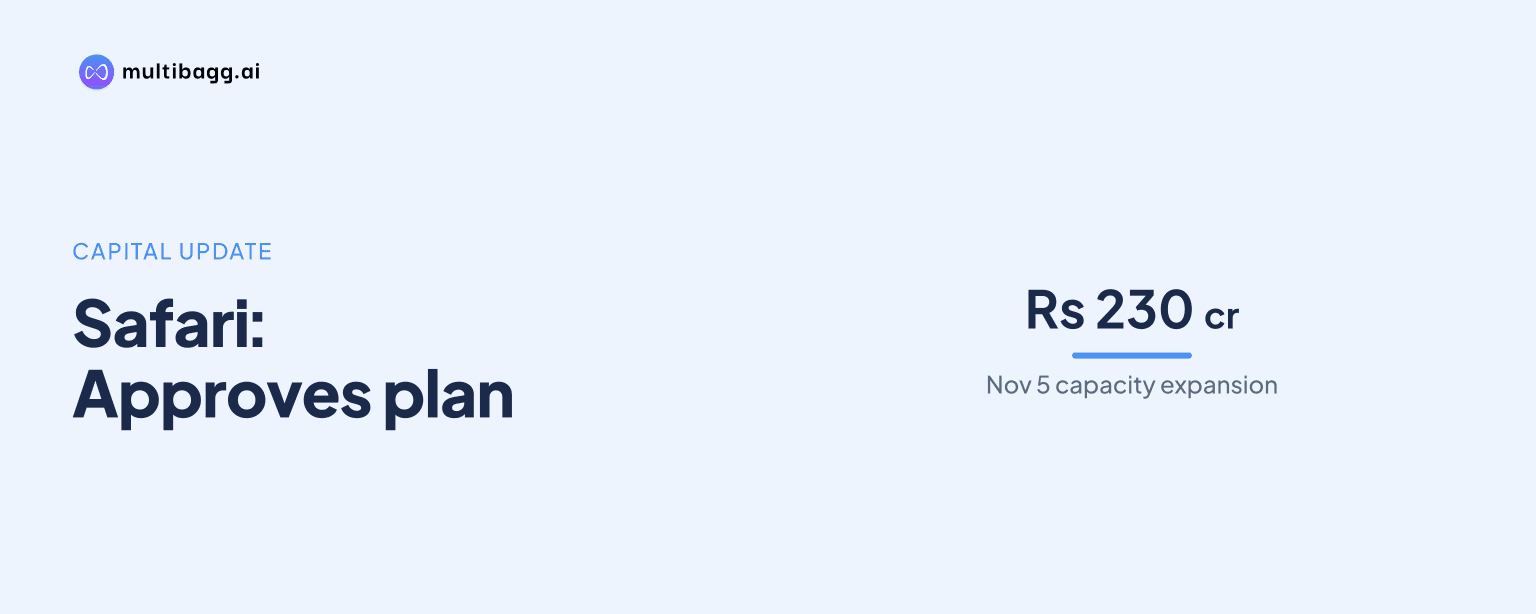
Safari Industries (India) Limited approved up to Rs 230 crore of capital expenditure on November 5, 2026, to expand manufacturing at Halol and Jaipur and lift combined output to approximately 18 lakh luggage pieces a month after completion. The approval assigns up to Rs 170 crore to Safari Industries and up to Rs 60 crore to its wholly owned subsidiary, Safari Manufacturing Limited.
Know Safari Industries (India) inside out
Results, valuation, peers and who's buying, in one view.
What capacity expansion has Safari Industries approved?
Safari Industries has approved a maximum Rs 230 crore capacity-expansion programme, comprising up to Rs 170 crore for the company and up to Rs 60 crore for Safari Manufacturing Limited. The Board approved the expenditure at its November 5, 2026 meeting for manufacturing facilities in Halol and Jaipur, following reported total revenue growth of 9.1% in the second quarter of financial year 2027, or Q2FY27.
Once the programme is completed, Safari Industries expects combined production capacity across all its units to reach approximately 18 lakh pieces per month. The release does not state the company’s current monthly capacity, the incremental volume that the project will add, or a completion date. It also does not provide a separate capacity target for the Halol facility or the Jaipur facility.
The Rs 60 crore approval for Safari Manufacturing Limited is specifically part of the overall Rs 230 crore programme rather than a separately disclosed project. Safari Industries has not set out whether the subsidiary’s spending will be directed to a particular plant, product category or manufacturing process. The announced capacity target covers all units, not only the two facilities named in the release.
How will Safari Industries use the approved investment?
Safari Industries said the approved expenditure will fund infrastructure improvements, land acquisition for a new warehouse, and installation of plant and machinery. These uses apply to the up-to-Rs-230-crore programme at Halol and Jaipur, combining factory equipment with warehouse-related infrastructure. The announcement does not disclose the amount allocated to land, machinery, infrastructure or warehouse development.
The new warehouse land acquisition adds a logistics component to the capacity plan, while plant and machinery installation addresses production capability. Safari Industries has not disclosed the warehouse location, its size, or whether it will serve Halol, Jaipur or the wider manufacturing network. Nor has it stated whether the infrastructure work will be undertaken before, alongside or after machinery installation.
Safari Industries describes the project as part of a plan to strengthen domestic manufacturing and respond to emerging market opportunities. The company operates manufacturing facilities in Gujarat and Rajasthan, while the announced expansion specifically names Halol and Jaipur. Its stated output objective of 18 lakh pieces a month is a network-wide production measure rather than a sales forecast or a disclosed utilisation target.
What financial performance preceded Safari Industries' decision?
Safari Industries reported Q2FY27 total revenue of Rs 582.22 crore, up 9.1% from Rs 533.55 crore in Q2FY26, and profit after tax, or PAT, of Rs 36.93 crore. The quarter ended September 30, 2026, preceding the Board’s November 5 approval. The release does not provide a Q2FY26 PAT figure, so a year-on-year profit comparison cannot be calculated from the announcement.
For the first half of financial year 2027, or H1FY27, Safari Industries reported total revenue of Rs 1,170.80 crore, compared with Rs 1,061.38 crore in H1FY26, an increase of 10.31%. H1FY27 PAT was Rs 84.68 crore. Revenue growth in H1FY27 was 1.21 percentage points higher than the 9.1% increase reported for Q2FY27, based on the figures disclosed in the release.
Safari Industries also declared an interim dividend of Rs 2 per equity share with a face value of Rs 2, described as a 100% dividend. The company said payment would be made on or before December 5, 2026. The release does not link the dividend to the capacity programme or state how the up-to-Rs-230-crore expenditure will be funded.
Got a follow-up? Ask IRIS
How does Safari Industries link the project to premiumisation?
Safari Industries says the capacity expansion will support its premiumisation drive and longer-term growth plans. Management described its strategy as building scale while differentiating brands for consumers across value-oriented and premium segments. The release identifies Safari, Urban Jungle, Safari Select and Carlton as brands serving different consumer groups, price points and travel needs.
The company said product innovation, differentiation and improved product mix are intended to help address changing consumer preferences across its portfolio. Safari Industries’ broader brand range includes Magnum, Genius, Genie and Volt alongside Safari, Urban Jungle, Safari Select and Carlton. The announcement does not disclose revenue, production volumes, pricing or margins by any individual brand or segment.
Safari Industries also announced a 20-year brand licensing agreement with Carlton Retail Pvt. Ltd. and appointed Saif Ali Khan as brand ambassador for Magnum by Safari. Chairman and Managing Director Sudhir Jatia said management was investing in capabilities for the next phase of growth, with luggage evolving beyond a functional necessity into an extension of a traveller’s lifestyle.
What does the release disclose about Safari Industries' market position?
Safari Industries describes itself as India’s largest luggage and travel accessories manufacturer, established in 1974 and headquartered in Mumbai. It said it was recognised as the No. 1 luggage brand in India in revenue terms for the third successive year, based on Euromonitor International’s 2026 edition using 2025 data for the luggage category across retail channels.
The company’s manufacturing footprint spans Gujarat and Rajasthan, and the Halol and Jaipur programme is presented as a way to strengthen that domestic base. Safari Industries does not disclose segment-level sales between value and premium offerings, capacity utilisation, or the mix of hard luggage, soft luggage and travel accessories within the approximately 18 lakh-pieces-a-month target.
The filing therefore provides a defined expenditure ceiling of Rs 230 crore and a stated post-expansion capacity level, but not a financial return target. It does not quantify expected revenue from the added capacity, any anticipated change in product mix, or the timing at which the 18 lakh monthly capacity will become available.
Conclusion
Safari Industries has paired revenue growth of 9.1% in Q2FY27 and 10.31% in H1FY27 with a manufacturing and logistics programme of up to Rs 230 crore. The plan combines infrastructure, warehouse land and machinery spending at Halol and Jaipur, with the stated aim of taking combined output across all units to approximately 18 lakh pieces each month.
What to watch next is execution detail on the Rs 170 crore company allocation and Rs 60 crore subsidiary allocation, including the project schedule, funding method and incremental capacity. The next dated event disclosed is payment of the Rs 2 interim dividend on or before December 5, 2026, while the completion timing for the manufacturing expansion remains undisclosed.