










Sahasra receives NSE no-objection to file merger with NCLT
Key highlights
- Sahasra received NSE’s no-objection letter on November 4, 2026.
- The scheme includes Sahasra and 3 private transferor companies.
- NSE’s observation letter is valid for 6 months from November 4, 2026.
- Financials used for the scheme cannot be more than 6 months old.
powered by IRIS
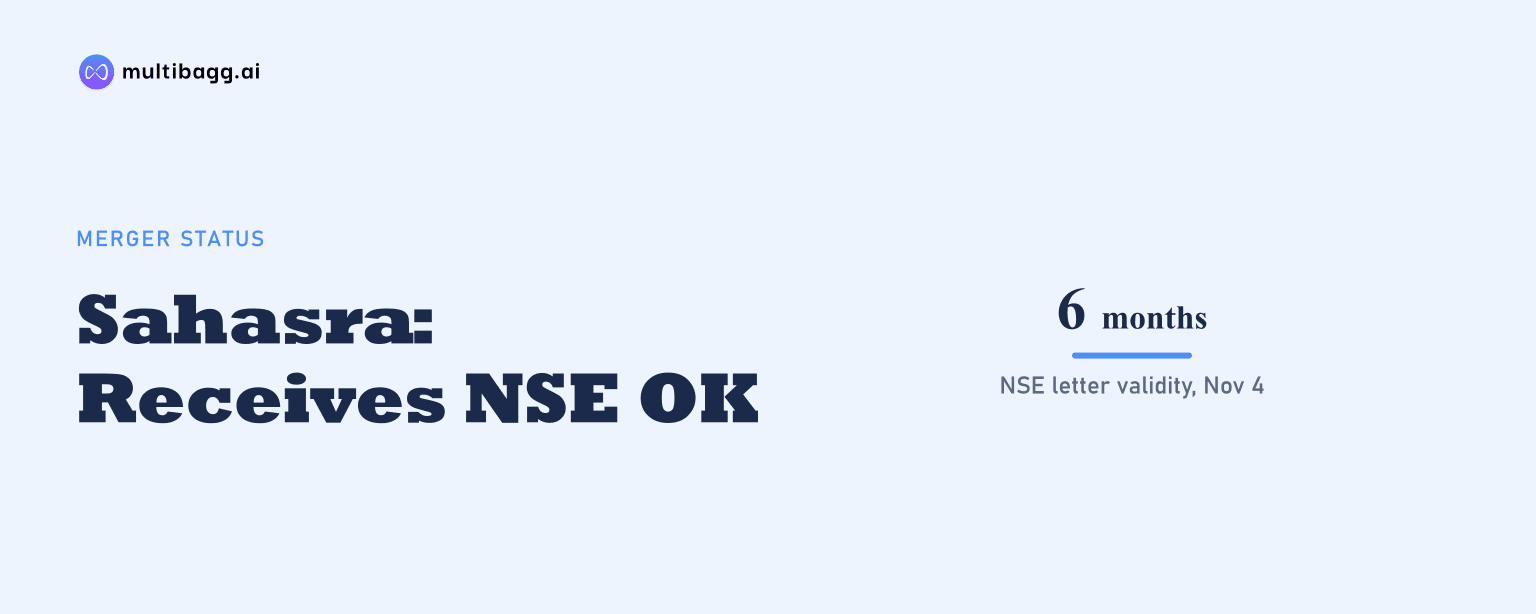
Sahasra Electronic Solutions Limited received a no-objection letter from the National Stock Exchange of India Limited (NSE) on November 4, 2026, enabling it to file its proposed amalgamation with three private companies before the National Company Law Tribunal (NCLT). The scheme remains subject to shareholder, creditor, statutory and regulatory approvals.
Know Sahasra Electronic Solutions inside out
Results, valuation, peers and who's buying, in one view.
What did Sahasra receive from NSE?
Sahasra received an NSE observation letter, which it described as a no-objection letter, on November 4, 2026, allowing the draft scheme to be filed with NCLT under Sections 230 to 232 of the Companies Act, 2013. The letter was issued under Regulation 37 of the Securities and Exchange Board of India (Listing Obligations and Disclosure Requirements) Regulations, 2015.
The NSE letter followed comments issued by the Securities and Exchange Board of India (SEBI) on November 3, 2026. NSE said its no-objection was based on the draft scheme, documents submitted by Sahasra and an undertaking under Regulation 11, and it said the communication was not approval under other laws, rules or exchange requirements.
Which companies are included in Sahasra’s amalgamation?
Sahasra is the transferee company, while Sahasra Electronics Private Limited, Infopower Technologies Private Limited and Sahasra Sambhav Skill Development Private Limited are the three transferor companies. The proposed arrangement also covers the respective shareholders and creditors of each of the four companies.
The boards of Sahasra and the three transferor companies approved the scheme on March 13, 2026, subject to applicable approvals. The November 4 disclosure does not state a share-exchange ratio, merger consideration, valuation, ownership outcome or completion date, although NSE requires such information in materials sent to shareholders.
The arrangement is therefore not effective merely because NSE issued its November 4 letter. Sahasra said effectiveness remains conditional on statutory and regulatory permissions, the conditions set out in the scheme, and shareholder and creditor approvals where required.
What must Sahasra disclose before shareholders vote?
Sahasra must provide the scheme’s rationale, objectives, need and expected business synergies in the explanatory statement, notice or proposal sent to shareholders under Sections 230 to 232. NSE also requires an explanation of the effect on shareholders, including dilution, changes in rights and the impact on Sahasra’s revenue-generating capacity.
The shareholder materials must include the latest financial information for all companies involved, and the financials used cannot be more than six months old. NSE also requires a cost-benefit analysis, promoter-wise and aggregate promoter-group holdings before and after the scheme, and the corresponding effect on public shareholding.
NSE also requires details of transferor-company assets and liabilities moving to Sahasra, the post-scheme balance sheet, capital build-up over the past three years, and complaints received about the scheme. The source does not provide these figures, but requires Sahasra to disclose them before shareholder approval.
Got a follow-up? Ask IRIS
What conditions accompany the NSE no-objection?
Sahasra must incorporate SEBI and stock-exchange observations in its NCLT petition and bring them to the tribunal’s attention. The entities involved cannot alter the draft scheme after its filing with SEBI through the exchanges, except for changes mandated by a regulator, authority or tribunal.
Sahasra must disclose ongoing adjudication and recovery proceedings, prosecutions and other enforcement actions involving itself, its promoters and directors before NCLT and shareholders. The shareholder documentation must also cover regulatory actions involving the companies, their promoters, directors and key managerial personnel, along with possible effects on the transferor companies, Sahasra and public shareholders.
Any equity shares issued under the scheme must be in dematerialised form. Sahasra must also present information on the unlisted transferor companies in the abridged-prospectus format set out in Part E of Schedule VI of the SEBI (Issue of Capital and Disclosure Requirements) Regulations, 2018.
When must Sahasra file the scheme with NCLT?
Sahasra must submit the scheme to NCLT within six months from November 4, 2026, when NSE issued its observation letter. This gives the company until May 4, 2027 to make the filing, but the six-month validity period is not a deadline for the amalgamation to become effective.
NSE required Sahasra to publish the no-objection letter on its website within 24 hours of receipt and to file a compliance-status report for every observation through the NEAPS exchange portal. Sahasra’s November 4 announcement said the disclosure and enclosed NSE letter were available on its website.
NSE reserved the right to raise objections at any stage if submitted information is incomplete, incorrect, misleading or false, or if there is a contravention of applicable rules and regulations. NSE and SEBI also said their processing of documents should not be construed as approval of the scheme’s financial soundness or the accuracy of statements and opinions in the submitted material.
Conclusion
The November 4, 2026 no-objection moves Sahasra’s proposed four-company arrangement beyond the exchange-review stage and permits an NCLT filing. It does not complete the amalgamation, as Sahasra must still meet the observation-letter conditions and obtain the shareholder, creditor, statutory and regulatory approvals required for the scheme.
The next disclosed milestone is submission of the scheme to NCLT by May 4, 2027. Before a shareholder vote, the key disclosures to watch are the share-exchange terms, valuation basis, financials no older than six months, pre- and post-scheme ownership, business synergies, costs and regulatory matters.