








SC Agrotech Limited's Year 3 case models Rs 220 crore revenue
Max Plan at ₹4,999/yr₹8,999

Find your next multibaggerBe a Pro Investor
Research stocks and track your picks on the go. Download the app.
Key highlights
- SC Agrotech’s accelerated scenario models Rs 220 crore of revenue and Rs 79.2 crore of EBITDA in Year 3.
- The corporate assumption is Rs 60 crore from 600,000 covered employees at Rs 1,000 each annually.
- The insurer assumption requires 3 million covered lives at Rs 150 a year to generate Rs 45 crore.
- SC Agrotech plans to launch SC Health Suite on 27 November 2026, subject to stated validation and governance gates.
powered by IRIS
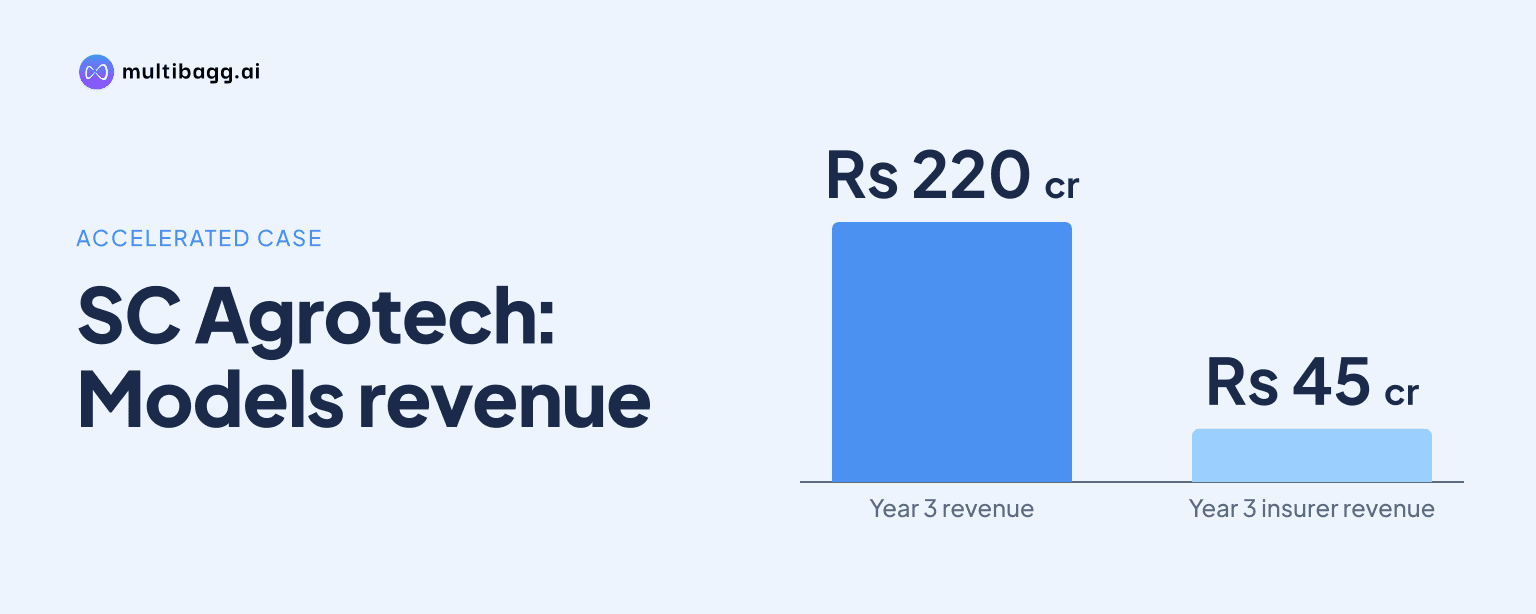
SC Agrotech Limited’s accelerated SC Health Suite case models Year 3 revenue of Rs 220 crore and earnings before interest, tax, depreciation and amortisation (EBITDA) of Rs 79.2 crore, but it is not guidance and assumes uncontracted corporate, insurer, clinic, consumer, partner and licensing scale.
Know SC Agrotech inside out
Results, valuation, peers and who's buying, in one view.
What does SC Agrotech’s accelerated case project?
SC Agrotech projects illustrative revenue of Rs 18 crore in Year 1, Rs 75 crore in Year 2 and Rs 220 crore in Year 3 under its accelerated commercial scenario. Year 1 means the first 12 months after the planned 27 November 2026 launch of SC Health Suite, and the presentation labels the model aspirational and assumption-driven rather than realised revenue or approved guidance.
The case adds Rs 202 crore of revenue between Year 1 and Year 3, with the Year 3 figure more than 12 times the Year 1 amount. SC Agrotech says this progression requires substantial enterprise contract wins, high retention, scaled distribution and successful licensing, while stating that each milestone must be earned.
SC Agrotech’s first-year execution plan has four stages: launch in months 0 to 3, activation in months 3 to 6, pilots in months 6 to 9, and scale in months 9 to 12. The roadmap specifies quality assurance, free-access adoption and privacy controls first, followed by Day-30 retention, paid plans, corporate and clinical programmes, contracts, localisation and support operations.
How is SC Agrotech’s Year 3 revenue divided?
SC Agrotech divides the Rs 220 crore Year 3 bridge among six monetisation engines: Rs 60 crore from corporate customers, Rs 45 crore from insurers, Rs 35 crore each from consumers and white-label licensing, Rs 25 crore from clinics, and Rs 20 crore from partners. Corporate is the largest individual revenue line, at Rs 60 crore.
The five non-consumer channels account for Rs 185 crore, or 84.1% of the illustrative Year 3 total, compared with Rs 35 crore from consumer subscriptions. SC Agrotech cautions that the bridge is mathematical and illustrative because partner contracts, users and conversion rates have not yet been established.
SC Agrotech’s commercial flywheel starts with free access, then identifies habit formation, family profiles, business-to-business distribution, user-consented insights and paid plans as later steps. Its listed critical performance measures are activation, repeat checks, Day-30 retention, paying conversion, enterprise contracts and net revenue retention, without current results for those measures on these pages.
What volumes must SC Agrotech reach for the case?
SC Agrotech’s consumer assumption requires about 350,000 average paying equivalents at Rs 1,000 a year to produce Rs 35 crore. It defines equivalent paying users as average revenue-generating subscribers and says these are required scenario volumes, not current operating metrics.
The corporate line requires 600,000 covered employees at Rs 1,000 annually to generate Rs 60 crore, while the clinics line requires 5,000 clinics at Rs 50,000 annually to generate Rs 25 crore. Together, those two assumptions account for Rs 85 crore of the Year 3 bridge.
Insurer revenue requires 3 million covered lives at Rs 150 a year for Rs 45 crore, while partner revenue requires about 1 million qualified transactions at Rs 200 net for Rs 20 crore. These assumptions require both broad programme coverage and activity at the specified per-life or per-transaction monetisation level.
White-label licensing requires 100 partner contracts at Rs 35 lakh annually to generate Rs 35 crore. SC Agrotech’s Year 2 to Year 3 expansion roadmap calls for localisation, retention, enterprise conversion and validated pilots in Year 2, then insurance programmes, international white-label offerings, application programming interfaces and multi-brand bundles in Year 3, subject to local approvals.
Got a follow-up? Ask IRIS
What EBITDA does SC Agrotech model?
SC Agrotech models EBITDA of Rs 3.6 crore in Year 1, Rs 20.25 crore in Year 2 and Rs 79.2 crore in Year 3 under its positive-path scenario. The associated EBITDA margin rises from 20% in Year 1 to 27% in Year 2 and 36% in Year 3.
The model uses operating costs of Rs 14.4 crore in Year 1, Rs 54.75 crore in Year 2 and Rs 140.8 crore in Year 3. Revenue rises by Rs 202 crore between Year 1 and Year 3, while modeled operating costs rise by Rs 126.4 crore, producing the 16-percentage-point modeled margin increase.
SC Agrotech also presents a dossier-base Year 3 case of Rs 55.6 crore revenue and Rs 15.6 crore EBITDA, and an expansion case of Rs 120 crore revenue and Rs 32 crore EBITDA. The Rs 220 crore revenue and Rs 79.2 crore EBITDA accelerated case is the highest of the three, but the company says the alternatives are not cumulative, contracted business, audited results or estimates of stock returns.
What gates must SC Agrotech clear before scale?
SC Agrotech says commercial scale depends on clinical, product, privacy, commercial, global and financial governance gates. The clinical gate covers screening performance, contraindications and medical oversight, while the product gate requires completion of four features currently marked “Soon.”
The privacy requirements cover health-data permissions, consent, security and retention. The commercial gate requires signed contracts, revenue recognition and audited key performance indicators, making those items necessary evidence before the Rs 220 crore scenario can be regarded as commercially supported.
SC Agrotech also identifies country-specific laws, licensing and data-transfer review for international activity. Its financial gate requires board validation of scenario drivers and capital needs, and the planned 27 November 2026 launch remains subject to management validation with no contracted revenues or assured returns implied.
Conclusion
The Rs 220 crore revenue and Rs 79.2 crore EBITDA figures represent SC Agrotech’s upper Year 3 planning case rather than guidance. That case combines six revenue streams, but depends on 600,000 covered corporate employees, 3 million insurer-covered lives, 5,000 clinics, about 350,000 paying consumer equivalents and 100 licensing contracts.
The next disclosed event is the planned 27 November 2026 launch, followed by a first-year programme focused on retention, product reliability, paid plans and corporate and clinical pilots. Progress depends on completion of four features marked “Soon,” signed contracts, audited performance measures, clinical and privacy controls, and board validation of capital needs.

