










SecureKloud Technologies Reports ₹3.14 Crore Interest Default
Key highlights
- SecureKloud Technologies disclosed a ₹3.14 crore promoter-loan interest default on October 1, 2026.
- The unpaid interest was originally due on or before September 30, 2026.
- Promoter R. S. Ramani extended the interest-payment deadline to March 31, 2027.
- The company separately disclosed a ₹8.11 crore Indian Bank cash-credit account irregularity on October 16, 2026.
powered by IRIS
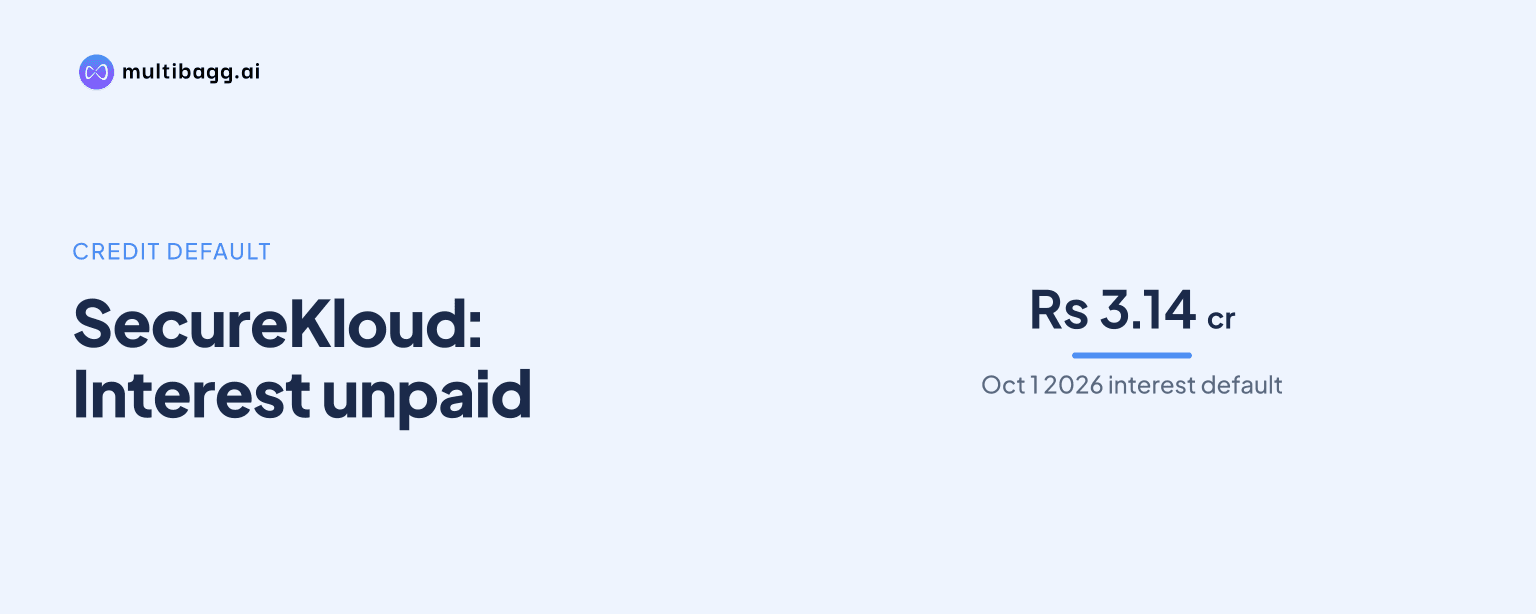
SecureKloud Technologies Limited reported a default of ₹3.14 crore in interest payable on a promoter loan to R. S. Ramani, with payment originally due by September 30, 2026. The disclosure, made on October 1, followed the company’s inability to repay the accrued interest, although the promoter agreed to extend the timeline.
Know SecureKloud Technologies inside out
Results, valuation, peers and who's buying, in one view.
What did SecureKloud Technologies default on?
SecureKloud Technologies defaulted on interest of ₹3.14 crore payable on a loan availed from its promoter, R. S. Ramani. The amount disclosed was ₹3,14,26,183 and related to interest accrued up to March 31, 2026, net of taxes.
The company stated that the interest payment was due on or before September 30, 2026. It reported the default under Regulation 30 of the Securities and Exchange Board of India’s Listing Obligations and Disclosure Requirements regulations, read with the relevant provisions of Schedule III.
The disclosure recorded October 1, 2026 as the time of occurrence. R. S. Ramani was identified as the person involved in the default in his capacity as promoter and lender to the company.
Why was the promoter-loan interest payment delayed?
SecureKloud Technologies said the payment timeline was extended after discussions with the promoter regarding the company’s tight financial position. The promoter agreed to defer payment of the overdue interest until March 31, 2027.
The company said there would be no fresh financial impact from the default beyond the continuing outstanding liability. This means the disclosed interest obligation remains payable, while the agreement to extend the timeline provides the company more time to regularise the payment.
In its initial disclosure, SecureKloud Technologies listed possible legal action by the lender or promoter as the estimated impact on the listed entity. The later agreement to extend the payment timeline is therefore material, as it records the promoter’s willingness to defer recovery of the stated interest amount.
What other payment default did SecureKloud Technologies disclose?
SecureKloud Technologies also reported a separate default in regularising its cash credit account with Indian Bank on October 16, 2026. The company said it did not remit the required funds within the stipulated time for the cash credit account.
The amount involved in the Indian Bank disclosure was ₹8.11 crore, or ₹811.42 lakh. The company said the account could become irregular and may be liable for classification as a non-performing asset under Reserve Bank of India guidelines.
The promoter-loan interest default and the cash-credit account disclosure relate to different obligations and lenders. The first concerns unpaid interest to the promoter, while the second concerns timely funding of a working-capital banking facility.
Got a follow-up? Ask IRIS
How do these disclosures matter for investors and lenders?
These disclosures matter because they identify payment stress across both promoter funding and bank working-capital facilities. The ₹3.14 crore default concerns an interest obligation, while the ₹8.11 crore cash-credit matter concerns the company’s ability to deposit required funds within the specified period.
For lenders, an account becoming irregular can require closer monitoring under applicable banking norms. SecureKloud Technologies did not state that the Indian Bank account had already been classified as a non-performing asset; it said that such classification could occur under RBI guidelines.
For shareholders, the promoter’s extension removes an immediate requirement to pay the disclosed interest by the original September 30 deadline. However, the liability remains outstanding, and the company’s filing does not indicate that the interest has been settled or waived.
The disclosures also provide a formal record of the company’s financing obligations under SEBI’s continuous disclosure framework. Investors assessing the company’s position may track subsequent exchange filings for updates on repayment, account regularisation, or any change in the status of these liabilities.
What should investors monitor after the defaults?
Investors should monitor whether SecureKloud Technologies makes payments towards the promoter interest by the extended deadline of March 31, 2027. Any confirmation of settlement, further extension, revised terms, or enforcement-related action would be relevant to the outstanding promoter-loan obligation.
The status of the Indian Bank cash credit account is also important. The company’s October 16 disclosure stated that failure to regularise the account could lead to its being treated as irregular and potentially classified as an NPA under RBI guidelines.
Further updates on the company’s liquidity, borrowings, cash-credit operations and repayment arrangements will help clarify whether the stated defaults are being regularised. The available disclosures establish the amounts, counterparties and dates, but do not provide a repayment schedule for the Indian Bank account.
Conclusion
SecureKloud Technologies has disclosed two separate financing-related issues in October 2026: a ₹3.14 crore default on interest payable to promoter R. S. Ramani and an ₹8.11 crore cash-credit account regularisation default involving Indian Bank. The promoter has extended the interest-payment timeline, but both disclosed obligations remain relevant to the company’s liquidity position.
The key scheduled point to watch is March 31, 2027, the extended deadline for the promoter-loan interest payment. Investors should also watch for company disclosures on whether the Indian Bank cash credit account is regularised and whether its classification status changes.