










Senco Gold funds Rs 430.78 crore operating outflow
Key highlights
- Senco Gold used Rs 430.78 crore in operating activities during the six months ended 30 September 2026.
- Senco Gold reported Rs 497.13 crore of net proceeds from current borrowings in the first half.
- Senco Gold's current borrowings rose to Rs 2,080.50 crore at 30 September 2026 from Rs 1,569.05 crore at 31 March 2026.
- Senco Gold's gold metal loans fell to Rs 484.37 crore from Rs 776.21 crore over the same period.
powered by IRIS
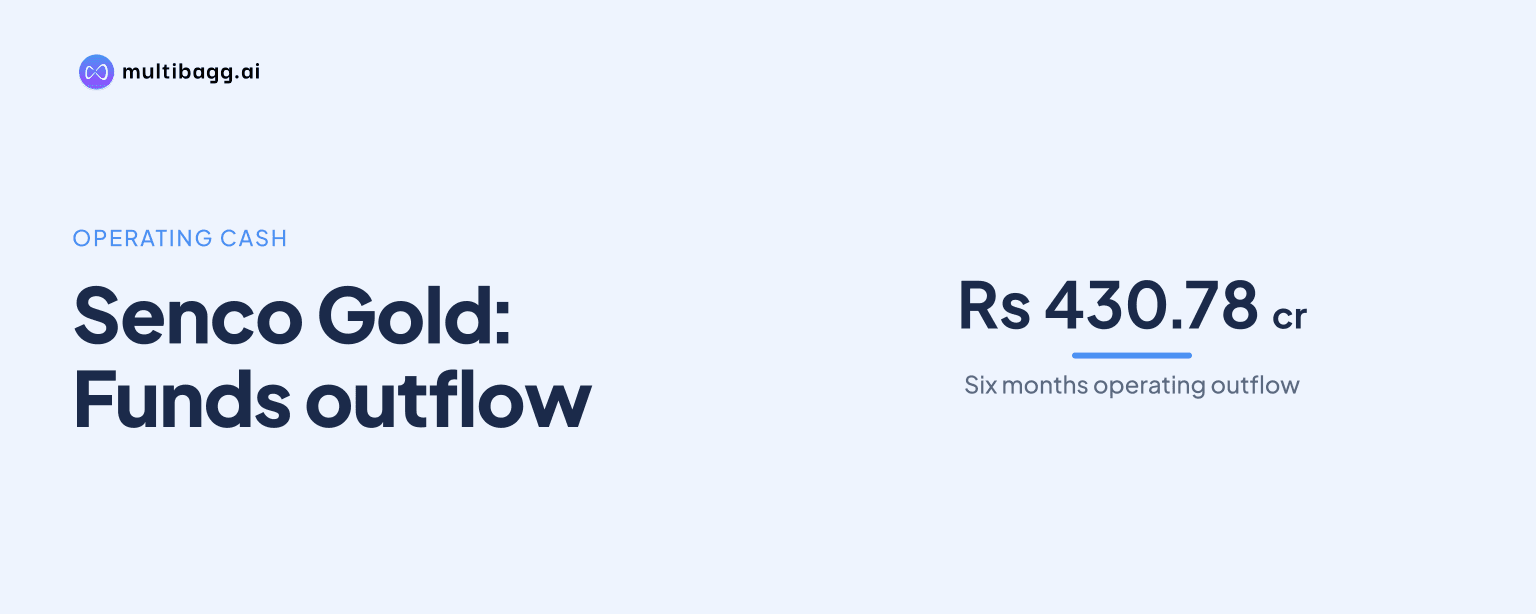
Senco Gold Limited, referred to hereafter as Senco Gold, used Rs 430.78 crore in operating activities in the six months ended 30 September 2026 despite reporting Rs 187.81 crore of profit after tax, while Rs 497.13 crore of net proceeds from current borrowings helped generate Rs 438.88 crore of financing cash inflow.
Know Senco Gold inside out
Results, valuation, peers and who's buying, in one view.
Why did Senco Gold report negative operating cash flow?
Senco Gold reported negative operating cash flow because working-capital movements and tax payments exceeded operating profit during the six months ended 30 September 2026. Operating profit before working-capital changes rose to Rs 413.36 crore from Rs 303.10 crore in the six months ended 30 September 2025, but cash used in operating activities before tax was Rs 265.89 crore.
The principal cash demands were a Rs 191.76 crore increase in inventories, a Rs 165.67 crore increase in trade receivables and a Rs 341.33 crore reduction in gold metal loans. Income taxes paid, net of refunds, were Rs 164.89 crore, compared with Rs 37.43 crore in the prior-year half. Together, these movements resulted in Rs 430.78 crore of net cash used in operations, against Rs 333.91 crore a year earlier.
Senco Gold nevertheless recorded consolidated profit after tax of Rs 187.81 crore for the six months to 30 September 2026, compared with Rs 153.44 crore in the corresponding period of 2025. Revenue from operations increased to Rs 5,114.76 crore from Rs 3,362.39 crore. The cash-flow statement therefore shows that the half-year profit did not convert into positive operating cash after inventory, receivable, financing-related working-capital and tax movements.
Which working-capital items used Senco Gold's cash?
Senco Gold's inventory, receivable and gold metal loan movements together used Rs 698.75 crore of cash in the six months ended 30 September 2026. The inventory outflow of Rs 191.76 crore was below the Rs 1,009.92 crore outflow recorded a year earlier, while the receivables outflow rose to Rs 165.67 crore from Rs 91.43 crore.
Gold metal loans were the largest adverse liability movement, using Rs 341.33 crore of cash compared with Rs 81.97 crore in the six months ended 30 September 2025. Trade payables supplied Rs 55.13 crore of cash, down from Rs 414.49 crore in the prior-year period. Other liabilities used Rs 114.93 crore, whereas they had supplied Rs 147.02 crore in the earlier half.
Other financial assets released Rs 38.92 crore, other assets released Rs 6.12 crore and provisions added Rs 4.88 crore. Those inflows did not offset the larger movements in inventory, trade receivables and gold metal loans. The result was a Rs 265.89 crore pre-tax operating cash deficit despite the Rs 413.36 crore operating profit before working-capital changes.
How did Senco Gold finance its operating cash deficit?
Senco Gold generated Rs 438.88 crore of net cash from financing activities in the six months ended 30 September 2026, exceeding its Rs 430.78 crore operating cash outflow. Net proceeds from current borrowings were Rs 497.13 crore, higher than Rs 457.24 crore in the corresponding six months of 2025.
The group also received Rs 111.13 crore from non-current borrowings and repaid Rs 1.21 crore of such borrowings. These inflows were partly offset by Rs 108.48 crore of finance costs paid, Rs 27.81 crore of lease-liability principal repayments, Rs 19.73 crore of lease-liability interest payments and Rs 14.75 crore of dividends paid, net of taxes.
Investing activities used Rs 4.13 crore, compared with Rs 6.60 crore in the prior-year half. Senco Gold spent Rs 44.95 crore on property, plant and equipment, intangible assets, capital work-in-progress, capital creditors and capital advances, while interest received contributed Rs 17.14 crore. Financing inflow after these cash uses lifted cash and cash equivalents by Rs 3.97 crore during the period.
Got a follow-up? Ask IRIS
What changed in Senco Gold's borrowings and debt measures?
Senco Gold's current borrowings rose to Rs 2,080.50 crore at 30 September 2026 from Rs 1,569.05 crore at 31 March 2026. Non-current borrowings increased to Rs 97.81 crore from Rs 0.69 crore over the same dates. The balance-sheet change followed the Rs 497.13 crore of net current-borrowing proceeds and Rs 111.13 crore of non-current borrowing proceeds reported in the half-year cash-flow statement.
Gold metal loans moved in the opposite direction, declining to Rs 484.37 crore at 30 September 2026 from Rs 776.21 crore at 31 March 2026. The cash-flow statement recorded a Rs 341.33 crore outflow from gold metal loans. The balance-sheet decrease and cash-flow movement are related disclosures, although they need not be identical because the statements reflect their respective accounting classifications.
The debt-equity ratio was 0.94 at 30 September 2026, compared with 0.90 at 31 March 2026. Senco Gold defines total debt for this ratio as current and non-current borrowings plus gold metal loans, excluding leases. Its total-debt-to-total-assets ratio was 0.35 at 30 September 2026, compared with 0.33 at the March 2026 year-end.
What happened to Senco Gold's cash and current assets?
Senco Gold ended the six-month period with Rs 41.55 crore of cash and cash equivalents, up from Rs 37.59 crore at the beginning of the period. The Rs 3.97 crore increase reflected the Rs 438.88 crore financing inflow after the Rs 430.78 crore operating outflow and Rs 4.13 crore investing outflow.
Bank balances other than cash and cash equivalents were Rs 448.55 crore at 30 September 2026, down from Rs 479.05 crore at 31 March 2026. Inventory was Rs 5,487.85 crore, up from Rs 5,296.09 crore, while trade receivables increased to Rs 390.30 crore from Rs 224.72 crore. These balance-sheet movements are consistent with the operating cash-flow uses reported for the first half.
The current ratio, defined by Senco Gold as current assets divided by current liabilities, was 1.62 at 30 September 2026, compared with 1.65 at 31 March 2026. The current-liability ratio, defined as current liabilities divided by total liabilities, was 0.91 at 30 September 2026 versus 0.93 at the March year-end.
Conclusion
Senco Gold's first-half accounts show that Rs 187.81 crore of profit after tax and Rs 5,114.76 crore of revenue did not prevent a Rs 430.78 crore operating cash outflow. Inventory and receivables increased, gold metal loans declined and tax payments rose, while net current-borrowing proceeds of Rs 497.13 crore were the largest disclosed funding source.
The next disclosed funding development is Rs 20 crore of commercial papers issued and allotted after 30 September 2026 and before the results were approved on 13 November 2026. The commercial papers, listed on the National Stock Exchange of India Limited, mature on 30 March 2027. Subsequent results will show whether operating cash conversion, working-capital balances and borrowings change after the half-year period.