










Service Care housekeeping revenue rises 39% in first half
Key highlights
- Service Care’s housekeeping and janitorial revenue rose 39% to Rs 24.98 crore in the half year ended 30 September 2026.
- Service Care’s housekeeping and janitorial segment profit increased 49% to Rs 4.58 crore.
- Service Care’s manpower revenue grew 17% to Rs 85.28 crore, remaining its largest disclosed segment.
- Service Care reported first-half profit before tax of Rs 7.23 crore, up from Rs 2.54 crore a year earlier.
powered by IRIS
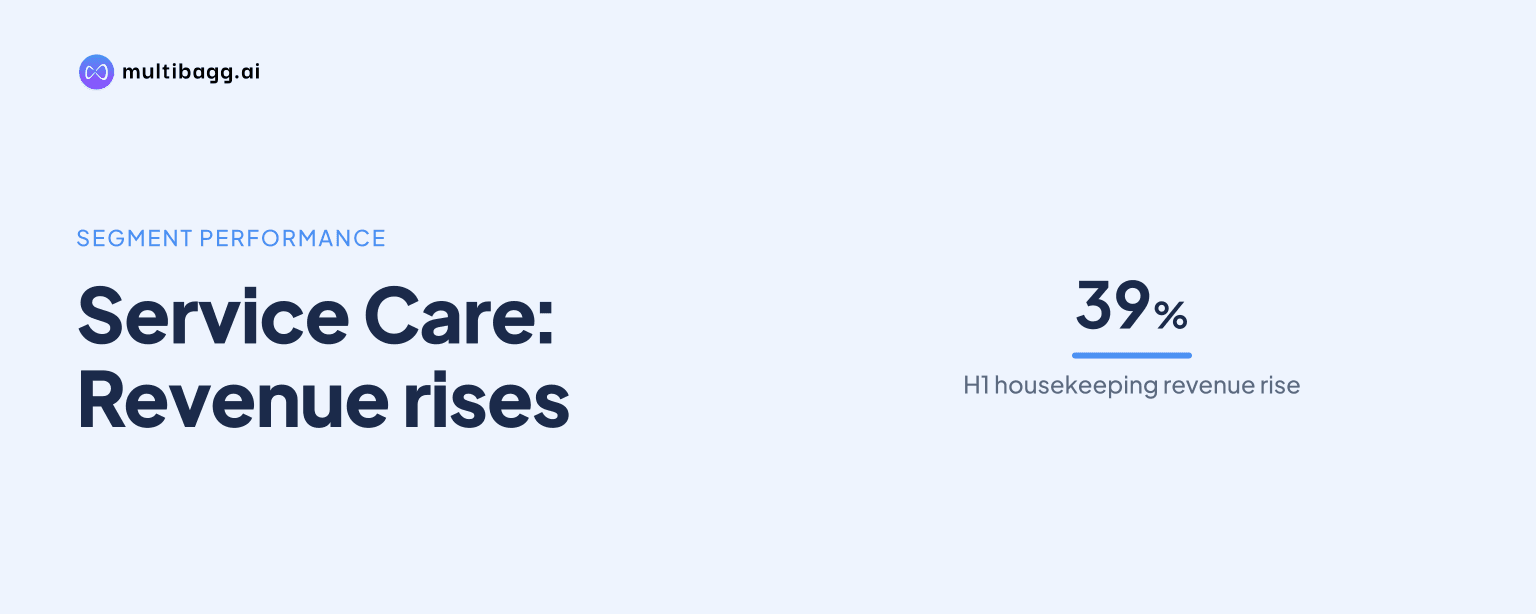
Service Care Limited’s housekeeping and janitorial business lifted first-half revenue by 39% to Rs 24.98 crore in the half year ended 30 September 2026, while its much larger manpower business grew 17% to Rs 85.28 crore. Housekeeping segment profit increased 49% to Rs 4.58 crore, compared with 21% growth in manpower segment profit.
Know Service Care inside out
Results, valuation, peers and who's buying, in one view.
How fast did Service Care's housekeeping business grow?
Service Care’s housekeeping and janitorial business grew revenue by Rs 7.04 crore year on year to Rs 24.98 crore in the half year ended 30 September 2026, from Rs 17.94 crore in the corresponding 2025 half year. That represents growth of about 39%, ahead of the company’s total revenue from operations, which increased about 22% to Rs 112.36 crore from Rs 92.29 crore.
The segment’s expenses rose to Rs 20.40 crore from Rs 14.87 crore, an increase of about 37%. As revenue growth was marginally faster than expense growth, segment profit before other unallocable expenditures and incomes rose to Rs 4.58 crore from Rs 3.08 crore. The reported segment profit measure is before costs and incomes not allocated to individual operating segments.
How did Service Care's housekeeping growth compare with manpower?
Service Care’s housekeeping and janitorial business outgrew its manpower service business in both revenue and segment profit during the half year ended 30 September 2026. Manpower remained the largest operation, generating Rs 85.28 crore of revenue and Rs 2.28 crore of segment profit, but its revenue increase of Rs 12.11 crore was 17% on the prior-year base of Rs 73.17 crore.
Service Care’s manpower expenses increased to Rs 83.01 crore from Rs 71.28 crore, or about 16%, leaving a segment-profit increase of Rs 38.87 lakh. By contrast, housekeeping and janitorial profit rose from Rs 3.08 crore to Rs 4.58 crore despite its revenue base being less than one-third of manpower revenue. All other segments moved differently, with revenue declining by Rs 33.93 lakh while segment profit increased by Rs 12.30 lakh.
What changed in Service Care's segment revenue mix?
Service Care’s housekeeping and janitorial business accounted for about 22% of reported segment revenue in the 2026 first half, up from about 19% a year earlier. This calculation uses the three disclosed segment revenue lines of Rs 112.36 crore for 2026 and Rs 93.55 crore for 2025, and reflects faster growth in housekeeping than in manpower.
Manpower still contributed roughly 76% of the 2026 disclosed segment revenue, compared with about 78% in the prior-year half. The change therefore represents a shift in the composition of growth rather than a change in the largest business line: manpower added Rs 12.11 crore of revenue, while housekeeping and janitorial added Rs 7.04 crore.
Service Care’s disclosed segment-profit mix changed more sharply. Housekeeping and janitorial contributed about 62% of total segment profit of Rs 7.40 crore in the 2026 half year, versus about 59% of Rs 5.23 crore in the 2025 half year. Manpower contributed Rs 2.28 crore of segment profit in 2026, while all other segments contributed Rs 54.77 lakh.
Got a follow-up? Ask IRIS
Why did Service Care's profit before tax rise faster than revenue?
Service Care reported profit before tax, or PBT, of Rs 7.23 crore for the half year ended 30 September 2026, up from Rs 2.54 crore a year earlier. The increase followed a Rs 2.17 crore rise in aggregate segment profit to Rs 7.40 crore, alongside lower other unallocable expenditure and higher other unallocable income.
Other unallocable expenditure fell to Rs 4.80 crore from Rs 8.22 crore, while other unallocable income rose to Rs 4.71 crore from Rs 2.40 crore. Finance cost was Rs 7.86 lakh in the 2026 first half, compared with Rs 6.23 lakh in the prior-year period. These items reconcile the total segment-profit figure to the reported PBT figure.
Service Care’s profit after tax was Rs 7.17 crore in the 2026 first half, compared with Rs 2.47 crore in the corresponding 2025 period. Current tax was Rs 42.73 lakh and deferred tax was a credit of Rs 36.70 lakh. Separately, the cash-flow statement reported Rs 3.41 crore of short-term commodity capital gain and Rs 1.11 crore of unrealised gain among adjustments to PBT.
What limits apply to Service Care's segment disclosures?
Service Care does not provide segment assets and liabilities because it says assets and liabilities are used interchangeably among segments and cannot be identified accurately by segment. Its segment reporting follows the management approach under Indian Accounting Standard 108, or Ind AS 108, under which the chief operating decision maker evaluates performance and allocates resources using business-segment indicators.
The 2026 first-half interim financial statements were subjected to a limited review, and the statutory auditor issued an unqualified report, according to the notes approved by the board on 14 November 2026. Service Care also states that it applied the same accounting policies and methods of computation as in the financial year ended 31 March 2026, while prior-period figures were regrouped or reclassified where necessary for comparability.
Service Care says available tax deduction under Section 80JJAA is estimated, based on the present rate of growth and profitability, to be sufficient to reduce tax on business or professional income to nil for the period ended 30 September 2026. The company says it provided tax liability arising from capital gains. That disclosure describes management’s tax estimate rather than a segment-level profitability measure.
Conclusion
Service Care’s first-half segment data show that housekeeping and janitorial was the faster-growing business line: revenue rose 39% to Rs 24.98 crore and segment profit increased 49% to Rs 4.58 crore. Manpower remained substantially larger at Rs 85.28 crore of revenue, but its 17% revenue growth and 21% profit growth were below the housekeeping and janitorial rates.
The next results will show whether the higher housekeeping and janitorial share of segment revenue, about 22% in the 2026 first half, is sustained. Investors can also watch the effect of unrealised gains in other income, as Service Care says restatement gains or losses on short-term market investments are notional at the balance-sheet date and may affect profit or loss when those investments are disposed of.